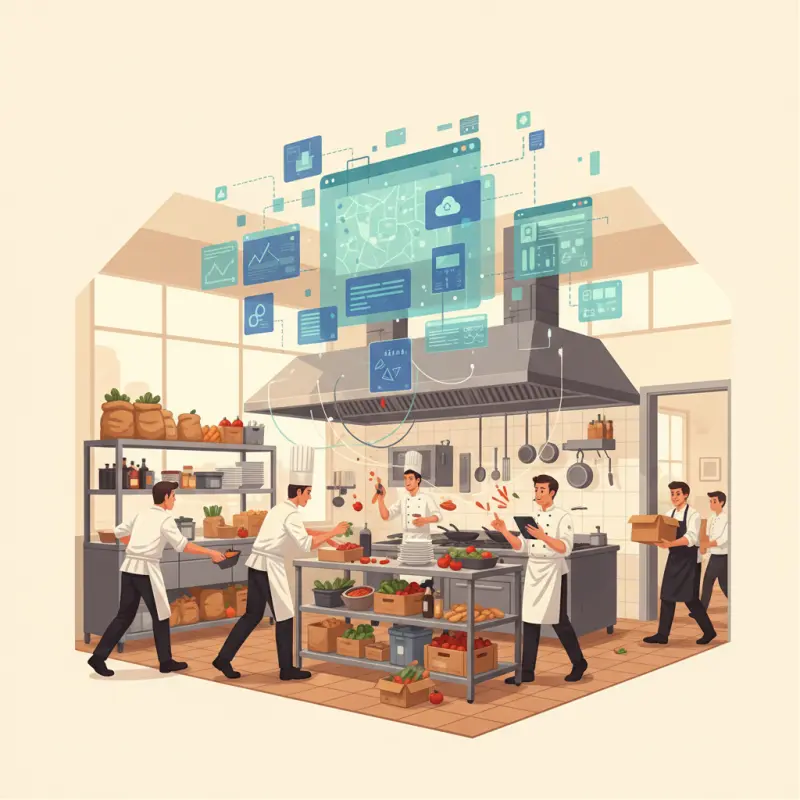
Restaurant Supply Chain Management Software: Why Most Fail in Real Kitchens
Blog Manager
··6 min read
AI Overview
Most restaurant supply chain management software fails in real kitchens because developers build features without understanding actual restaurant operations. Restaurant supply chain management software created in Silicon Valley offices doesn't account for Morocco's infrastructure challenges, staff training needs, or local supplier workflows. Ahmed in Casablanca checks vegetable stock by hand at 5 AM because his modern inventory system crashed overnight. Commission-based platforms bundle free inventory tools, but restaurants lose 15-30% on every order — enough to buy proper software. Staff resistance hits hardest during busy periods like Ramadan rush when new systems get abandoned first. Morocco's internet infrastructure creates unique challenges that most software can't handle. Choose restaurant management platforms that understand local operations and don't charge commissions that drain your inventory budget.
Table of Contents
For restaurant owners
Start your restaurant in 60 minutes.
From signup to your first real order — no commission, no setup fee, no sales call.
Why Most Restaurant Inventory Software Fails in Real Kitchens
Every morning at 5 AM, Ahmed checks his Casablanca restaurant's vegetable stock by hand — because his "modern" inventory system crashed again. He's not alone. Across Morocco, restaurant owners discover their restaurant supply chain management software creates more problems than it solves.
The disconnect starts with design. Most restaurant stock management software comes from Silicon Valley offices, not Moroccan kitchens. Developers who've never worked a dinner rush build features that sound impressive but crumble under real pressure. Your chef doesn't have time to log each tomato during the 8 PM rush. Your suppliers don't send standardized invoices that auto-import. Your internet cuts out when the whole neighborhood streams the Raja match.
The Hidden Cost of "Free" Inventory Modules
Commission-based delivery platforms love bundling "free" inventory tools with their ordering systems. The math tells a different story. That 15-30% commission on every order? It's your inventory budget disappearing before you buy a single tomato. A restaurant doing 100,000 MAD monthly loses 30,000 MAD to commissions — enough to buy proper restaurant software inventory that actually saves money.
Restaurant owners end up paying twice: once in commissions, again in waste. The "free" tool tracks basic stock levels but can't handle recipe costing, supplier management, or multi-branch transfers. You get what you pay for — which in this case is a glorified spreadsheet dressed up as software.
Three Implementation Killers Nobody Mentions
First, staff resistance hits harder than you expect. Your head chef who's been eyeballing portions for 20 years won't suddenly embrace tablet-based tracking. Training takes weeks, not the "one hour setup" vendors promise. During Ramadan rush, that new system becomes the first thing abandoned.
Second, Morocco's internet infrastructure creates unique challenges. Your fiber connection works perfectly at 3 PM but throttles during dinner service when every business on the block goes online. Cloud-based restaurant inventory management software becomes useless precisely when you need it most. OCHI's offline mode keeps working through outages — sync happens automatically when connection returns.
Third, garbage data produces garbage reports. One waiter enters "kg" while another uses "g". Your morning prep cook forgets to log wastage. By month end, your reports show impossible numbers like negative tomato inventory or 500% food cost on tagines.
Stack audit
What do you currently use?
Tick what you have. We’ll show what OCHI replaces or connects to.
The Real Numbers: What 25% Waste Reduction Actually Means
Restaurant margins in Morocco average 10-15% on good days. Cutting waste by 25% doesn't just improve profits — it determines survival. Let's examine real numbers from actual Moroccan restaurants using proper restaurant inventory program tools.
Casablanca Restaurant Case Study
La Terrace in Maarif serves 150 covers daily across lunch and dinner. Before implementing gram-level tracking, they threw away 2,400 MAD worth of ingredients weekly. Overordering vegetables "just in case." Meat portions varying by 30 grams between cooks. Dairy expiring in back fridges nobody checked.
After three months with OCHI's ingredient management system, weekly waste dropped to 1,800 MAD. The key? Recipe-level tracking that caught portion drift immediately. When new line cooks used 180g of beef instead of 150g for bourguignon, alerts fired. Managers corrected portions before food cost exploded. Annual savings: 31,200 MAD — enough to hire another prep cook.
Break-Even Timeline for Different Restaurant Sizes
Restaurant Size
Monthly Waste Before
Monthly Waste After
Monthly Savings
Break-Even Time
Small (30 seats)
4,000 MAD
3,000 MAD
1,000 MAD
3-4 months
Medium (80 seats)
8,000 MAD
6,000 MAD
2,000 MAD
2-3 months
Large (150+ seats)
12,000 MAD
9,000 MAD
3,000 MAD
1-2 months
Gram-Level Tracking vs. Unit-Based Systems: Why Precision Matters
Most restaurant supply chain management software thinks in "units" — one chicken, five tomatoes, three boxes of pasta. Moroccan cuisine laughs at this simplicity. Your grandmother's harira recipe doesn't call for "one unit" of coriander. It needs 15 grams fresh leaves, stems removed.
Why Moroccan Recipes Demand Precision
Consider saffron. Buy it by the gram, use it by the milligram. Unit-based systems force you to track "1 container" without knowing if that's 1g or 5g. When saffron costs 30 MAD per gram, that ambiguity burns money. Traditional Moroccan spice blends require exact ratios — ras el hanout isn't just "some of each spice."
Meat presents another challenge. A "unit" of lamb could mean a 2kg shoulder or 500g of chops. Portion control becomes impossible. Your food cost reports show "consumed: 10 units lamb" — meaningless data that helps nobody. Price negotiations with suppliers suffer when you can't specify exact quantities needed.
The OCHI Difference: Inventory That Understands Local Cuisine
OCHI's restaurant stock management software speaks Moroccan kitchen language. Track saffron by the gram with automatic conversion to recipe portions. Build couscous recipes with semolina in kilos, almonds in grams, raisins by the handful (yes, we support custom units). The system knows one chicken yields specific weights of breast, thigh, and wing — crucial for accurate portioning.
Recipe costing becomes automatic. Enter your grandmother's pastilla recipe once: 500g warka, 1.2kg pigeon, 200g almonds, 5g cinnamon. OCHI calculates cost per portion based on real supplier prices. When almond prices spike before Ramadan, you see the impact on menu profitability instantly. Adjust portions or prices before margins disappear.
Purchase Order Automation: From Supplier Chaos to One-Click Ordering
Walk into any Moroccan restaurant at 7 AM. You'll find the owner juggling three phones, calling suppliers for daily orders. "Hassan, I need 20 kilos tomatoes... no, make it 25... actually, what's the price today?" This stone-age ordering system wastes hours and money.
The WhatsApp Trap
In Agadir alone, 67% of restaurants order ingredients through WhatsApp messages. Seems modern until disputes arise. "I ordered 10kg, you sent 8kg." "My message said grade A meat, this is grade B." No documentation, no recourse. Price agreements made in voice notes vanish when bills arrive 20% higher.
Manual ordering also misses price optimization. Your vegetable guy charges 8 MAD/kg for tomatoes while the supplier two blocks away sells at 6 MAD/kg. Without systematic comparison, you overpay daily. Those 2 MAD differences compound into thousands in unnecessary costs monthly.
Automated Reordering That Actually Works
OCHI's purchase order system learns your patterns. Set minimum levels per ingredient — when chicken stock drops below 10kg, automatic purchase orders generate. But intelligence goes deeper. The system tracks price history, suggesting orders when costs dip. Buy olive oil when it's 45 MAD/L, not during the 55 MAD/L spike.
Multi-supplier comparison happens automatically. Need 50kg onions? OCHI shows prices from all your suppliers, including delivery fees and payment terms. One click sends orders with PDF confirmation. When deliveries arrive short, photo evidence links directly to the purchase order. Disputes resolve with documentation, not shouting matches.
How to Choose Restaurant Stock Management Software That Won't Fail You
Choosing restaurant inventory management software requires brutal honesty about your operation's reality. That beautiful cloud system means nothing when Maroc Telecom hiccups. Those AI-powered predictions fail when your team can't read the English interface.
Non-Negotiable Features for Moroccan Restaurants
Offline functionality tops the list. During the dinner rush, you can't wait for servers to reconnect. OCHI works offline with automatic sync when internet returns. No lost data, no service delays. Arabic and French interfaces ensure your entire team — from Tunisian prep cooks to Moroccan servers — uses the system confidently.
Local supplier integration saves more time than any other feature. Your restaurant software inventory should know Moroccan suppliers by name, with contact details and price lists built in. Payment flexibility matters too — some suppliers want cash, others bank transfer, many prefer mobile money. Support all methods or watch adoption fail.
Red Flags That Indicate Poor Software
Beware restaurant inventory program pricing that scales with your success. Monthly fees tied to revenue percentage mean you pay more for growing — backwards incentives. Fixed pricing like OCHI's rewards growth instead of punishing it. Commission-based models especially hurt during slow months when you need savings most.
Missing mobile interfaces kill implementation. Your chef won't leave the hot line to update inventory on an office computer. Kitchen-friendly mobile apps with large buttons and offline capability determine real-world success. If demos only show desktop screens, run away.
Time zone troubles reveal priority markets. Support teams available 9-5 Pacific Time abandon you during Moroccan dinner service. Local phone support during your business hours — not California's — separates real solutions from imported problems.
Ready to cut food waste by 25%? See how Rabat's Café Atlas reduced monthly waste from 8,000 to 6,000 MAD with gram-level inventory tracking. Start your free trial at votrenom.ochi.ma — no commission fees, ever.
Why does restaurant supply chain management software fail in Morocco?
Most software is built by developers who never worked in actual kitchens and doesn't account for Morocco's internet infrastructure, local supplier workflows, or staff training needs during busy periods.
How much do commission-based platforms cost restaurants?
Commission-based delivery platforms charge 15-30% on every order. A restaurant doing 100,000 MAD monthly loses 30,000 MAD to commissions — enough to buy proper inventory software.
What causes staff resistance to new inventory systems?
Head chefs who've been eyeballing portions for years resist tablet-based tracking. Training takes weeks, and new systems get abandoned first during rush periods like Ramadan.
What should restaurants look for in supply chain software?
Look for platforms built for local operations that handle recipe costing, supplier management, and multi-branch transfers without charging commissions on every order.
Restaurant owners · Weekly
The guide to running a restaurant in 2026.
One article per week. No commission advice.
Just honest operational insight for Moroccan restaurants.
Blog Manager
Comments
No comments yet. Be the first to share your thoughts.