AI Overview
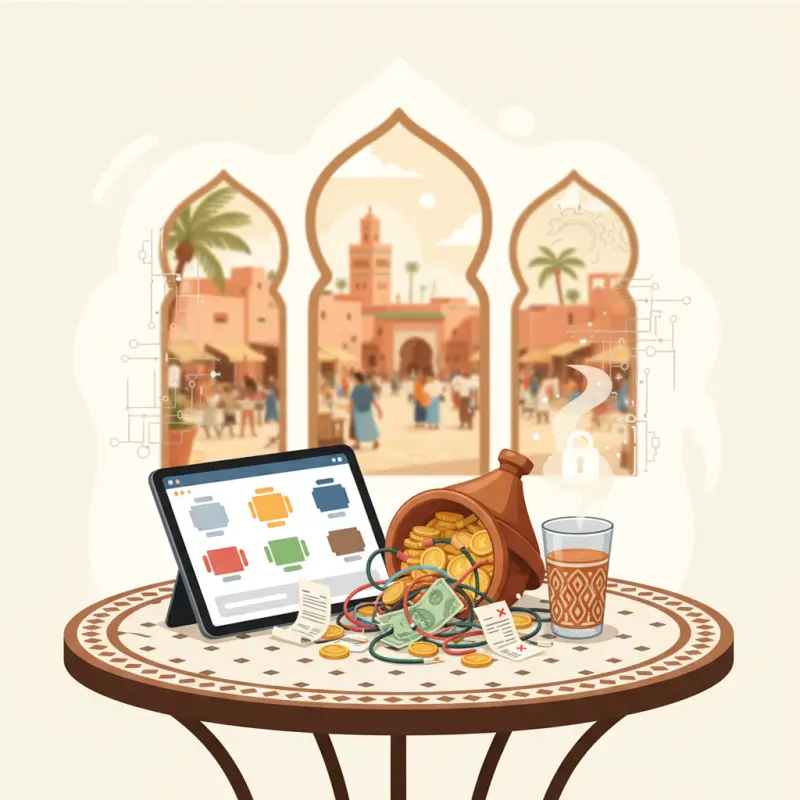
Restaurant table management software costs Moroccan restaurants far more than advertised pricing suggests. A Casablanca restaurant owner pays 8,200 MAD monthly across platforms yet can't track lunch bookings. OpenTable charges 220 MAD monthly plus 22 MAD per seated customer. For a 60-seat restaurant at 80% occupancy, that's 26,400 MAD monthly in per-cover fees alone. Commission platforms advertise 3.5% fees but layer additional charges for payment processing, currency conversion, and SMS notifications. The real cost reaches 8.2% per transaction. On 500,000 MAD monthly revenue, restaurants lose 41,000 MAD to platform fees. Add payment processing at 2.9% plus integration costs, and total software expenses can exceed staff wages. Choose platforms that show transparent pricing upfront and avoid commission-based models that scale with your success.
Table of Contents
A Casablanca restaurant owner told us last week he's paying 8,200 MAD monthly across three different platforms — and still can't see which tables are booked during lunch rush. This disconnect between restaurant table management software and actual operations costs Moroccan restaurants an average of 22% in lost revenue.
Most software comparisons focus on features. We'll show you the hidden costs, integration nightmares, and Morocco-specific challenges that determine whether your investment actually improves operations or just adds another screen to manage.
The Hidden Cost Problem Most Software Reviews Won't Tell You
Restaurant table management software pricing looks simple until you run the numbers. That "affordable" 2,900 MAD monthly subscription becomes a different story when you factor in the complete cost structure most vendors hide in their fine print.
What "Free" Actually Costs Your Restaurant
Free reservation platforms make money through commission fees on every booking. OpenTable charges restaurants 220 MAD per month plus 22 MAD per seated cover. For a 60-seat Casablanca restaurant averaging 80% occupancy at dinner, that's 26,400 MAD monthly just in per-cover fees — before the base subscription.
The math gets worse with add-ons. Payment processing adds 2.9% plus 3 MAD per transaction. SMS confirmations cost 0.80 MAD each. Email marketing runs another 500 MAD monthly. Premium support? 1,200 MAD extra. That "free" platform now costs more than hiring another server.
The Commission Trap: Why 3.5% Becomes 8.2%
Commission-based platforms layer fees at every step. Start with the advertised 3.5% booking commission. Add 2.9% for payment processing. Include 0.5% for currency conversion if you accept international cards. Tack on 1.2% for "marketing fees" and another 0.1% for SMS notifications.
Your actual cost? 8.2% of every transaction. On 500,000 MAD monthly revenue, you're losing 41,000 MAD to fees alone. That's enough to cover rent in most Casablanca neighborhoods or pay two full-time employees.
Integration Fees That Kill Your Budget
Integration costs hit hardest. Connecting restaurant reservation software to your POS typically requires a 15,000 MAD setup fee plus 890 MAD monthly. Kitchen display integration? Another 12,000 MAD setup. Accounting sync adds 650 MAD monthly. Before serving a single customer, you're down 27,000 MAD with recurring costs of 1,540 MAD.
| Hidden Cost Category | Setup Fee | Monthly Cost | Annual Impact |
|---|---|---|---|
| POS Integration | 15,000 MAD | 890 MAD | 25,680 MAD |
| Kitchen Display Sync | 12,000 MAD | 0 MAD | 12,000 MAD |
| Payment Processing (2.9%) | 0 MAD | 14,500 MAD | 174,000 MAD |
| Per-Cover Fees | 0 MAD | 26,400 MAD | 316,800 MAD |
| SMS/Email Marketing | 0 MAD | 1,300 MAD | 15,600 MAD |
| Total First Year | 27,000 MAD | 43,090 MAD | 544,080 MAD |
Stack audit
What do you currently use?
Tick what you have. We’ll show what OCHI replaces or connects to.
Table Management Basics: Skip the Feature Lists, Focus on Flow
Features don't determine success — workflow does. The best restaurant table management software disappears into your operations instead of demanding attention. Understanding the actual flow from booking to bill matters more than counting features.
The 15-Minute Window That Makes or Breaks Service
Table turnover hinges on a 15-minute window after guests leave. In that window, your team must clear, sanitize, reset, and update the system. Most table reservation software assumes instant updates, but reality involves a server finishing with another table, a busser handling three sections, and a host managing walk-ins.
Smart systems buffer this reality. OCHI's dining area management assigns tables by section and tracks server workload. When table 12 requests the check, the system alerts the assigned busser while showing the host that table 12 will be available in approximately 15 minutes — not immediately.
Why Waitlist Management Matters More Than Online Booking
Moroccan restaurants see 60% walk-in traffic on weekends. Your restaurant booking software needs robust waitlist features more than elaborate online booking forms. The waitlist determines whether those walk-ins become loyal customers or go next door.
Effective waitlist tools estimate real wait times based on current table status, not just party size. They send SMS updates so guests can browse nearby shops instead of crowding your entrance. Most importantly, they integrate with table status so hosts see actual availability, not theoretical capacity.
Floor Plan Reality: What Works in Morocco vs. What Vendors Promise
Western table management assumes fixed layouts and predictable party sizes. Morocco's dining culture breaks these assumptions. Large families need flexible seating. Ramadan shifts require complete reconfiguration. Terrace season doubles capacity.
Your software must handle dynamic floor plans. Moving tables for a party of 12 shouldn't require IT support. Seasonal layouts should switch with one click. OCHI's area management lets you define Indoor, Terrace, and VIP zones with drag-and-drop table assignment — reflecting how Moroccan restaurants actually operate.
The Multi-Platform Mess: Why Most Restaurants Need Three Systems
The average Moroccan restaurant juggles separate systems for reservations, POS, and delivery. Each system has its own interface, login, and data format. During Friday dinner rush, your staff switches between apps hundreds of times, losing orders and frustrating customers in the process.
When Your Booking System Can't Talk to Your Kitchen
A reservation system that doesn't connect to your kitchen display creates chaos. The host seats table 7 with a reservation for eight people. The server takes the order on the POS. The kitchen receives a ticket with no context about allergies noted during booking or the VIP status that should prioritize their appetizers.
This disconnect causes 18% longer ticket times according to our partner data. Kitchens prepare dishes in the wrong order. Servers can't answer timing questions. The reservation notes about a birthday surprise get lost between systems.
The Server Nightmare: Juggling Four Apps During Rush Hour
Picture your best server during Saturday dinner rush. Phone tucked under their chin taking a delivery order. POS terminal in one hand entering table 5's mains. Tablet in the other checking if the reservation for table 12 has special requests. A fourth device buzzing with kitchen updates.
Each system interruption adds 45 seconds to table service. Multiply that by 20 tables and four systems — your servers lose 30 minutes per shift just switching between platforms. That's why integrated systems like OCHI matter: one interface handles reservations, orders, kitchen communication, and payments.
Why "All-in-One" Usually Means "Good at Nothing"
Most "integrated" restaurant reservation software bolts features together without true data flow. The reservation module doesn't share allergen info with the POS. The POS doesn't update table status for the host. The payment system doesn't sync with accounting. You get feature checkboxes but not operational integration.
True integration means data flows automatically. When a customer books online at votrenom.ochi.ma, their preferences appear on the POS when ordering. Table status updates reflect across host stand, server tablets, and kitchen displays simultaneously. One source of truth instead of four conflicting systems.
OCHI's Integrated Approach: One Dashboard, Zero Commission
OCHI built Morocco's first truly integrated restaurant platform. Instead of connecting separate systems, we created one platform that handles online reservations, table management, POS operations, kitchen display, and delivery tracking. More importantly, we charge zero commission on any transaction.
Reservation to Kitchen Display in One Flow
A customer books a table through your branded site (votrenom.ochi.ma). Their party size, time, and special requests flow directly into your dining area view. When they arrive, the host sees their preferences on the same screen used for walk-ins. The server takes their order on OCHI's POS, with allergen notes from the reservation highlighted automatically.
The kitchen display shows not just the order but context: reservation for eight, birthday dessert surprise noted, VIP customer requiring priority service. Every team member sees relevant information without switching systems or checking notes.
Why Zero Commission Changes Your Table Economics
Traditional platforms take 3-8% of every transaction. On a 3,000 MAD table for eight, you lose 240 MAD in fees. OCHI charges a flat monthly fee with zero transaction costs. That same table keeps all 3,000 MAD in your restaurant.
This changes how you think about bookings. Without per-cover fees, you can accept last-minute reservations. Without transaction percentages, large parties become more profitable. Your restaurant table reservation software becomes a growth tool, not a cost center.
Real Integration: yourname.ochi.ma Handles Everything
Your OCHI subdomain (yourname.ochi.ma) becomes your complete digital presence. Customers discover your menu, book tables, and order delivery from one place. Your team manages everything through one dashboard: reservations appear alongside walk-ins, delivery zones integrate with dining areas, and payment reports combine all channels.
This integration extends to business intelligence. See which reserved tables order appetizers most often. Track how reservation lead time affects party spend. Identify which dining areas generate highest revenue per cover. Data that typically requires three analysts to compile appears in automated daily snapshots.
The Morocco Reality Check: What Works in Agadir vs. Casablanca
International restaurant booking software assumes dining patterns that don't match Morocco. Our restaurants serve large families, accommodate flexible timing, and navigate cultural considerations that Western platforms ignore. Your system needs Morocco-specific features, not generic "global" solutions.
Peak Hours That Don't Match the Textbooks
Restaurant management textbooks claim lunch runs 12:00-14:00 and dinner 19:00-21:00. In Casablanca, lunch stretches from 12:30-15:00. Dinner doesn't peak until 21:30. Agadir's tourist areas see completely different patterns, with Europeans dining at 19:00 while Moroccans arrive after 22:00.
Your restaurant table management software must accommodate these realities. Fixed time slots don't work when customers expect flexibility. OCHI's reservation system allows custom slot durations and buffer times by day of week, accommodating the Thursday lunch rush differently than Tuesday's quiet service.
Family Table Dynamics: Why Party Size Matters More Here
Moroccan family dining means larger parties and longer meals. A table for six might become eight when cousins join. That two-hour reservation extends to three for proper tea service. Western assumptions about 90-minute table turns don't apply.
Smart table management software adapts to this reality. Flexible seating algorithms suggest combining tables for large parties. Extended reservation windows prevent overbooking. OCHI's system tracks actual dining duration by party size, learning your restaurant's specific patterns rather than applying generic rules.
Ramadan and Holiday Planning: Features You Actually Need
Ramadan transforms restaurant operations for an entire month. Lunch service disappears. Iftar creates massive simultaneous demand. Suhoor adds late-night service. Most reservation platforms can't handle this operational shift.
Effective systems allow seasonal service models. Switch from regular hours to Ramadan mode without rebuilding your setup. Manage iftar group bookings with mandatory prepayment. Handle the Eid rush with expanded capacity planning. OCHI's platform includes Ramadan-specific features developed with Moroccan restaurant partners.
Restaurant table management software succeeds when it fits your actual operations, not theoretical best practices. Morocco's restaurants need platforms built for our market, our culture, and our economics. Skip the commissioned middlemen and complex integrations — your restaurant deserves better.
See how OCHI's restaurant table reservation software works for Morocco. Get your free branded site at votrenom.ochi.ma and manage tables, orders, and delivery from one dashboard.
For more insights on restaurant management in Morocco, visit the OCHI Blog. Explore complete platform capabilities and see real partner success stories at ochi.ma/partners.
Frequently Asked Questions
What are the hidden costs of restaurant table management software?
Hidden costs include per-cover fees, payment processing charges, SMS notifications, email marketing add-ons, and premium support. A 'free' platform can cost 26,400 MAD monthly for a busy restaurant once all fees are included.
How much do commission-based restaurant platforms actually charge?
Advertised 3.5% commissions become 8.2% after adding payment processing, currency conversion, marketing fees, and notifications. On 500,000 MAD monthly revenue, total fees reach 41,000 MAD.
What should Moroccan restaurants look for in table management software?
Look for transparent pricing with no hidden fees, local customer support, integration with existing POS systems, and the ability to handle Arabic and French languages for Moroccan customers.
How much should restaurants budget for table management software in Morocco?
Budget 2-5% of monthly revenue for quality software. Avoid commission-based platforms that scale costs with success. Factor in training time and integration costs when calculating total investment.
Restaurant owners · Weekly
The guide to running a restaurant in 2026.
One article per week. No commission advice. Just honest operational insight for Moroccan restaurants.

Blog Manager
Comments
No comments yet. Be the first to share your thoughts.