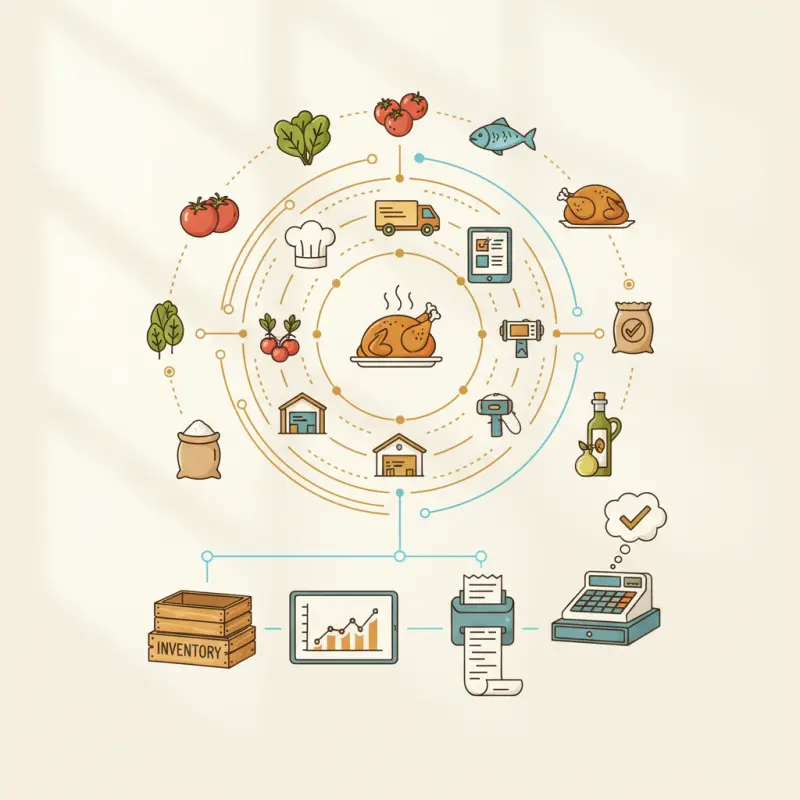
Supply Chain Software for Restaurants: Beyond Basic Inventory Tracking
Blog Manager
··5 min read
AI Overview
Supply chain software for restaurants eliminates the guesswork in ordering by tracking actual consumption patterns rather than estimated needs. Unlike basic inventory systems that only show current stock levels, restaurant supply chain software predicts when you'll run out based on traffic patterns and automatically connects to suppliers for reordering. A seafood restaurant in Agadir discovered their supplier consistently delivered 20% less weight than invoiced — their new system now flags these discrepancies instantly, saving 8,400 MAD monthly. The software tracks waste sources with precision: over-ordering accounts for 40% of food waste, incorrect portions for 35%, and poor storage tracking for 25%. A 100-seat restaurant in Casablanca typically wastes 166,400 MAD annually on spoiled ingredients. Start by implementing gram-level precision tracking for your three highest-cost perishable ingredients.
Table of Contents
For restaurant owners
Start your restaurant in 60 minutes.
From signup to your first real order — no commission, no setup fee, no sales call.
Why Restaurant Supply Chain Software Isn't Just About Inventory
Your restaurant loses money before the first customer walks in. Not from rent or salaries — from the 2 kg of meat that expired yesterday because your supplier delivered Thursday instead of Tuesday.
The real problem restaurants face isn't knowing what they have in stock. It's knowing what to order, when, and from whom. Traditional inventory tracking tells you that you have 2 kg of tomatoes left. Restaurant stock management software tells you that based on your Thursday night traffic patterns, you'll run out by 7 PM — and connects directly to your supplier to reorder.
A seafood restaurant in Agadir discovered their fish supplier consistently delivered 20% less weight than invoiced. Manual checks caught this once a month. Their restaurant software inventory now flags discrepancies instantly, saving 8,400 MAD monthly.
The hidden costs compound. Labor hours counting stock. Emergency supplier runs at premium prices. Menu items unavailable during peak hours. Each failure point bleeds profit.
Stack audit
What do you currently use?
Tick what you have. We’ll show what OCHI replaces or connects to.
The 25% Waste Reality: What the Numbers Actually Mean
A 100-seat restaurant in Casablanca typically wastes 3,200 MAD per week on spoiled ingredients. That's 166,400 MAD annually — enough to hire an additional cook.
The breakdown tells the real story. Over-ordering perishables accounts for 40% of waste. You order 15 kg of tomatoes every Monday because that's what you've always done. But last week's Ramadan schedule meant you only used 11 kg. The remaining 4 kg spoiled.
Waste Source
Percentage
Weekly Cost (MAD)
Annual Impact (MAD)
Over-ordering perishables
40%
1,280
66,560
Incorrect portions
35%
1,120
58,240
Poor storage tracking
25%
800
41,600
Restaurant inventory management software with gram-level precision changes these numbers. Your tomato usage drops from 15 kg weekly orders to 11.2 kg when the system tracks actual consumption patterns versus estimated needs. That's 3.8 kg saved weekly — 197.6 kg annually.
OCHI's inventory module tracks ingredients down to the gram. When your chef uses 347g of saffron for a special tagine, the system deducts exactly that amount. No rounding. No estimates. Pure data that drives smarter ordering.
Why Most Restaurant Software Inventory Solutions Fail Small Operations
Enterprise restaurant inventory programs require dedicated staff and complex integrations. A family-owned restaurant in Agadir doesn't need supplier management for 47 locations. They need simple purchase orders, automatic low-stock alerts, and supplier contact management that works on mobile.
The real test: can the owner check inventory levels while at the fish market at 6 AM? Most systems require desktop access and trained operators. Your supplier asks if you need more sea bass. You can't answer because your inventory data sits on an office computer.
Independent restaurants need different tools. Mobile-first design for on-the-go ordering. Integration with local suppliers who don't use EDI systems. Pricing that scales with actual usage, not per-terminal licenses.
A traditional supply chain software for restaurants charges 15,000 MAD setup plus 2,000 MAD monthly for features you'll never use. Module pricing means you pay for supplier portals, multi-warehouse management, and enterprise reporting while you just need to track your walk-in cooler.
Recipe Costing vs. Inventory Tracking: The Missing Connection
You track that chicken costs 45 MAD per kg this week. Your restaurant software inventory knows you used 12 kg for tajine dishes. But does it automatically update your menu profitability when chicken prices spike to 52 MAD?
True supply chain software connects ingredient costs to menu prices in real-time. When your supplier increases lamb prices, you see exactly which dishes become unprofitable before you serve them at a loss.
A Marrakech restaurant discovered their signature lamb dish lost 8 MAD per serving after a supplier price change. They'd served 200 portions at a loss before manual calculations caught the error. That's 1,600 MAD gone in one week.
OCHI's recipe builder links directly to ingredient costs. Price changes flow through instantly. Your POS shows updated margins on every dish. Your staff sees profitability before they recommend specials. No spreadsheet updates. No delayed discoveries.
The Math That Matters
Consider pastilla preparation. Traditional recipe: 500g chicken, 200g almonds, 10 sheets of warqa, spices. Your costs: chicken at 45 MAD/kg = 22.50 MAD, almonds at 120 MAD/kg = 24 MAD, warqa at 2 MAD/sheet = 20 MAD, spices = 8 MAD. Total ingredient cost: 74.50 MAD.
Sell at 150 MAD and you think you're profitable. But chicken jumps to 52 MAD/kg next week. Your new cost: 81.50 MAD. Margin drops from 75.50 MAD to 68.50 MAD — a 9% profit reduction you won't notice without integrated tracking.
Building Your Restaurant Supply Chain: Beyond the Software
Software doesn't fix poor supplier relationships or missing storage procedures. Start with your current process and identify specific failure points.
A Rabat steakhouse implemented restaurant stock management software but saw minimal improvement initially. The problem: three different managers ordered from suppliers without coordination. The software revealed duplicate orders and conflicting delivery schedules. Simple process changes cut waste by 18% before automation even kicked in.
Week One Implementation Reality
Document everything first. Which staff members handle ordering? When do suppliers typically deliver? How long does fresh produce actually last in your storage conditions?
Track waste for seven days before implementing any restaurant inventory program. Weigh spoiled items. Note why they spoiled. Was it over-ordering? Poor storage? Forgotten in the back of the cooler? This baseline data makes your software configuration match reality, not theory.
Test supplier response times for urgent orders. If your vegetable supplier takes 24 hours minimum, your low-stock alerts need different thresholds than a supplier who delivers within 4 hours.
Your system becomes effective when it fits existing workflows. The morning prep cook who checks vegetable levels shouldn't need manager credentials to flag low stock. The chef reviewing tonight's specials needs instant visibility into available ingredients.
Supply chain software for restaurants transforms operations when implemented thoughtfully. The OCHI blog shares real implementation stories from restaurants across Morocco — honest accounts of what worked and what didn't.
The path from 25% waste to single-digit loss rates isn't instant. But with gram-level tracking, real-time cost updates, and supplier integration, every order gets smarter. Ready to see how modern inventory control works? Get your complete restaurant management platform at votrenom.ochi.ma — where technology meets the reality of running a restaurant.
Frequently Asked Questions
What's the difference between inventory software and supply chain software for restaurants?
Inventory software tracks what you have in stock. Supply chain software predicts what you'll need, when you'll run out, and automatically manages supplier relationships and ordering.
How much can restaurants save with supply chain software?
A typical 100-seat restaurant wastes 166,400 MAD annually on spoiled ingredients. Supply chain software can reduce this waste by 60-70% through precise ordering and consumption tracking.
Does supply chain software work with Moroccan suppliers?
Yes, modern restaurant supply chain software integrates with local suppliers through APIs, email, or direct ordering portals. Many systems support Arabic and French interfaces for Moroccan restaurant operations.
Can supply chain software prevent supplier delivery issues?
Supply chain software tracks delivery weights, quality scores, and timing patterns. It flags discrepancies like short deliveries or late arrivals, helping restaurants identify and address supplier issues immediately.
How does supply chain software reduce food waste in restaurants?
The software tracks actual consumption patterns versus estimated needs, preventing over-ordering. It monitors storage conditions and expiration dates, reducing spoilage by up to 40% in perishable categories.
Restaurant owners · Weekly
The guide to running a restaurant in 2026.
One article per week. No commission advice.
Just honest operational insight for Moroccan restaurants.
Blog Manager
Comments
No comments yet. Be the first to share your thoughts.