AI Overview
Most restaurants discover that table booking system free platforms aren't actually free after the first three months. These systems typically charge 2.9% processing fees on prepaid bookings, $1.50 per reservation after 100 covers, and $30 monthly for POS integration. A 40-seat restaurant in Casablanca hitting 160 covers on Friday nights exceeds free limits by 6 PM, triggering immediate charges. Popular platforms like OpenTable use the '100-cover trap' — restaurants with 25 tables hit limits in one weekend through normal turnover. Processing fees alone average $87 monthly on $3,000 in prepaid bookings. The switching cost becomes prohibitive once you've trained staff and built customer habits around the platform. Choose systems with transparent pricing from day one to avoid surprise charges that scale with your success.
Table of Contents
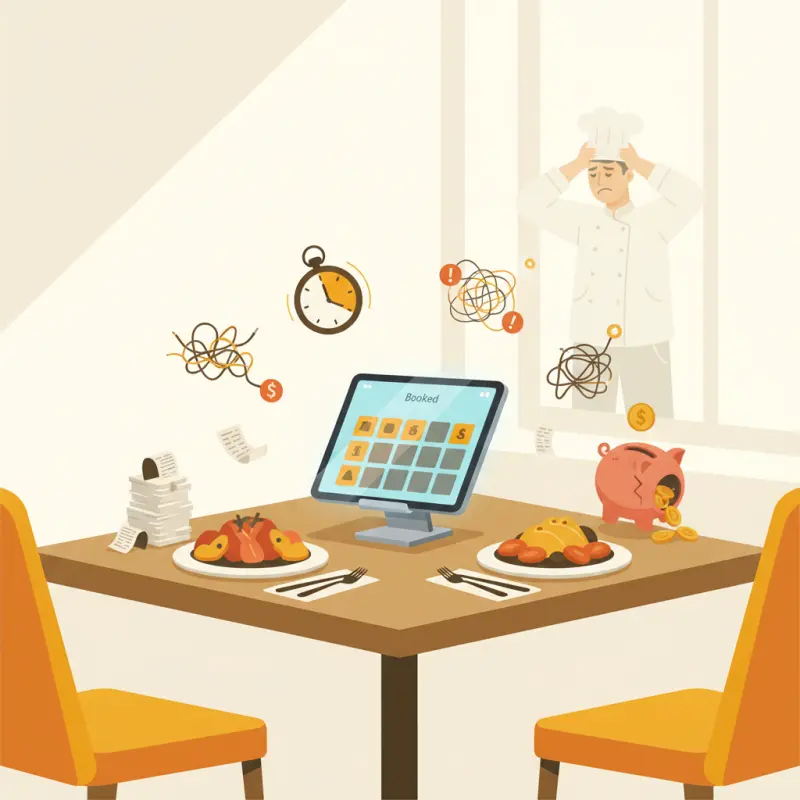
Most restaurant owners discover the real cost of their "free" table booking system after three months — when the credit card processing fees hit $87, the reservation limits kick in, and they're still managing walk-ins on paper napkins. The promise of free restaurant software has created a new kind of expense: the hidden monthly drain that nobody talks about until it's too late.
Here's what actually happens when you install that table booking system free of charge.
The Hidden Math Behind 'Free' Restaurant Software
You sign up for a free table reservation system because the pricing page says zero dirhams. Three months later, you're paying 2.9% on every prepaid booking, $1.50 per reservation after your first 100, and another $30 monthly to connect it to your POS. The math gets uglier when you realize these costs scale with your success — the busier you get, the more you pay.
Take a typical Friday night in Casablanca. Your 40-seat restaurant turns tables four times during dinner service. That's 160 covers, which means you've already blown past the "free" tier by 6 PM. Every additional booking costs money. Every credit card payment shaves off profit. Every integration adds a monthly fee.
The 100-Cover Trap
Software companies know exactly what they're doing with the "free up to 100 covers" model. A functioning restaurant with 25 tables hits that limit in one weekend. Do the math: 25 tables × 4 turns × Friday and Saturday = 200 covers. You're paying for half your weekend business before Sunday brunch even starts.
The trap works because switching systems means retraining staff, migrating customer data, and explaining to regulars why their usual booking method changed. Most owners just accept the fees as a cost of doing business. They shouldn't have to.
Payment Processing: The Silent Revenue Killer
Here's a number that should make you angry: $87. That's what the average restaurant pays monthly in processing fees on just $3,000 in prepaid bookings. Add the "convenience fee" for online payments, the monthly POS integration charge, and the per-transaction costs, and you're looking at $150 monthly for features that should be basic.
The worst part? These fees are buried in financial reports where they look like tiny percentages. But 2.9% of your revenue is real money — money that could cover a server's shift or buy ingredients for tomorrow's special.
Demand heatmap
When do Moroccan restaurants get busy?
Typical demand across the week. Iftar shifts the pattern during Ramadan.
| 7h | 10h | 12h | 15h | 19h | 22h | |
|---|---|---|---|---|---|---|
| Mon | ||||||
| Tue | ||||||
| Wed | ||||||
| Thu | ||||||
| Fri | ||||||
| Sat | ||||||
| Sun |
What Restaurant Owners Actually Need (vs. What Software Companies Sell)
Software companies love talking about AI-powered table optimization and predictive analytics. Restaurant owners need a system that shows which tables are free right now, takes bookings without crashing, and doesn't require a computer science degree to operate.
The Three Non-Negotiables
First, real-time availability. Not "updates every 15 minutes." Not "syncs overnight." Real-time. When a customer calls at 7:45 PM asking about a table for four, your host needs to see what's actually available, not what was available when they logged in.
Second, POS integration that actually works. Your restaurant management software free trial might promise seamless connection, but if orders from booked tables don't flow directly to the kitchen, you're still running two systems. That's not integration — that's parallel chaos.
Third, you need to own your customer data. Not rent it. Not access it through an API. Own it. Those email addresses and phone numbers are your direct line to revenue. Any system that locks them behind a paywall or export limit is holding your business hostage.
Features That Sound Good But Don't Matter
Auto-posting reservations to Instagram stories? Worthless. Complex segmentation for your 50-seat restaurant? You already know your regulars by name. Predictive analytics when you're still tracking inventory on paper? Cart before the horse.
The feature list that impresses investors rarely matches what helps during a Saturday night rush. Focus on what moves orders from customer to kitchen to table — everything else is marketing fluff.
Why Morocco's Restaurant Scene Needs a Different Approach
Silicon Valley booking platforms don't understand that 60% of Moroccan diners still prefer calling for reservations. They don't grasp that your Agadir beachfront restaurant needs Arabic SMS confirmations, not just English emails. They definitely don't get that payment integration needs to work with Moroccan banks, not just Stripe.
The Casablanca Reality Check
Walk into any successful restaurant in Casablanca and watch the reservation process. The phone rings constantly. Customers speak a mix of Darija, French, and English. The reservation book is physical because it's faster than logging into software during rush hour.
Your online ordering system free of charge needs to match this reality. Staff turnover in restaurants means your system must be learnable in under two hours. Payment processing must handle local cards. Confirmation messages need proper Arabic RTL support, not Google Translate nonsense.
This is where generic "free restaurant reservation system" platforms fall apart. They're built for restaurants where everyone has smartphones, speaks one language, and trusts online payments. That's not Morocco. That's not even Marrakech.
The True Cost Breakdown:
Free vs. Actually Free
Let's put real numbers on the table. Here's what "free" actually costs versus a genuinely free solution like OCHI:
| Feature | Typical "Free" System | Hidden Monthly Cost | OCHI |
|---|---|---|---|
| Table bookings | Free up to 100/month | $75 (at 150 bookings × $0.50) | Unlimited, zero cost |
| Payment processing | 2.9% + $0.30 | $87 (on $3K revenue) | Zero commission |
| POS integration | Free 30-day trial | $30 after trial | Included forever |
| Custom branding | Generic booking page | $20 for custom domain | yourname.ochi.ma included |
| SMS confirmations | Email only | $0.05 per SMS | Included |
| Total Hidden Costs | "Free" | $212+ monthly | Actually $0 |
That $212 monthly? It's one server's wages. It's your profit margin on 70 meals. It's money leaving your restaurant for features that should be free.
Setting Up Your Free Table Reservation System (The Right Way)
Switching systems doesn't have to be chaos. But it does require a plan that goes beyond "install the app and figure it out." Here's what actually works.
Week One: Data Migration and Staff Training
Start with your customer database. Export it from your current system or type it from your reservation book. Yes, this takes time. Do it anyway. Those phone numbers and preferences are gold.
Train one person completely before involving others. Pick your sharpest host or manager. Let them master the system, then have them train the team. Peer training sticks better than manuals.
Test with ten loyal customers before going live. Call them personally. Ask them to make online bookings and give honest feedback. Fix issues while the stakes are low.
Integration with Your Existing Operations
Your table booking system free of promises means nothing if it doesn't talk to your kitchen. Connect table bookings to your KDS so chefs know when large parties arrive. Link walk-ins and reservations in one view so hosts see the full picture.
Configure confirmations for your market. In Morocco, that means Arabic and French options, SMS for older customers, and WhatsApp integration for millennials. One size fits none here.
Set up your free restaurant reservation system to match your actual operations. If you don't take bookings during lunch, disable lunch slots. If Table 7 is always reserved for VIPs, block it from online booking. Make the software work like your restaurant works, not the other way around.
The question isn't whether you need digital table management — it's whether you're willing to keep paying for "free" software that nickel-and-dimes you into the red. Real restaurants need real solutions, not freemium tricks designed to extract maximum revenue once you're locked in.
See what an actually free table booking system looks like at ochi.ma/partners.
Frequently Asked Questions
What hidden costs come with free table booking systems?
Free table booking systems typically charge 2.9% processing fees on prepaid reservations, $1.50 per booking after 100 covers monthly, and $30 for POS integration. These fees scale with your restaurant's success.
How quickly do restaurants exceed free booking limits?
A 25-table restaurant hits the 100-cover free limit in one weekend. With four table turns Friday and Saturday, that's 200 covers — double the free tier before Sunday.
What are typical processing fees for restaurant bookings?
Most platforms charge 2.9% on prepaid bookings. For a restaurant processing $3,000 monthly in prepaid reservations, this equals $87 in processing fees alone.
Why don't restaurants switch away from expensive booking systems?
Switching means retraining staff, migrating customer data, and changing booking methods for regular customers. The operational disruption often outweighs short-term savings.
Are there truly commission-free restaurant booking platforms?
Yes, platforms like OCHI offer zero-commission restaurant management including table booking, where restaurants keep 100% of revenue without processing fees or per-reservation charges.
Restaurant owners · Weekly
The guide to running a restaurant in 2026.
One article per week. No commission advice. Just honest operational insight for Moroccan restaurants.

Blog Manager
Comments
No comments yet. Be the first to share your thoughts.