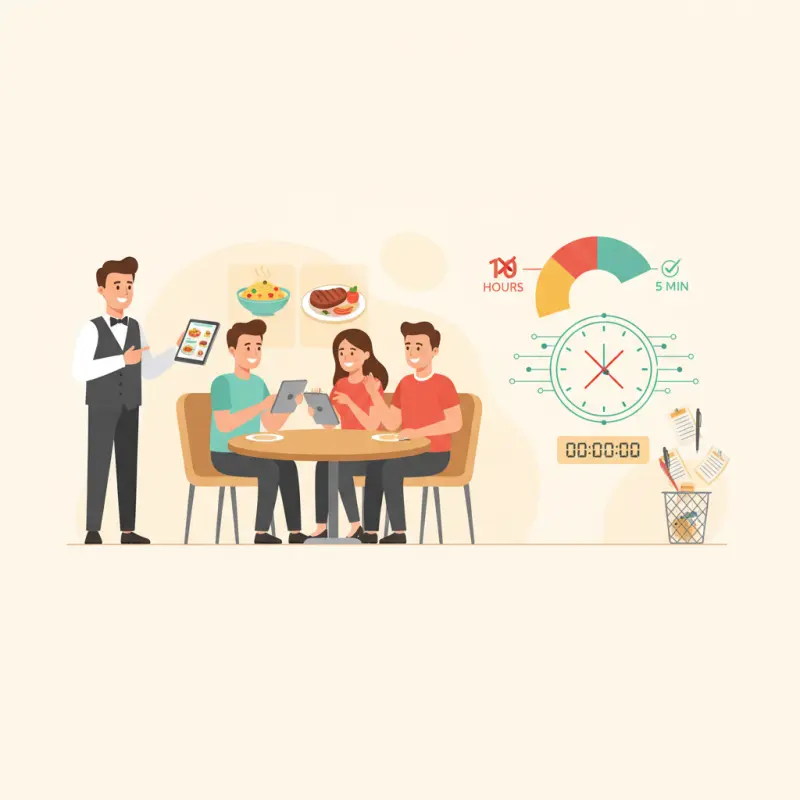
AI Overview
A table ordering system reduces order-taking time from 11 minutes to 1.5 minutes per table, freeing staff for hospitality-focused tasks. Restaurants implementing QR-based table ordering systems see immediate labor cost reductions of up to 350 MAD daily on order capture alone. In Morocco's restaurant sector, establishments like those in Agadir and Casablanca report cutting server requirements from eight to five staff members while improving service quality. The technology eliminates traditional bottlenecks where waiters spend four minutes per order on greeting, menu explanation, and payment confirmation. Staff redirect saved time toward upselling, wine recommendations, and guest experience enhancement — activities that directly increase tips and customer retention. Restaurants should calculate their current order-taking time per table and multiply by daily order volume to identify potential labor savings.
Table of Contents
Your waiter hasn't approached your table in 20 minutes. Not because service is poor — they're taking orders from six other tables, each conversation lasting three to five minutes. This scene repeats across thousands of Moroccan restaurants daily, where staff productivity vanishes into order-taking instead of hospitality.
A modern table ordering system transforms this dynamic. Customers scan, browse, and order from their phones while staff focus on what matters: food quality, ambiance, and the human touches that create memorable dining experiences.
How Much Time Your Staff Spends on Order Taking
Let's examine the math most restaurant owners never calculate. In a typical Agadir beachfront restaurant, each order interaction consumes four minutes — greeting, menu explanation, order recording, clarification of modifications, and payment method confirmation. Multiply this by 150 daily orders during summer season, and your staff dedicates 10 hours solely to order capture.
That's 10 hours not spent on table turnover, upselling desserts, or ensuring hot food arrives hot. With average labor costs at 35 MAD per hour, you're spending 350 MAD daily on a task technology handles better.
When restaurants implement QR-based ordering, waiters shift from order-takers to experience enhancers. They recommend wine pairings, check on meal satisfaction, and handle special requests — activities that directly impact tips and return visits.
Traditional Service | With Table Ordering | Time Saved |
|---|---|---|
Order taking: 4 min | QR scan assist: 30 sec | 3.5 min |
Menu questions: 2 min | Digital descriptions: 0 min | 2 min |
Bill processing: 5 min | Mobile payment: 1 min | 4 min |
Total per table: 11 min | Total per table: 1.5 min | 9.5 min saved |
Digital menu ROI
How much are paper menus costing you?
Saved per month
1.2K MAD
Saved per year
14K MAD
The Real Economics: Beyond Commission Savings
Commission-free platforms matter, but labor optimization delivers immediate impact. A 200-seat restaurant in Casablanca's Maarif district reduced staffing needs from eight servers to five after implementing digital ordering, while improving customer satisfaction scores.
Table turnover accelerates by 18 minutes on average when ordering friction disappears. Customers order within two minutes of sitting down instead of waiting for menus, water, and a server's availability. They add desserts and coffee with one tap instead of flagging down busy staff.
Service quality paradoxically improves with fewer interactions. Staff arrive at tables with purpose — delivering food, refilling drinks, responding to requests — rather than interrupting conversations for routine order-taking.
Why Most Table Ordering Systems Fail in Morocco
Generic QR ordering solutions stumble on Moroccan dining culture. They assume individual ordering when families share tagines. They offer English-only interfaces in neighborhoods where Darija and French dominate. They require app downloads when tourists want instant access.
The language barrier creates immediate friction. A restaurant online ordering system must seamlessly switch between Arabic (with proper right-to-left formatting), French, and English based on customer preference, not device settings. Menus need cultural translation, not just linguistic — explaining "pastilla" to tourists while showing locals the filling details they expect.
Cultural Dining Patterns That Break Standard QR Systems
Moroccan dining revolves around sharing. Four people order three mains, multiple salads, and shared appetizers. Standard ordering interfaces force item-by-item selection when diners think in complete meal compositions. They need "add to table" functionality, not individual carts.
Payment splitting follows social rules, not mathematical division. The eldest might cover mains while others handle drinks and dessert. Young professionals split equally except for the person celebrating. Your food ordering system online must accommodate these patterns or staff intervene anyway, defeating the efficiency purpose.
The 15-22% Average Order Value Increase Explained
Digital menus remove the psychological pressure of holding up the table. Customers browse every category, discover items they'd miss on printed menus, and add impulse purchases without embarrassment. High-resolution photos and detailed descriptions replace hurried server explanations.
A seafood restaurant in Agadir's marina district documented their results: appetizer attachment rates jumped from 30% to 45% after implementing QR ordering. Customers discovered grilled octopus and seafood briouates through enticing photos they'd previously skip in text-heavy menus.
Real-time inventory prevents the disappointment of unavailable dishes. Instead of servers returning with "désolé, we're out of lamb," the online food ordering system for restaurants only displays available items. Customers choose alternatives immediately, maintaining ordering momentum.
Guest Checkout Flow That Actually Converts
Single-tap reordering transforms beverage sales. After finishing mint tea, customers reorder without eye contact or hand signals. The same applies to wine bottles, soft drinks, and that second round of Moroccan salads that arrives perfectly timed.
Payment preferences in Morocco vary by generation and city. Marrakech's international visitors expect credit card processing. Fès locals prefer cash. Students in Rabat use mobile money. A proper food online ordering system accommodates all methods while maintaining transaction security.
Implementation Timeline: Days, Not Months
Restaurant owners expect complex installations. Reality proves simpler. Within 48 hours, your complete table ordering system operates — from QR code generation to first orders. Compare this to traditional POS deployments requiring hardware installation, network configuration, and weeks of vendor coordination.
Week One: Menu Setup and Staff Training
Day one focuses on menu upload and organization. Digital photography showcases your dishes while descriptions clarify portions and spice levels. QR codes print on weatherproof table cards, with placement tested for optimal scanning angles.
Staff training emphasizes support, not replacement. Servers learn to recognize confused customers, assist with first-time QR scanning, and handle edge cases where manual ordering makes sense. They discover time freed for wine recommendations and dessert suggestions — activities that boost both tips and revenue.
Month One: Optimization Based on Real Data
After 30 days, patterns emerge. Peak lunch hours might show slower adoption than dinner service. Tourist-heavy tables embrace QR ordering while local regulars prefer traditional service. Your system adapts to these realities rather than forcing uniform adoption.
Menu engineering becomes data-driven. Items with high view-to-order ratios need better photos or descriptions. Popular combinations suggest new combo offerings. Abandoned carts reveal price sensitivity or confusing options.
Why votrenom.ochi.ma Beats Generic Pages
Branded subdomains matter more than restaurants realize. When customers share their dining experience on Instagram, they link to laperle.ochi.ma, not generic-ordering-platform.com/restaurant/12345. Your brand travels with every social share.
Search engines recognize subdomains as extensions of your digital presence. Reviews mentioning "La Perle restaurant online ordering" find your branded ordering page, not a marketplace listing among competitors. Direct discovery increases while commission fees stay at zero.
Integration depth separates real restaurant platforms from ordering overlays. Orders flow directly to kitchen displays, update inventory counts, and sync with your POS. Multi-branch restaurants manage all locations from one dashboard while maintaining unique menus and pricing per site.
The future of Moroccan dining isn't replacing human service — it's amplifying what humans do best while technology handles the repetitive tasks. Your staff builds relationships. Your table ordering system processes transactions. Together, they create experiences worth returning for.
See what a branded ordering experience looks like for your restaurant at ochi.ma/partners.
Frequently Asked Questions
How much time does a table ordering system save per customer?
A table ordering system saves approximately 9.5 minutes per table, reducing service time from 11 minutes to 1.5 minutes. This includes eliminating 4 minutes of order taking and 5 minutes of bill processing.
What are the labor cost savings with digital table ordering?
Restaurants save around 350 MAD daily on order-taking labor costs alone, based on 150 orders at 4 minutes each. Many establishments reduce staffing requirements by 30-40% while maintaining service quality.
Do customers prefer QR ordering or traditional waiters?
Modern diners appreciate the speed and convenience of QR ordering for placing orders, while still valuing waiter interaction for recommendations and hospitality. The hybrid model optimizes both efficiency and experience.
How quickly can restaurants implement a table ordering system?
Most modern table ordering systems deploy within 24-48 hours. Setup involves generating QR codes for tables and basic staff training on the dashboard interface.
What happens if customers need help with the digital ordering system?
Staff assist customers with QR scanning and menu navigation when needed, typically requiring just 30 seconds compared to traditional 4-minute order taking. Most customers adapt quickly to the interface.
Restaurant owners · Weekly
The guide to running a restaurant in 2026.
One article per week. No commission advice. Just honest operational insight for Moroccan restaurants.

Blog Manager
Comments
No comments yet. Be the first to share your thoughts.