AI Overview
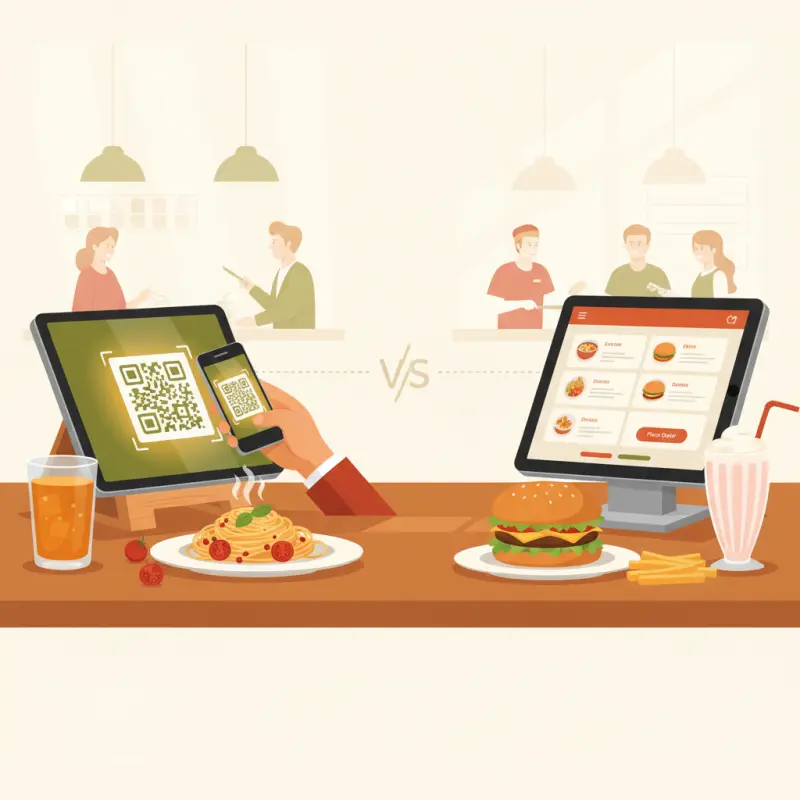
Most Moroccan restaurants choose QR code ordering over dedicated tablet ordering systems for restaurants. A tablet ordering system for restaurants requires 40,000-80,000 MAD upfront for hardware plus 2,000-4,000 MAD monthly maintenance. QR-based systems eliminate these costs entirely while achieving 78% customer adoption in post-pandemic Morocco. Restaurants in Marrakech's Gueliz district demonstrate this trend — QR codes on tables instead of iPads. One Agadir beachfront café spent 8,000 MAD annually replacing tablet screens from sand damage alone. QR ordering delivers 15-22% higher average order values with zero hardware investment and 2-3 day implementation versus weeks for tablets. Staff training drops from three hours per person to minimal orientation. Calculate your table count multiplied by 2,000-4,000 MAD to understand tablet system costs before choosing your ordering platform.
Table of Contents
A tablet ordering system for restaurants sounds like a technology decision. It's not. It's a business model choice that affects every peso coming through your door.
Most Moroccan restaurant owners asking about digital ordering face the same crossroads: invest 50,000 MAD in dedicated tablets, or let customers use their own phones? The answer might surprise you.
Why Most Restaurants Choose QR Codes Over Dedicated Tablets
Walk into any successful restaurant in Marrakech's Gueliz district today. You'll see QR codes on tables, not iPads. There's a reason.
The math is brutal for dedicated hardware. Each tablet costs 2,000 to 4,000 MAD. A 20-table restaurant needs at least 10 units (accounting for charging rotations). That's 40,000 MAD before you've taken a single order. Add protective cases, charging stations, and the inevitable replacements when devices hit tile floors.
The Hidden Costs of Dedicated Tablets
Hardware is just the beginning. Your staff needs three hours of training per person. Cable management becomes a daily task. Battery degradation means replacing units every 18 months. One Agadir beachfront café spent 8,000 MAD annually just on replacement screens from sand damage.
Meanwhile, QR-based ordering requires zero hardware investment. Customers bring their own devices. No charging. No maintenance. No theft risk.
QR Code Economics: The Numbers
| Metric | Dedicated Tablets | QR Code Ordering |
|---|---|---|
| Initial Investment | 40,000-80,000 MAD | 0 MAD |
| Monthly Maintenance | 2,000-4,000 MAD | 0 MAD |
| Customer Adoption Rate | 95% | 78% |
| Average Order Value Increase | 18-25% | 15-22% |
| Implementation Time | 2-3 weeks | 2-3 days |
Post-pandemic Morocco shows 78% of diners comfortable scanning QR codes. That's not 100%, but it's enough to transform your business. The 22% who prefer traditional ordering? Your servers handle them normally.
Digital menu ROI
How much are paper menus costing you?
Saved per month
1.2K MAD
Saved per year
14K MAD
The Real Implementation Challenge: Menu Psychology
Digital menus change how people order. Not might change — will change. Understanding this psychology determines whether your restaurant online ordering system prints money or creates chaos.
How Screen Menus Change What People Order
Photos sell. A high-resolution image of your signature tagine increases orders by 30% versus text description alone. But here's what nobody tells you: photo quality matters more than professional photography. A well-lit smartphone shot outperforms a poorly compressed professional image.
Category placement drives revenue. Items at the top of each section see 40% more orders. Smart operators rotate high-margin dishes to these positions weekly. Your traditional paper menu couldn't do that.
Visual hierarchy replaces verbal upselling. Highlighted "chef's recommendations" or "most popular" badges drive 25% higher selection rates than identical items without badges.
The Casablanca Café Test
A 45-table café near Hassan II Mosque switched from paper menus to QR ordering last October. Week one was rough. Servers spent more time explaining the system than taking orders. Customer satisfaction dipped 15%.
By week three, patterns emerged. Order accuracy jumped 30% — no more misheard items in a noisy dining room. Average ticket time dropped from 12 minutes to four minutes. Kitchen errors virtually disappeared.
Month two brought the real surprise: revenue per table increased 18%. Not from higher prices. From better photos driving appetizer orders and suggested add-ons working every time.
Why Your Restaurant Online Ordering System Needs Multilingual Support
Morocco's linguistic reality: your customers think in Arabic, French, and increasingly English. Your online food ordering system for restaurants must speak all three fluently.
The Language Revenue Gap
A French-only menu reaches 65% of your potential market. Add Arabic and you hit 85%. Include English for tourists and expatriates? You're at 95% market coverage.
But coverage isn't conversion. Guest checkout in a customer's preferred language shows 23% higher completion rates than forcing a second-choice language. That's pure revenue lost to poor localization.
OCHI handles this automatically. Full Arabic support with right-to-left rendering. French for traditionalists. English for international visitors. One menu, three languages, zero friction.
Technical Requirements Most Platforms Miss
Arabic isn't just translated French. Right-to-left text requires specific fonts and layout adjustments. Numbers must display correctly (٩٨٧ or 987?). Currency symbols need proper placement.
Your food ordering system online needs device-agnostic rendering. A Samsung phone, an iPhone, a Huawei tablet — all must display your menu perfectly. One broken character destroys credibility.
The Staffing Reality: How Tablet Systems Actually Affect Your Team
Digital ordering doesn't replace servers. This myth costs restaurants talented staff who fear technology will eliminate their jobs. The truth? It transforms their role into something more valuable.
What Your Servers Will Actually Do
Order-taking consumed 60% of server time in traditional service. Digital ordering reclaims those minutes for actual hospitality. Servers become experience enhancers, not order transcribers.
A server at a Rabat bistro told me her tips increased 30% after QR ordering launched. Why? She had time to recommend wine pairings, explain dish preparations, and check on table satisfaction. The human touch became more valuable, not less.
New skills emerge. Basic tech support becomes essential. "The QR code won't scan" replaces "What's in the Caesar salad?" as the common question. Smart operators train for this reality.
The Training Investment
Initial setup takes two to three hours per staff member. Not just "here's how to use it" but "here's how to help customers who struggle." Role-playing common problems prevents opening-night disasters.
Weekly 15-minute refreshers keep skills sharp. New features, common issues, customer feedback — all need regular discussion. The restaurants thriving with food online ordering system treat training as ongoing, not one-time.
Building Your Food Ordering System Online: Technical Essentials
Implementation separates successful digital restaurants from expensive failures. The technical foundation matters more than any feature list.
Integration Requirements
Your POS system must connect seamlessly. Orders flow from customer phone to kitchen printer without manual entry. Payment processing happens automatically. Inventory updates in real-time.
Kitchen display systems need compatibility too. Color-coded orders by course. Timer displays for service standards. Clear station routing for complex kitchens.
WiFi infrastructure can't be afterthought. Minimum 50 Mbps for 20 simultaneous users. Dedicated network for ordering separate from customer WiFi. Backup internet connection for business continuity.
The OCHI Advantage: Branded Storefront Without Development
Most platforms force you onto their domain. Customers order from genericplatform.com/yourrestaurant. OCHI gives you votrenom.ochi.ma — your brand, your identity, their infrastructure.
Multi-branch management happens from one dashboard. Fès location runs different specials than Casablanca? Set it once. Real-time inventory syncs across locations. Customer data stays unified.
Zero commission structure means menu prices equal customer prices. No hidden 15-30% platform fees inflating costs. Your food online ordering system works for you, not against you.
The future of restaurant ordering isn't about choosing between human service and digital efficiency. It's about using technology to amplify what makes your restaurant special. Whether that's through QR codes or dedicated tablets depends on your specific situation. But one thing's certain — the restaurants still using paper menus exclusively won't be here in five years.
See what OCHI can do for your restaurant at ochi.ma/partners.
Frequently Asked Questions
What's the cost difference between tablet ordering systems and QR code ordering?
Dedicated tablet ordering systems cost 40,000-80,000 MAD upfront plus 2,000-4,000 MAD monthly maintenance. QR code ordering systems have zero hardware costs and no ongoing maintenance fees.
How many customers actually use QR code ordering in Morocco?
78% of Moroccan diners are comfortable scanning QR codes for restaurant ordering post-pandemic. The remaining 22% can still order through traditional server interaction.
Do tablet ordering systems increase sales more than QR codes?
Dedicated tablets increase average order value by 18-25% while QR systems achieve 15-22% increases. The difference is minimal compared to the massive cost savings of QR implementation.
How long does it take to implement a tablet ordering system?
Tablet systems require 2-3 weeks for implementation including hardware setup and staff training. QR code systems deploy in 2-3 days with minimal training required.
What are the hidden costs of restaurant tablet systems?
Beyond hardware costs, expect cable management, battery replacements every 18 months, protective cases, charging stations, and frequent screen repairs. Staff training requires three hours per person initially.
Restaurant owners · Weekly
The guide to running a restaurant in 2026.
One article per week. No commission advice. Just honest operational insight for Moroccan restaurants.

Blog Manager
Comments
No comments yet. Be the first to share your thoughts.