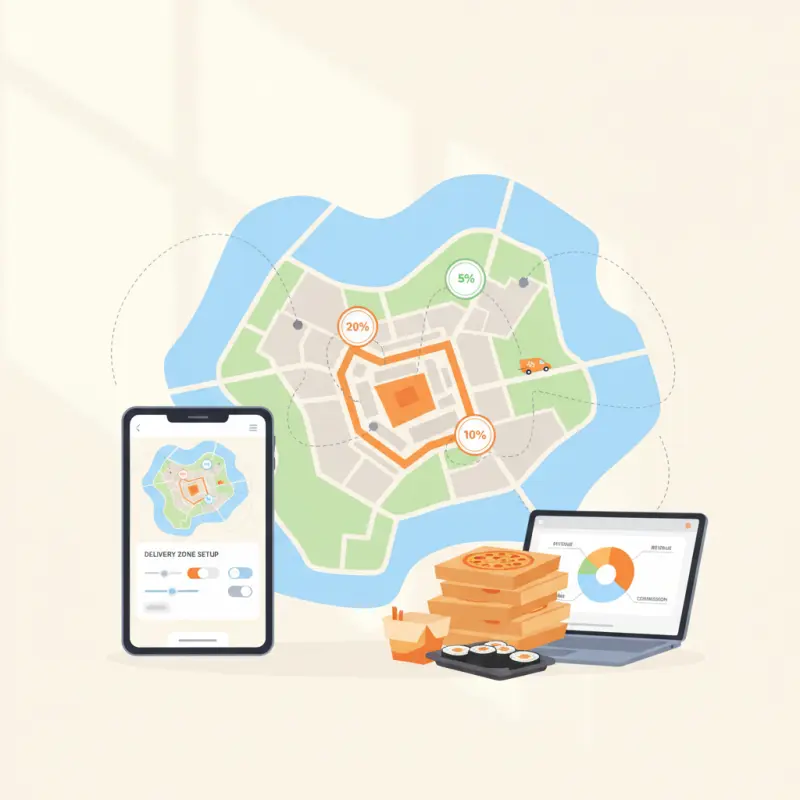
The Commission Trap: Why 15-30% Fees Kill Restaurant Margins
Platform commission isn't just expensive — it's mathematically impossible for most restaurants to sustain. When your net margin sits at 3-7% and platforms take 15-30%, you're effectively paying to stay in business.
The Hidden Cost Breakdown
| Fee Type |
Typical Range |
Monthly Impact (400 orders × 85 MAD) |
| Platform Commission |
15-30% |
5,100 - 10,200 MAD |
| Payment Processing |
2-3% |
680 - 1,020 MAD |
| Marketing Fees |
3-5% |
1,020 - 1,700 MAD |
| Total Platform Cost |
20-38% |
6,800 - 12,920 MAD |
These aren't theoretical numbers. A typical Agadir restaurant processing 34,000 MAD in monthly delivery orders loses up to 12,920 MAD to platform fees. That's rent money. Staff salaries. Equipment upgrades — all going to a middleman.
Why "Marketing Reach" Doesn't Justify 30% Commission
Platforms promise customer access in exchange for commission. But customer acquisition through paid channels costs 50-80 MAD per first order in Morocco. If your average order is 85 MAD with a 7% margin, you need 10 repeat orders just to break even on acquisition.
The platform dependency trap emerges quickly. Customers associate your food with the platform brand, not yours. When you try to shift them to direct ordering, conversion rates drop below 5%. You're renting customers at 30% commission forever.
Driver Assignment: Auto vs. Manual and Why It Actually Matters
Every delivery starts with a decision: which driver gets this order? The wrong choice means cold food, angry customers, and lost revenue. Most food delivery management software treats this as a simple proximity calculation. Reality is more complex.
Auto-Assignment Algorithms: What They Optimize For
Basic algorithms assign the nearest available driver. Better systems consider driver rating, current route efficiency, and order characteristics. The best platforms let you set priority rules: high-value orders to experienced drivers, new customers to your most reliable team members.
Batch delivery changes the calculation entirely. During lunch rush, grouping 2-3 orders per trip cuts delivery costs by 40%. But the algorithm must balance pickup times, delivery zones, and food type. Hot pizza and cold salads don't batch well together.
Manual Override: When Restaurants Need Control
Some situations demand human judgment. Your regular customer who tips generously deserves your best driver. The order going to a difficult-to-find address needs someone familiar with the area. Bad weather means assigning only to drivers with proper vehicles.
Restaurant delivery software must balance automation efficiency with manual control. Pure algorithms miss context. Pure manual assignment doesn't scale. The sweet spot: auto-assignment with instant override capability and clear driver performance data.
GPS Tracking: Beyond "Real-Time Updates"
Every food ordering and delivery platform mentions GPS tracking. Few explain what actually matters: the data that improves operations and the psychology that keeps customers happy.
What Restaurant Owners Actually Track
Raw GPS dots on a map tell you nothing. Useful tracking shows planned route versus actual route, time spent at each delivery, and zones where drivers consistently run late. This data feeds back into zone optimization and driver training.
Delivery time accuracy improves when you track patterns. If orders to Hay Hassani always take five minutes longer than estimated, adjust the zone timing. If certain drivers consistently beat estimates, learn their routes and train others.
The Customer Psychology of Tracking
Customers check tracking an average of 2.3 times per order. They're not just curious — they're planning their availability. The most valuable tracking update isn't "driver on the way" but "driver 5 minutes away." This triggers customers to prepare for receipt.
Proactive communication prevents complaints. When delays happen, automated notifications explaining the situation reduce negative reviews by 60%. Customers accept delays they understand but hate surprises.
The OCHI Advantage: Zero Commission Meets Operational Control
OCHI approaches delivery differently. Instead of taking commission and controlling your customer relationships, it provides the tools while you keep the revenue. Every order through your branded subdomain (votrenom.ochi.ma) is 100% yours.
Complete Delivery Management Without the Markup
The platform includes polygon-based zone drawing, automated driver assignment with manual override, and real-time GPS tracking visible to both restaurant and customer. Batch delivery optimization groups orders intelligently. Driver performance analytics show exactly where improvements are needed.
Most importantly: zero commission on every order. Not reduced commission. Not promotional rates. Zero. The same online food ordering and delivery platform capabilities as premium services, without the revenue share that makes delivery unprofitable.
Real Restaurant Scenario: Casa Verde in Agadir
Casa Verde switched to OCHI in January. Previous platform: 25% commission plus fees. Monthly delivery revenue: 34,000 MAD. Take-home after fees: 22,000 MAD.
With OCHI's food delivery management software: same 34,000 MAD revenue, 34,000 MAD kept. The 12,000 MAD difference hired an additional driver and upgraded their delivery bags. Orders increased 15% from improved service quality.
Setup took one afternoon. Zone drawing, driver profiles, and menu upload completed in under two hours. The branded ordering site went live immediately. Marketing strategies focused on shifting platform customers to direct ordering, aided by the same-price guarantee.
The path forward is clear. Restaurants need delivery to compete. But they need profitable delivery to survive. The right takeaway delivery software makes this possible — through smart zone setup, fair pricing models, and operational tools that actually work. See the complete toolset and start your free trial at ochi.ma/partners.