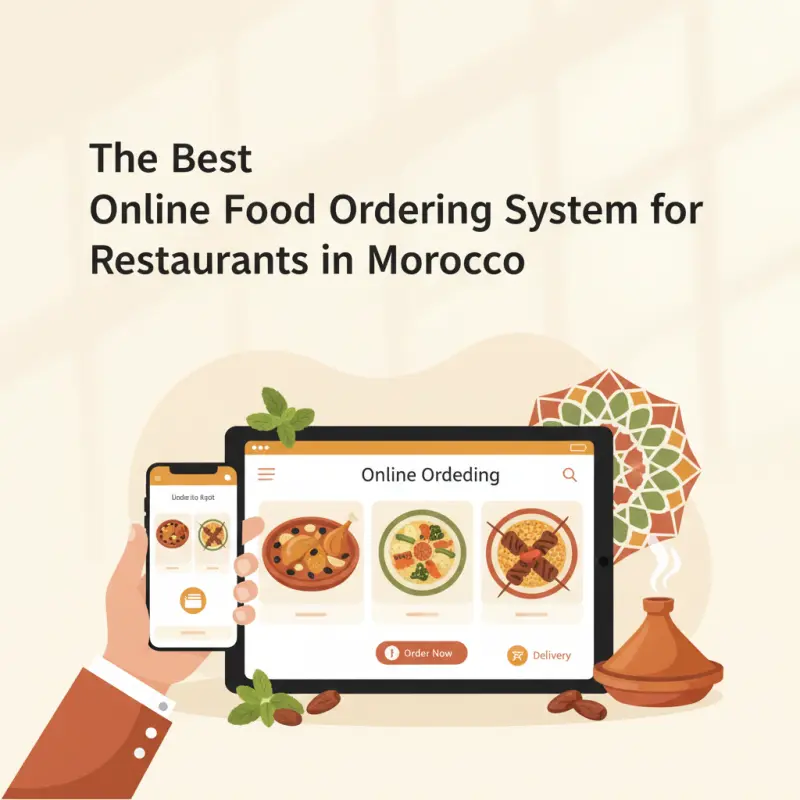
What Restaurants in Morocco Actually Need (It's Not What Silicon Valley Built)
International ordering platforms assume every market operates like San Francisco or London. They don't. A restaurant online ordering system built for Morocco must handle trilingual menus seamlessly — Arabic reading right-to-left, French for business professionals, English for tourists. Most global platforms treat Arabic as an afterthought, breaking layouts and confusing navigation.
Payment preferences differ too. While Western markets embrace app-based wallets, Moroccan diners prefer cash on delivery or direct card payments. They want guest checkout — no forced app downloads, no account creation, just order and pay. A food ordering system online that requires registration loses 35% of potential orders at the first screen.
Consider Ramadan scheduling. During the holy month, restaurants need to pause lunch service, adjust iftar timing, and manage surge ordering at sunset. Platforms designed elsewhere can't handle these operational realities. They offer generic "business hours" that don't reflect how Moroccan restaurants actually operate.
Family-style ordering creates another challenge. A table of eight sharing multiple dishes needs split bills, item modifications, and portion adjustments. The online food ordering system for restaurants must accommodate these cultural dining patterns, not force Western individual-meal assumptions.
The Revenue Data: QR Ordering vs. Traditional Methods
QR table ordering transforms the economics of service. Customers scan, browse at their own pace, and order directly from their phones. No app download required. The impact on average order value surprises even experienced operators.
Data from 50 restaurants using QR ordering in Agadir shows consistent patterns:
Metric | Traditional Ordering | QR Table Ordering | Improvement |
|---|
Average Order Value | 165 MAD | 201 MAD | +22% |
Items per Order | 2.8 | 3.6 | +29% |
Dessert Attachment | 18% | 34% | +89% |
Order Accuracy | 91% | 99% | +9% |
Table Turnover | 68 min | 54 min | -21% |
Why do customers spend more? Without time pressure from waiting staff, they explore the full menu. High-quality photos and descriptions replace rushed verbal explanations. They add that extra appetizer or upgrade to premium options.
Staff productivity jumps too. Waiters focus on hospitality instead of order-taking. One server can manage 12 tables instead of eight. The kitchen receives clear, accurate orders instantly. OCHI's Kitchen Display System shows this in practice — orders flow directly from customer phones to kitchen screens, eliminating transcription errors.
Why Your Ordering System Should Be Your Brand (Not Theirs)
Most platforms want customers to remember them, not you. Your restaurant becomes "that place on Platform X" instead of building direct recognition. This matters more than operators realize. When customers bookmark votrenom.ochi.ma, they're saving your restaurant, not navigating through a marketplace of competitors.
Branded domains change customer behavior. A family in Marrakech orders from their favorite restaurant by typing the remembered URL directly. No searching, no browsing alternatives, no competitor ads. The food online ordering system becomes invisible infrastructure, not a middleman.
Consider two customer journeys:
Generic platform path: Open app → Search location → Browse restaurants → Maybe find yours → View competitor promotions → Eventually order (or not).
Branded domain path: Type votrenom.ochi.ma → See your menu → Order immediately → Build direct loyalty.
The psychological difference matters. Customers feel they're ordering from you, not through someone else. Your brand colors, your messaging, your personality — preserved throughout the experience. Email confirmations come from your name. SMS updates show your logo. Every touchpoint reinforces your identity.
Platform dependency creates hidden risk. What happens when your ordering provider changes terms, raises prices, or simply shuts down? Smart operators evaluate control before convenience.
Key questions that reveal true platform ownership:
Can you export your complete customer database today? Not just emails — full order history, preferences, contact details. Real ownership means downloadable CSV files with all data intact. Can you message customers directly without platform approval? Your SMS and email campaigns should bypass platform restrictions.
What about payment processing? If you leave tomorrow, can you keep the same payment setup? True independence means your Stripe or PayPal account, not theirs. API access matters too. Can you integrate with your accounting software? Pull sales data automatically? Build custom reports? Closed platforms lock you out of your own information.
Contract terms reveal intentions. Monthly commitments respect your freedom. Multi-year locks with penalty clauses show who benefits from the relationship. The best online food ordering system treats you as a partner, not a captive customer.
OCHI exemplifies this philosophy. Restaurants own their data completely. Export everything anytime. Use your own payment accounts. Cancel monthly without penalties. The platform provides tools, not chains.
Your ordering system should strengthen your business, not create dependencies. When evaluating options, imagine switching providers next month. If that thought creates panic about losing customers or data, you're choosing a trap, not a tool. The right platform makes you stronger whether you stay or leave. Test the difference with votrenom.ochi.ma — see your restaurant's branded ordering experience in action. Learn more about zero-commission ordering at ochi.ma/partners.