AI Overview
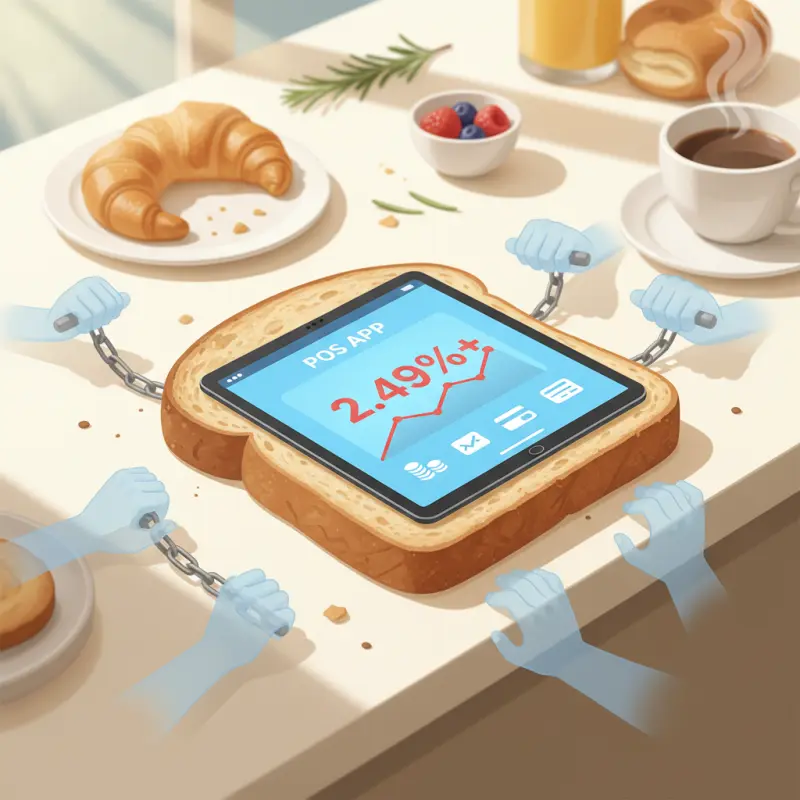
The toast pos app costs 2.49% plus $0.15 per transaction, with monthly software fees starting at $69 per terminal. The toast pos company requires two-year contracts with automatic renewal and early termination fees starting at $500 per terminal. Online orders cost an extra 0.5%, gift card processing adds 2.99%, and international cards trigger additional cross-border fees up to 1%. A Casablanca restaurant processing MAD 100,000 monthly pays around $320 in processing fees alone, before software subscriptions and hardware rentals. Proprietary hardware starts at $799 per terminal, with kitchen displays at $899 and handheld devices at $399. Toast locks restaurants into their ecosystem with three-year hardware leases that continue even after software contract termination. Calculate your total monthly costs including all fees before signing any contract.
Table of Contents
Toast POS App:
What It Actually Costs Beyond the Marketing
The toast pos app charges 2.49% + $0.15 per transaction — before adding monthly software fees starting at $69 per terminal. Most Moroccan restaurant owners discover these numbers only after signing multi-year contracts.
Your actual monthly cost depends on transaction volume. A Casablanca restaurant processing MAD 100,000 monthly (roughly $10,000) pays around $320 in processing fees alone. Add software subscriptions, hardware rentals, and premium features — you're looking at $500+ monthly before considering the toast pos company's additional service charges.
Processing Fees and Hidden Charges
Beyond the base rate, Toast adds fees for specific payment types. Online orders cost an extra 0.5%. Gift card processing adds another 2.99%. International cards — common with Morocco's tourist traffic — trigger additional cross-border fees up to 1%.
The billing structure mimics systems like petpooja billing but with higher rates. A restaurant accepting 30% online orders effectively pays 2.99% per transaction, not the advertised 2.49%.
Contract Length and Cancellation Terms
Toast requires two-year contracts with automatic renewal clauses. Early termination fees start at $500 per terminal. Miss the 60-day cancellation window? You're locked for another two years.
Hardware leases run separately with three-year terms. Even if you exit the software contract, hardware payments continue. One Marrakech restaurant owner paid MAD 15,000 in termination fees after eight months of declining sales.
Hardware Requirements and Costs
Toast's proprietary hardware starts at $799 per terminal. Kitchen display screens cost $899 each. Handheld devices for waiters run $399. A basic two-terminal setup with kitchen display approaches $2,500 before installation.
Unlike platforms offering device flexibility, Toast locks you into their ecosystem. Break a terminal? Replacement costs full price — no warranty after year one.
Stack audit
What do you currently use?
Tick what you have. We’ll show what OCHI replaces or connects to.
Why Toast POS Company Built Their System for US Chains, Not Independent Restaurants
Toast's feature set reveals its true target market: multi-location chains processing millions in monthly revenue. The platform assumes operational complexity that independent restaurants rarely need.
Consider inventory management. Toast offers 15 different cost calculation methods, enterprise supplier networks, and multi-warehouse tracking. A family restaurant in Agadir needs simple ingredient costs and daily stock counts — not supply chain optimization.
Commission Structure That Favors Volume
Processing rates drop only after $50,000 monthly volume — unrealistic for most Moroccan independents. Below that threshold, you pay the same rates as a food truck while navigating enterprise-level complexity.
Compare this to local solutions. OCHI charges zero commission regardless of volume. Whether you process MAD 10,000 or MAD 100,000 monthly, the restaurant keeps every dirham.
Feature Complexity vs. Daily Operations
Toast includes labor compliance modules, multi-state tax calculations, and franchise royalty tracking. Features designed for US chains add confusion without value for single-location restaurants.
Training staff takes weeks. One Rabat restaurant spent 45 days onboarding after switching from basic petpooja billing. Daily operations that took minutes now required navigating multiple screens and permissions.
Support Model for Different Restaurant Sizes
Enterprise clients get dedicated account managers. Independent restaurants reach overseas call centers. Support operates on US Eastern Time — when Moroccan restaurants close for the night, Toast support opens.
Critical dinner rush issue? Wait until tomorrow. Local platforms like OCHI provide Moroccan timezone support with Arabic-speaking staff who understand local operations.
Toast POS App Performance in Morocco:
The Infrastructure Reality
Cloud-based systems require constant internet connectivity. Toast downloads transaction data, processes payments, and syncs inventory through US-based servers. One internet hiccup stops everything.
Moroccan internet infrastructure improved significantly, but consistency varies. Coastal cities enjoy fiber connections. Interior regions face daily disruptions. Toast offers no true offline mode — only limited transaction caching.
Internet Speed Requirements for Cloud POS
Toast recommends 25 Mbps dedicated bandwidth per location. Factor in staff phones, customer WiFi, and security cameras — most restaurants need 50+ Mbps business connections costing MAD 800-1,200 monthly.
Latency matters more than speed. Data traveling to US servers and back creates 120-200ms delays. During peak hours, simple operations like printing receipts lag noticeably.
Local Payment Integration Limitations
Toast integrates with US payment processors exclusively. Moroccan banks, local payment methods, and cash-heavy operations require workarounds. The pos toast system assumes card-dominant markets.
Cash transactions must be manually entered. No integration with Moroccan fiscal requirements. No Arabic receipt printing. Features that seem basic locally simply don't exist.
Support Hours vs. Moroccan Business Hours
Toast support operates 8 AM to midnight Eastern Time. In Morocco, that's 1 PM to 5 AM. Your lunch rush starts when their office closes. Friday prayers? Middle of their Thursday workday.
Emergency support exists but requires enterprise contracts. Independent restaurants get email tickets with 24-48 hour response times.
Zero-Commission Alternative: Why Casablanca Restaurants Choose OCHI Over Toast
Ahmed runs La Perle, a 50-seat seafood restaurant in Casablanca's Maarif district. His monthly revenue averages MAD 120,000. With Toast, he'd pay MAD 3,600 in processing fees alone. With OCHI? Zero.
| Monthly Cost Comparison | Toast POS | OCHI |
|---|---|---|
| Processing Fees (3%) | MAD 3,600 | MAD 0 |
| Software Subscription | MAD 690 | MAD 0 |
| Hardware Rental | MAD 450 | MAD 0 |
| Online Ordering Fees | MAD 600 | MAD 0 |
| Total Monthly Cost | MAD 5,340 | MAD 0 |
That's MAD 64,080 yearly — enough to hire another chef or renovate the dining room.
Commission Impact: 3% vs. 0% on MAD 50,000 Monthly Revenue
Smaller restaurants feel the impact more. At MAD 50,000 monthly revenue, Toast's 3% equals MAD 1,500 — often the difference between profit and loss. Add software fees, and you're giving away MAD 2,500 monthly.
OCHI's zero-commission model means that MAD 2,500 stays in your bank account. No processing fees. No software subscriptions. No surprise charges. The price on your menu is what customers pay and what you keep.
Local Infrastructure and Support Benefits
OCHI servers run from Moroccan data centers. Support speaks Arabic, French, and English. Business hours match yours. When your dinner rush hits, support stands ready.
The platform works offline-first. Internet drops? Orders continue processing locally. Connection returns? Everything syncs automatically. Built for Moroccan infrastructure realities, not Silicon Valley assumptions.
Branded Subdomain vs. Generic App Presence
Toast puts every restaurant in the same app. Customers download Toast, search for you among thousands, hopefully find and order. Your brand disappears into their interface.
OCHI gives you votrerestaurant.ochi.ma — your own branded space. Customers bookmark your site directly. No app downloads. No competing restaurants. Your menu, your branding, your customer relationship.
Making the Switch:
Contract Exit Strategy and Migration Timeline
Leaving Toast requires planning. Start documenting 90 days before your contract renewal date. Screenshot your settings. Export customer data. Download transaction histories. Toast makes data export difficult — prepare for manual work.
Documentation You Need Before Switching
Export these files while you still have access: complete menu with modifiers and prices, customer email list with order histories, staff schedules and permissions, inventory counts and recipes, tax settings and rates, integration configurations.
Toast limits bulk exports. Plan two weeks for data extraction. Their support won't help — data portability isn't their priority.
Data Export and Customer List Migration
Customer data exports exclude key fields. Phone numbers come separately from email addresses. Order histories link through ID numbers requiring manual matching. Budget 20-30 hours for cleaning data from a single location.
OCHI's migration team handles the technical work. Send your exports, they'll import and match everything. Your customers won't notice the switch except for lower prices.
Staff Training and Operational Continuity
Train your team in phases. Start with managers, then senior staff, finally part-timers. Run both systems parallel for one week minimum. This overlap costs extra but prevents launch day disasters.
OCHI's interface mimics familiar restaurant workflows. Staff comfortable with petpooja billing or similar systems adapt within days. No enterprise complexity. Just tables, orders, and payments — the way restaurants actually work.
Ready to stop paying commissions? Calculate your savings at ochi.ma/partners and claim your branded subdomain today.
Frequently Asked Questions
What does the toast pos app actually cost per month?
Toast charges 2.49% plus $0.15 per transaction, with monthly software fees starting at $69 per terminal. A restaurant processing $10,000 monthly typically pays $320+ in processing fees alone, plus software and hardware costs.
Are there hidden fees with Toast POS?
Yes, Toast adds 0.5% for online orders, 2.99% for gift cards, and up to 1% for international cards. Early termination fees start at $500 per terminal with required two-year contracts.
How much does Toast POS hardware cost?
Toast terminals start at $799, kitchen displays cost $899, and handheld devices are $399. A basic two-terminal setup with kitchen display costs around $2,500 before installation.
Can I cancel my Toast POS contract early?
Toast requires two-year contracts with 60-day cancellation notice. Early termination fees start at $500 per terminal, and hardware leases continue separately with three-year terms.
Does Toast POS work with any hardware?
No, Toast uses proprietary hardware exclusively. You cannot use existing terminals or third-party devices, and replacement hardware costs full price after the first year.
Restaurant owners · Weekly
The guide to running a restaurant in 2026.
One article per week. No commission advice. Just honest operational insight for Moroccan restaurants.

Blog Manager
Comments
No comments yet. Be the first to share your thoughts.