AI Overview
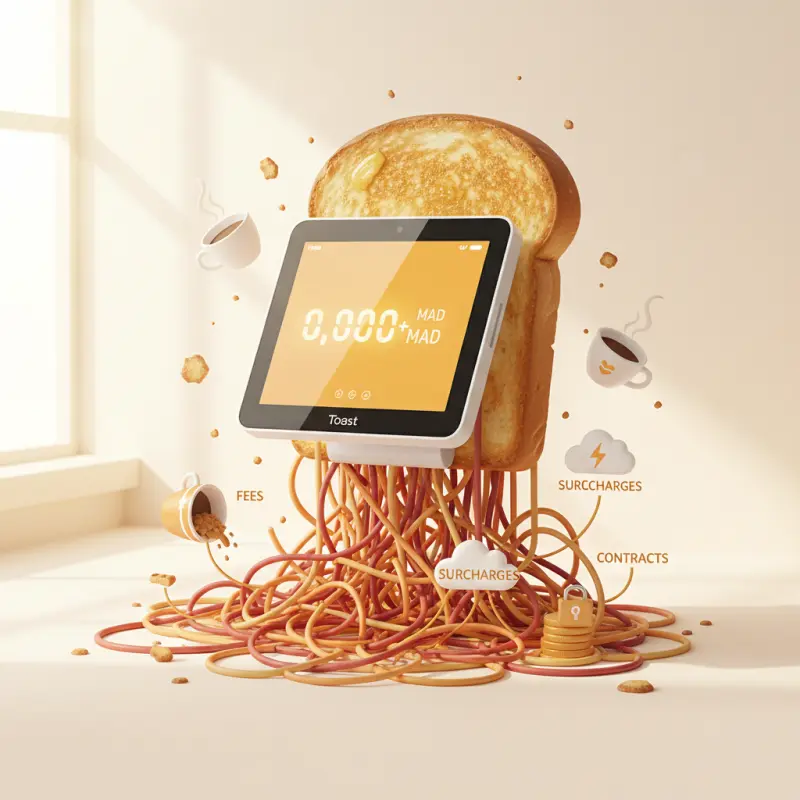
Toast POS system's $0 starting price misleads restaurant owners into expensive long-term commitments. The free tier lacks inventory tracking and advanced reporting, forcing most restaurants to upgrade to Essentials at $165 monthly per terminal within 60 days. Toast requires exclusive payment processing at 2.49% plus 15 cents per transaction, with online orders costing 2.99% plus 30 cents. A typical 40-seat restaurant in Morocco needs two terminals, creating a base cost of $330 monthly before processing fees. Hardware purchases add another $30,000 MAD upfront investment. Processing 200 daily orders costs an additional 11,250 to 15,750 MAD monthly depending on transaction type. Restaurant owners should calculate total monthly costs including processing fees before committing to any POS contract.
Table of Contents
When a restaurant owner in Casablanca told me she was paying 3,200 MAD monthly for her Toast POS system — not including the 30,000 MAD hardware investment — I knew something was wrong with the "starting at $0" promise. After analyzing dozens of restaurant tech stacks across Morocco, the pattern became clear: what looks free today costs thousands tomorrow.
The Hidden Costs Behind Toast POS System's "Starting at $0" Promise
Toast markets itself as the all-in-one restaurant platform with pricing that starts at zero. What they don't advertise prominently: that free tier is designed to frustrate you into upgrading. The real money flows through three carefully engineered revenue streams that most restaurant owners discover only after signing contracts.
Toast's Three-Tier Trap
The Starter plan at $0 per month sounds perfect until you realize it lacks inventory tracking, advanced reporting, and multi-location support. Most restaurants upgrade to Essentials within 60 days, suddenly paying $165 monthly per terminal. Need gift cards or loyalty programs? That requires the Growth plan at $405 per terminal monthly.
A typical 40-seat restaurant in Marrakech needs at least two terminals. That's $330 monthly just for basic functionality — before adding any modules or processing a single payment. The Toast POS company structures pricing this way because they know restaurants will hit limitations quickly.
Payment Processing: Where Toast Makes Its Money
Here's what the sales team glosses over: Toast requires you to use their payment processing exclusively. No negotiation. No switching to your bank's better rates. Every card swipe costs 2.49% plus 15 cents minimum. Online orders? That jumps to 2.99% plus 30 cents.
| Transaction Type | Toast Fee | Monthly Cost (200 orders/day) |
|---|---|---|
| In-person card | 2.49% + 15¢ | 11,250 MAD |
| Online ordering | 2.99% + 30¢ | 13,950 MAD |
| Keyed-in | 3.5% + 15¢ | 15,750 MAD |
Hardware Lock-In Costs Most Reviews Skip
Unlike systems that work with standard tablets, pos toast requires proprietary hardware. One terminal starts at $799. Need a kitchen display? That's $1,449. Customer-facing display? Another $649. When hardware fails — and restaurant hardware always fails — you can't grab a replacement from the local electronics store.
The full setup for a mid-size restaurant easily reaches $5,000 before training or installation. Toast offers payment plans, but you're still locked into their ecosystem for years.
Stack audit
What do you currently use?
Tick what you have. We’ll show what OCHI replaces or connects to.
What Toast POS Company Actually Delivers vs. Marketing Claims
After interviewing restaurant owners who've used Toast for at least one year, the gap between marketing promises and daily reality becomes stark. Some features work brilliantly. Others create more problems than they solve.
The Good: What Toast Does Well
Credit where due: Toast's kitchen display system genuinely speeds up service. Orders flow from server to kitchen instantly. Cooks see modifications clearly. The timer system helps maintain consistency during rushes.
Staff scheduling integrates smoothly with payroll processing. Managers can approve shift swaps through the app. Labor cost percentages update in real-time. For American-style restaurants with standard workflows, these features save hours weekly.
Sales reporting provides depth most billing petpooja alternatives lack. You can track performance by server, menu item, or daypart. The data exists — if you pay for the right tier and know where to find it.
The Problems Toast Won't Advertise
System outages hit when you need stability most. Friday night, full dining room, and suddenly credit cards won't process. Toast's status page shows 14 significant outages in the past year, each lasting two to six hours. Their solution? Keep a backup terminal from another processor — defeating the "all-in-one" promise.
Customization assumes you run an American restaurant. Need Arabic menu support? Complex modifiers for tagines? Shisha service tracking? Toast's rigid structure fights you at every turn. Petpooja billing systems face similar limitations when forcing Western workflows onto Moroccan operations.
Customer support means waiting. The advertised 24/7 availability translates to chat bots and tier-one agents who can't solve real problems. Actual technical support averages 24 to 48 hour response times. During an outage, you're on your own.
Why Billing Systems Like PetPooja Billing Face Similar Issues
The pattern repeats across commission-based platforms. They make money from transaction fees, so every feature pushes you toward more paid processing. Free trials convert to paid tiers. Basic features get moved to premium plans. Your data stays locked in their system.
These platforms survive on restaurant owner inertia. Switching systems means retraining staff, migrating data, updating workflows. They know you'll pay increasing fees rather than endure that pain. It's a business model built on your operational dependence.
The Real Test:
Toast POS in a Casablanca Restaurant Scenario
Let's model actual costs for Restaurant Bahia, a 40-table seafood restaurant in Casablanca's Corniche district. They process 200 orders daily, split between dine-in and takeaway, with average tickets of 250 MAD.
Monthly Cost Breakdown
| Cost Category | Amount (MAD) | Notes |
|---|---|---|
| Software (Essentials × 2) | 3,300 | Two terminals minimum |
| Payment processing | 12,000 | On 500,000 MAD revenue |
| Hardware amortization | 2,000 | 36-month financing |
| Add-on modules | 1,650 | Inventory + scheduling |
| Total Monthly | 18,950 | Before growth needs |
What Happens When You Scale
Restaurant Bahia opens a second location in Anfa. Toast treats each restaurant as separate entities. New hardware purchase: 50,000 MAD. New software subscriptions: another 3,300 MAD monthly. No unified dashboard unless you upgrade every location to Growth tier.
Multi-branch reporting requires enterprise pricing — "call for quote" territory where annual contracts start at $25,000. The toast pos system that seemed affordable for one location becomes a six-figure commitment at scale.
Why Zero-Commission Restaurant Management Changes Everything
OCHI flips the entire model. No transaction fees means we make money only when restaurants succeed with our tools. No commission creates aligned incentives. Your growth is our growth — not through processing fees but through platform adoption.
The Commission-Free Difference
Keep every dirham of your revenue. Process 1,000 MAD or 1,000,000 MAD — OCHI takes nothing. No payment processing markups hiding the real cost. Your money stays your money.
Your restaurant gets its own branded space at votrenom.ochi.ma. Customers order directly from you, not through a marketplace that owns the relationship. Build your brand, your customer base, your business.
Features That Actually Matter for Moroccan Restaurants
QR code menus work in Arabic, French, and English — with proper right-to-left support and local terminology. Customers scan, browse, and order from their phones. No app downloads. No commission fees. The same prices as your printed menu.
Local payment integration means accepting Cash Plus, CMI, and traditional cards without forced processing. Real GPS tracking shows delivery drivers on a map, with accurate ETAs based on Moroccan traffic patterns. Multi-branch control happens from one dashboard — whether you have two locations or 20.
The Math That Matters
Restaurant Bahia would save 227,400 MAD annually by switching from Toast to OCHI. No monthly software fees. No processing commissions. No hardware lock-in. That money funds two new staff members, kitchen upgrades, or pure profit.
The comparison isn't just about cost. It's about owning your technology stack versus renting it. Building your direct customer relationships versus sharing them. Growing your business versus growing someone else's transaction fees.
See what true restaurant independence looks like. Visit ochi.ma/partners and discover how Moroccan restaurants are keeping 100% of what they earn — starting with votrenom.ochi.ma today.
Frequently Asked Questions
How much does Toast POS system actually cost per month?
Toast POS starts at $0 but most restaurants pay $165 monthly per terminal for the Essentials plan within 60 days. A typical 40-seat restaurant needs at least two terminals, bringing monthly costs to $330 before payment processing fees.
Can I use my own payment processor with Toast POS?
No, Toast requires you to use their payment processing exclusively. Card transactions cost 2.49% plus 15 cents minimum, while online orders cost 2.99% plus 30 cents.
What hardware does Toast POS system require?
Toast requires proprietary hardware that starts at $799 per terminal. Kitchen displays cost $1,449 and customer-facing displays cost $649, with full setups reaching $5,000 for mid-size restaurants.
Is Toast POS really free to start?
The free tier lacks inventory tracking, advanced reporting, and multi-location support. It's designed to push restaurants toward paid plans, with most upgrading to paid tiers within two months.
What are the main disadvantages of Toast POS system?
Toast locks you into their payment processing at high rates, requires expensive proprietary hardware, and uses tiered pricing that forces upgrades. Monthly costs often exceed $500 for typical restaurants when including processing fees.
Restaurant owners · Weekly
The guide to running a restaurant in 2026.
One article per week. No commission advice. Just honest operational insight for Moroccan restaurants.

Blog Manager
Comments
No comments yet. Be the first to share your thoughts.