AI Overview
Toast POS system for restaurant operations in Morocco costs restaurants an average of 12,000 MAD monthly despite advertised $0 starter pricing. The American POS platform charges 2.49% plus transaction fees on all card payments, forcing restaurants to abandon existing merchant accounts with better local rates. Essential features like online ordering ($50), loyalty programs ($75), and marketing tools ($150) operate as mandatory add-ons rather than optional extras. Two-year contracts with automatic renewal and early termination fees reaching $5,000 create additional financial obligations. Hardware leases for tablets cost $799 each beyond the advertised free equipment. Moroccan restaurants should calculate total operational costs including processing fees and required add-ons before committing to multi-year Toast contracts.
Table of Contents
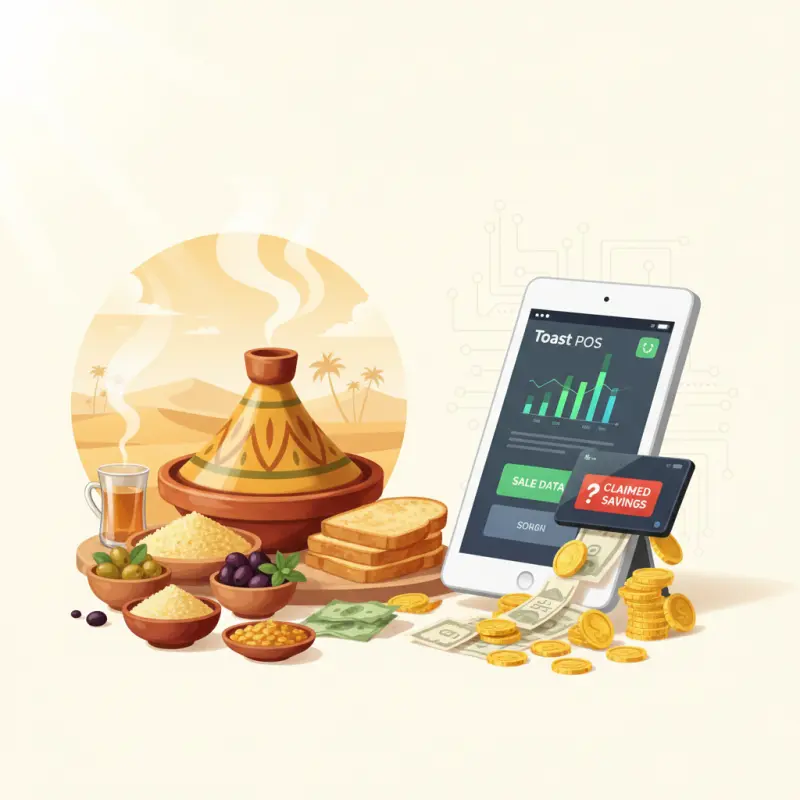
Restaurant owners in Casablanca pay an average of 12,000 MAD monthly for their Toast POS system for restaurant — far above the advertised "$0/month" pricing. The gap between marketing promises and actual costs reveals why this American POS giant might not fit Moroccan restaurants.
The Real Cost of Toast POS — Beyond the Marketing Numbers
Toast advertises "$0/month" starter plans, but no restaurant runs on the starter plan. The real monthly cost for a typical 100-seat restaurant in Morocco ranges from 8,000 to 15,000 MAD once you factor in the complete picture.
Processing Fees That Add Up Fast
Toast charges 2.49% + $0.15 per transaction for card-present payments. For a restaurant processing 500,000 MAD monthly, that's 12,450 MAD in fees alone. Online orders through Toast? Add another 0.5% on top. These rates apply even if you already have better rates with your local bank.
The pos toast pricing structure locks you into their payment processing. You cannot use your existing merchant account or negotiate better rates with local providers. For comparison, independent processors in Morocco offer rates starting at 1.5% for established businesses.
Required vs Optional Add-Ons Reality Check
The base Toast system lacks features most restaurants consider essential. Online ordering costs an extra $50/month. Gift cards? Another $50. Loyalty programs? $75. Email marketing? $150. These "optional" add-ons become mandatory for competitive operations.
| Toast Feature | Monthly Cost (USD) | Actually Optional? |
|---|---|---|
| Online Ordering | $50 | No — essential post-2020 |
| Gift Cards | $50 | Maybe — depends on clientele |
| Loyalty Program | $75 | No — drives repeat business |
| Marketing Suite | $150 | No — needed for campaigns |
| Advanced Reporting | $200 | No — required for multi-location |
Contract Terms Most Reviews Skip
Toast requires two-year contracts with automatic renewal clauses. Early termination fees can reach $5,000. Hardware leases run separately — tablets cost $799 each, not the "$0 hardware" advertised. You're also responsible for installation, which Toast outsources to third parties charging 5,000-10,000 MAD.
Stack audit
What do you currently use?
Tick what you have. We’ll show what OCHI replaces or connects to.
Toast's Morocco Problem:
What Works and What Doesn't
Toast built their platform for American restaurants. This creates specific challenges for Moroccan operators that most reviews never mention.
Local Payment Integration Challenges
Toast doesn't integrate with CMI or local Moroccan payment processors. You're forced to use their USD-based processing, creating currency conversion fees on every transaction. For a restaurant in Agadir processing 500,000 MAD monthly, exchange rate fluctuations add 2-3% in hidden costs.
Cash handling — still 60% of transactions in Morocco — requires manual entry. The system lacks dirham-specific cash drawer reconciliation, forcing staff to convert amounts mentally or maintain separate spreadsheets.
Customer Support Hours vs Morocco Time Zones
Toast pos company operates on Eastern Standard Time. Their phone support runs 8 AM to midnight EST — that's 1 PM to 5 AM Morocco time. During your dinner rush, you're on your own. Email support promises 24-hour response times but averages 36 hours for international tickets.
The knowledge base assumes American restaurant operations. Searching for help with Moroccan tax requirements or local regulations returns zero results. Community forums focus on US-specific issues like tip pooling laws that don't apply here.
Multi-Language Menu Limitations
Toast supports Spanish and French, but the implementation breaks with Arabic. Right-to-left text displays incorrectly on customer-facing screens. Mixed Arabic-French menus — standard in Marrakech — require workarounds that confuse staff and slow service.
Menu translation happens at the item level, not dynamically. Running a trilingual menu means manually entering each dish three times. Updates require changing all three versions separately. Most Moroccan restaurants need better language handling than this.
The Features That Actually Matter for Independent Restaurants
Toast offers 50+ features, but only five drive real revenue for independent restaurants. Here's honest assessment of the tools that matter.
Kitchen Display System Performance Under Pressure
Toast's KDS handles rush periods well — when it works. The system requires stable internet, which isn't guaranteed in many Moroccan locations. Offline mode exists but disables critical features like order routing and timing coordination.
Screen layouts work for American-style kitchens with defined stations. Moroccan kitchens often operate differently, with overlapping responsibilities that Toast's rigid station model doesn't accommodate. Customizing workflows requires enterprise-tier pricing.
Online Ordering Without Commission Drain
Toast charges $50/month for online ordering plus 2.99% per transaction — essentially charging commission on your own orders. For a restaurant doing 100 online orders daily at 150 MAD average, that's 13,500 MAD monthly in fees for orders from your own customers.
The online ordering creates generic subdomains like "restaurant.toasttab.com" rather than your own branded domain. Customers associate their experience with Toast, not your restaurant. SEO benefits flow to Toast's domain, not yours.
Staff Management That Scales
Scheduling works well for standard shifts. Toast handles time tracking, tip distribution, and basic permissions effectively. However, the system assumes American employment law. Features like overtime calculation and break tracking don't align with Moroccan labor regulations.
Role permissions lack granularity. You cannot create custom roles matching your actual positions. A sous chef might need inventory access but not pricing — Toast doesn't support this. You choose between over-permissioning or under-permissioning staff.
Why Toast Pos Company Struggles with Small Moroccan Restaurants
Toast optimized their platform for Chipotle and P.F. Chang's, not independent tagine restaurants in Rabat. The evidence shows in every product decision.
Minimum Volume Requirements Hidden in Fine Print
Toast's pricing tiers assume American transaction volumes. Processing under $30,000 monthly triggers higher rates and reduced support. Many Moroccan restaurants operate profitably below this threshold but face penalties in the Toast ecosystem.
Hardware pricing jumps dramatically for low-volume merchants. The same terminal costs 30% more if you process under 200 transactions monthly. Toast waives fees for high-volume chains while penalizing smaller operators.
Cultural Menu Customization Gaps
Moroccan dining involves shared plates, multiple courses, and complex modifications. Toast's modifier system caps at three levels — insufficient for dishes like couscous with its numerous accompaniment choices. The billing petpooja approach of other systems handles this better through flexible modification trees.
Prayer time adjustments, Ramadan scheduling, and Friday prayer breaks require manual workarounds. Toast's American-centric calendar doesn't recognize Islamic holidays or adjust automatically for cultural dining patterns.
Local Delivery Integration Missing Pieces
Toast integrates with DoorDash and Uber Eats — neither operating in Morocco. Local delivery coordination happens manually or through expensive third-party middleware. You're paying for delivery features you cannot use while missing integrations you need.
Zone-based pricing, critical for Moroccan delivery, requires enterprise features. The standard petpooja billing handles radius and polygon zones natively, while Toast treats this as an advanced add-on costing hundreds more monthly.
The Zero-Commission Alternative:
OCHI's Moroccan-Built Solution
OCHI built every feature specifically for Moroccan restaurants. Zero commission. Zero subscription fees. Your revenue stays yours.
Real Numbers: 500 Orders Per Month Cost Breakdown
| Cost Category | Toast POS | OCHI Platform |
|---|---|---|
| Monthly Software | $325 (with essentials) | 0 MAD |
| Payment Processing | 2.99% + fees | Your bank's rate |
| Online Order Commission | 2.99% | 0% |
| 500 Orders @ 150 MAD | 2,243 MAD fees | 0 MAD fees |
| Total Monthly Cost | 5,493 MAD | 0 MAD |
Features Toast Charges Extra For That OCHI Includes
Every OCHI restaurant gets online ordering, QR table ordering, loyalty programs, email marketing, and advanced analytics at zero cost. Multi-branch support? Included. API access? Included. The features Toast bundles into enterprise tiers come standard.
OCHI's Kitchen Display System works offline. Orders queue locally and sync when connection returns. Delivery zones support both radius and polygon mapping. Multi-language menus handle Arabic, French, and English simultaneously with proper RTL support.
Why {votrenom}.ochi.ma Beats Generic Subdomains
Your OCHI subdomain — like votrenom.ochi.ma — builds your brand, not ours. Customers remember your restaurant name. Search engines index your content. Marketing drives traffic to your property.
Compare this to Toast's generic URLs that dilute your brand. When customers share links or bookmark pages, they're promoting your restaurant with OCHI's clean, professional domains — not sending traffic to a corporate platform.
Ready to keep 100% of your restaurant revenue? Set up your branded ordering system at ochi.ma/partners
The toast pos system for restaurant works well for large American chains with dedicated IT staff and high volumes. For independent Moroccan restaurants, the hidden costs and cultural mismatches often outweigh the benefits. Choose technology built for your market, not adapted from another continent.
Frequently Asked Questions
What does Toast POS system actually cost restaurants in Morocco?
Restaurant owners in Morocco pay 8,000 to 15,000 MAD monthly for Toast POS once you include processing fees, required add-ons, and hardware costs. The advertised $0/month starter plan lacks essential features like online ordering, loyalty programs, and gift cards.
Can I use my existing payment processor with Toast POS?
No, Toast requires you to use their payment processing exclusively. You cannot integrate with CMI or local Moroccan processors, and you'll face currency conversion fees since Toast processes in USD.
What are Toast POS processing fees for card payments?
Toast charges 2.49% plus $0.15 per card-present transaction. For online orders, they add another 0.5% on top. A restaurant processing 500,000 MAD monthly pays approximately 12,450 MAD in processing fees alone.
Does Toast POS require long-term contracts?
Yes, Toast requires two-year contracts with automatic renewal clauses. Early termination fees can reach $5,000, and hardware leases run separately from software subscriptions.
Is Toast customer support available during Morocco business hours?
Toast operates on Eastern Standard Time with phone support from 1 PM to 5 AM Morocco time. This creates significant challenges for Moroccan restaurants needing real-time technical support during peak hours.
Restaurant owners · Weekly
The guide to running a restaurant in 2026.
One article per week. No commission advice. Just honest operational insight for Moroccan restaurants.

Blog Manager
Comments
No comments yet. Be the first to share your thoughts.