AI Overview
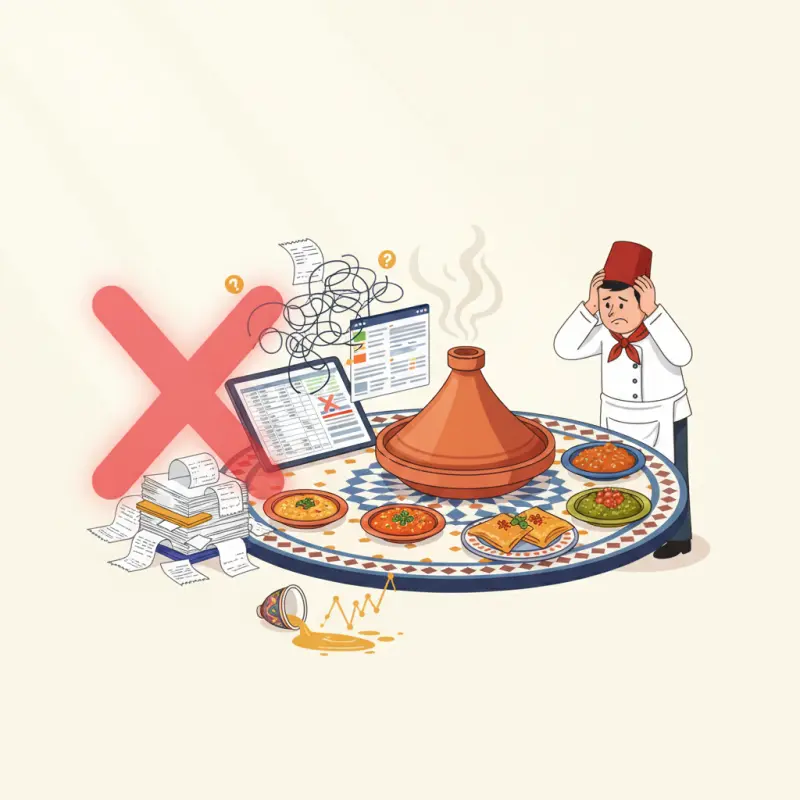
Xero for restaurants wasn't designed for Moroccan restaurant operations and creates more problems than it solves. Standard international restaurant accounting software like Xero assumes Western business practices — credit card transactions, formal receipts, and simplified tax structures. Moroccan restaurants operate differently. They handle cash purchases at markets like Derb Ghallef, provide staff advances without formal documentation, and must comply with Direction Générale des Impôts requirements for monthly VAT declarations at 20% and bilingual tax filings. These daily realities don't fit Xero's templates. Restaurant owners in cities like Casablanca spend two to three hours daily reconciling finances across multiple platforms, cash transactions, and informal payments. Choose accounting software built specifically for Moroccan restaurant operations and tax compliance requirements instead.
Table of Contents
The Daily Accounting Reality Most Restaurant Owners Face in Casablanca
Ahmed owns a popular seafood restaurant near the Corniche in Casablanca. Every morning at 6am, before the fish market opens, he's hunched over yesterday's receipts with a calculator and three different notebooks. Sound familiar?
Most restaurant owners in Morocco spend two to three hours daily on financial reconciliation. Not because they want to — because they have to. The reality of restaurant operations here doesn't match the assumptions built into international software like Xero for restaurants.
Morning Reconciliation Chaos
Your cash register shows 18,740 MAD in sales. Your bank deposit slip reads 12,300 MAD. The delivery platforms owe you 6,440 MAD — but that's before their 30% commission cut. Now add the 2,000 MAD you paid cash to the vegetable supplier at Derb Ghallef market this morning. No receipt, just a handwritten note.
This is before you account for the staff meal you provided (300 MAD in food cost), the 500 MAD advance Khalid needed for his mother's medicine, and the 1,000 MAD you took from the register for your daughter's school fees. Standard restaurant accounting software treats these as exceptions. In Morocco, they're the rule.
Moroccan Tax Compliance Isn't Optional
The Direction Générale des Impôts doesn't care that your receipts are scattered across WhatsApp photos and crumpled papers. You need monthly VAT declarations at the standard 20% rate. Annual corporate tax filings require documentation in both Arabic and French. Miss a deadline? The penalties start at 500 MAD and climb fast.
International restaurant bookkeeping software assumes you're operating in London or New York. The Moroccan tax code has different rules, different forms, different timelines. Your accountant needs specific reports that Xero's restaurant templates don't provide.
Platform comparison
Where does your money really go?
| Commission | 27% | 25% | 30% | 0% |
| Customer data | They own it | They own it | They own it | You own it |
| Your branding | Theirs | Theirs | Theirs | Yours |
| Payout cadence | Biweekly | Weekly | Biweekly | Weekly |
| Setup cost | Free | Free | Free | Paid |
Why Standard Restaurant Accounting Software Falls Short for Moroccan Operations
Here's what the software sales teams won't tell you: most restaurant accounting software was designed for markets where 80% of transactions happen via credit card. In Morocco, cash represents 60-70% of restaurant sales. That fundamental mismatch creates cascading problems.
The Integration Problem
Software restaurant accounting platforms promise seamless bank feeds and automatic reconciliation. Try setting that up with Attijariwafa Bank or BMCE. The integration either doesn't exist or requires manual CSV uploads that defeat the purpose of automation.
Your POS system speaks one language. Your accounting software speaks another. Your delivery platforms speak a third. Getting them to communicate requires either expensive middleware or hours of manual data entry. Most restaurant owners in Agadir or Marrakech end up maintaining parallel systems — one for operations, another for accounting.
Cost Reality Check
| Software | Monthly Cost (USD) | Monthly Cost (MAD) | Hidden Costs |
|---|---|---|---|
| Xero | $13-78 | 130-780 | Bank feed setup: 2,000 MAD Training: 5,000 MAD Data migration: 10,000 MAD |
| QuickBooks | $15-180 | 150-1,800 | Local support: Not available Custom reports: 3,000 MAD Multi-currency: Extra $10/month |
The advertised price is just the beginning. Factor in accountant training (most learned on Sage), custom report development for Moroccan compliance, and the inevitable consultant fees when something breaks. A "130 MAD" solution quickly becomes a 3,000 MAD monthly expense.
What Restaurant Bookkeeping Software Actually Needs to Track
Forget the generic profit-and-loss statements. Moroccan restaurant operations generate specific data points that determine survival or closure within six months.
Daily Financial Reconciliation
Your accounting system must track four separate cash flows simultaneously. First, POS sales versus physical cash count — the difference reveals theft or errors. Second, delivery platform settlements arrive 7-14 days after the order, minus commissions that vary by platform and promotional period.
Third, supplier invoices split between official receipts (for VAT reclaim) and informal cash transactions (reality of local markets). Fourth, staff financial interactions: advance salary payments, tip distributions, meal deductions. Accounting software for bars adds another layer with inventory shrinkage and pour cost tracking.
Weekly Inventory Accounting
Food cost percentage means nothing without context. A 35% cost on tagines might be profitable while 25% on beverages signals theft. Your restaurant bookkeeping software needs category-specific tracking: proteins, produce, dry goods, beverages, disposables.
Waste tracking reveals operational efficiency. Are you throwing away 200 MAD of bread daily because portion control failed? Is seafood spoilage climbing because the freezer temperature fluctuates? These metrics matter more than abstract financial ratios.
How OCHI Eliminates Accounting Software Complexity
Rather than adding another software layer, OCHI becomes your financial foundation. Every transaction, every payment, every cost flows through one system designed for Moroccan restaurant reality.
Automated Financial Reports
At midnight, OCHI generates your daily sales summary. Not a generic report — a detailed breakdown by payment method, order type, time period. Cash sales separate from card transactions. Dine-in distinct from delivery. The Excel export formats perfectly for your accountant's existing workflow.
No commissions distort your numbers. What customers pay is what you receive. This simplifies reconciliation from hours to minutes. Your delivery revenue matches your bank deposits. No mental math subtracting platform fees.
Real Integration That Works
OCHI's inventory tracking connects directly to your sales data. Sell 50 fish tagines today? The system deducts ingredients automatically, updating your food cost in real-time. Staff clock-in data exports to whatever payroll system your accountant prefers — no complex API setups required.
Multi-branch operators see consolidated reports across locations. The Gueliz branch underperforming compared to Hivernage? The data tells you why: higher food costs, lower average tickets, or operational inefficiencies.
The Smart Setup: OCHI + Simple Accounting
Yasmine runs two Lebanese restaurants in Marrakech. She tried QuickBooks for six months before admitting defeat. Her current setup took three months to optimize but now runs itself.
Month One: Foundation
OCHI handles every customer transaction, every inventory movement, every staff interaction. Yasmine maintains one Google Sheet for supplier invoices — vendor name, amount, VAT status, payment date. Every Monday, she exports OCHI's weekly reports and emails them to her accountant with the supplier spreadsheet.
Total time investment: 30 minutes weekly. Her accountant receives clean, organized data instead of shoe boxes full of receipts. VAT filings that once took two days now require two hours.
Month Three: Optimization
Daily reconciliation happens automatically. OCHI's morning snapshot shows yesterday's sales, payment breakdowns, and cash position. Inventory costs update live as deliveries arrive and sales process. The system flags when food cost percentage exceeds her 32% target.
Tax season becomes manageable. Every transaction has an audit trail. Every payment links to an order. Every cost tracks to revenue. Her accountant sends one message: "Everything looks perfect. Filing done."
The restaurants that survive in Morocco aren't necessarily the ones with the best food. They're the ones with the clearest financial picture. OCHI provides that clarity without the complexity of traditional restaurant accounting software. Set up your complete restaurant management system at votrenom.ochi.ma — no commissions, no hidden fees, just the data you need for smart financial decisions.
Frequently Asked Questions
Can Xero for restaurants handle Moroccan tax compliance?
No. Xero doesn't generate the specific VAT reports required by the Direction Générale des Impôts or support bilingual Arabic-French documentation required for Moroccan corporate tax filings.
Why doesn't Xero work well for restaurants in Morocco?
Xero assumes Western business practices with formal receipts and credit transactions. Moroccan restaurants rely heavily on cash operations, market purchases without receipts, and staff advances that don't fit Xero's structure.
What are the main accounting challenges for restaurants in Morocco?
Daily reconciliation across cash sales, delivery platform commissions, market purchases, staff advances, and tax compliance with monthly VAT declarations at 20% rate plus annual bilingual corporate filings.
How much time do Moroccan restaurant owners spend on daily accounting?
Most restaurant owners in Morocco spend two to three hours daily on financial reconciliation due to mixed cash-digital operations and complex platform integrations.
What happens if restaurants miss tax deadlines in Morocco?
The Direction Générale des Impôts imposes penalties starting at 500 MAD for missed deadlines, with amounts increasing for continued non-compliance.
Restaurant owners · Weekly
The guide to running a restaurant in 2026.
One article per week. No commission advice. Just honest operational insight for Moroccan restaurants.

Blog Manager
Comments
No comments yet. Be the first to share your thoughts.