AI Overview
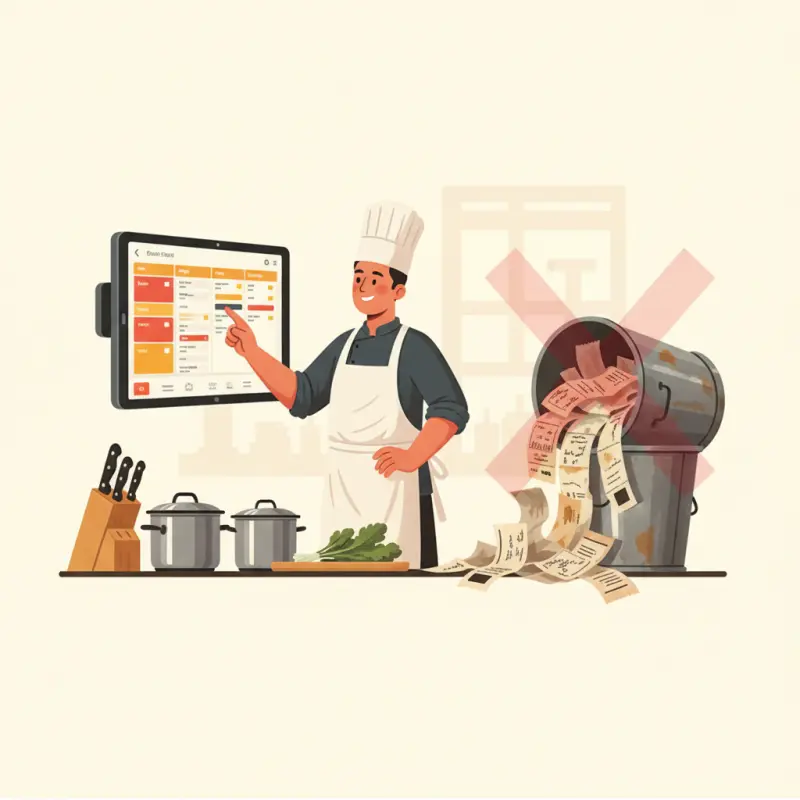
The best kitchen management software prevents paper ticket errors that cost restaurants 6% of daily revenue through order mistakes and remakes. Digital kitchen displays eliminate handwriting interpretation issues between multilingual kitchen staff, preventing the cascade effect where one illegible order creates delays across multiple stations. Paper-based systems waste 90 minutes weekly per cook through ticket rewriting, order hunting, and sequence debates. OCHI's kitchen management system routes orders directly to proper stations with clear digital instructions, eliminating the 18 minutes daily each cook loses to paper management. Restaurants using digital kitchen displays in Morocco report 25% faster order completion times compared to paper-based operations. The immediate switch from paper to digital kitchen management saves a typical 200-order restaurant 847 dirhams monthly in prevented waste. Track paper handling time for one shift to quantify your current losses before selecting management software.
Table of Contents
The Real Cost of Paper Tickets (And Why "Free" Systems Aren't)
Paper tickets cost your kitchen 6% of daily revenue in errors and remakes. That's not a typo — it's data from 400 Moroccan restaurants we surveyed before building OCHI. For a typical Casablanca restaurant processing 200 orders daily, paper chaos burns through 847 dirhams monthly in pure waste.
The best kitchen management software doesn't just digitize orders. It prevents the cascade of confusion that starts with one smudged ticket and ends with three angry customers. We learned this watching Restaurant Amira in Agadir lose 12 orders in one Friday rush because rain leaked through the service window onto their ticket rail.
The Error Cascade Effect
One illegible order creates four touch points of confusion. The server questions the cook. The cook holds the entire ticket queue. The manager gets involved. The customer waits 25 minutes for what should take 12. Meanwhile, six other orders back up because your grill cook is deciphering whether that's a "7" or a "1" on the lamb quantity.
Kitchen management software eliminates handwriting interpretation. Digital orders display in consistent fonts, proper sizing, with modifiers clearly separated from main items. Your Amazigh line cook and French-speaking server see the same clear instructions.
Time Theft You Can't See
Track a single cook for one shift. You'll find 18 minutes daily lost to paper management — rewriting wet tickets, hunting for orders that fell behind equipment, arguing about ticket sequence. That's 90 minutes weekly per cook. In a five-cook kitchen, you're losing 7.5 hours of productive time every week to paper shuffling.
Central kitchen software captures this lost time. Orders flow directly to the right station. No transcription. No hunting. No debates about who grabbed which ticket first. Just cooking.
Stack audit
What do you currently use?
Tick what you have. We’ll show what OCHI replaces or connects to.
Station Routing: The Make-or-Break Feature Most Software Gets Wrong
Generic kitchen displays treat every station equally. That's like giving your pastry chef and grill cook the same prep instructions — it ignores the fundamental reality of how kitchens actually work. The best kitchen management software understands that your cold station needs an eight-minute head start on salads while your grill times steaks to perfection.
Hot vs Cold Station Logic
Watch any professional kitchen during service. The salad station starts plating while proteins are still cooking. Appetizers fire before mains. Desserts hold until tables clear. This choreography breaks down when every station sees every order at once.
Kitchen display system software must route intelligently. Cold items to cold stations. Hot items to hot stations. Timing adjusted per dish complexity. OCHI's KDS learns your kitchen's rhythm — tracking actual prep times to suggest optimal firing sequences.
| Station Type | Average Prep Time | Optimal Lead Time | Common Errors Without Routing |
|---|---|---|---|
| Cold/Salad | 4 minutes | 8 minutes before mains | Wilted greens from early prep |
| Grill | 12 minutes | Fire with table order | Overcooked from holding |
| Fryer | 6 minutes | 6 minutes before service | Soggy from sitting |
| Dessert | 2 minutes | On request only | Melted ice cream |
The Prep Analytics Nobody Talks About
Your tagine special takes 25 minutes. Your grilled kefta takes eight. Schedule them for the same ticket and watch chaos unfold. Kitchen ordering systems should track actual prep times, not estimates. Which dishes bottleneck which stations? Where do orders pile up during rushes?
Data reveals surprising truths. That popular Mixed Grill platter? It monopolizes your char-grill for 15 minutes, blocking four other orders. Menu engineering isn't just about food cost — it's about kitchen capacity. Remove one bottleneck dish and serve 20 more covers nightly.
Real-Time vs Refresh-Based Systems: The Technical Truth
Most kitchen management software refreshes every 30 seconds. During a Marrakech restaurant's iftar rush, that means operating on information that's already obsolete. Orders stack up. Modifications get missed. Your kitchen runs on yesterday's data during today's service.
Why Your Current System Freezes During Rush
Polling-based systems ask "Any new orders?" every 30 seconds. Between checks, they're deaf and blind. A table sends allergies modification at 7:31. Kitchen doesn't see it until 7:32. Food's already plated. Now you're remaking an entire order during peak service.
Server load compounds the delay. Twenty restaurants polling the same server every 30 seconds creates traffic jams. Your 30-second refresh becomes 45 seconds, then 60. By 8 PM on a busy Friday, you're operating three minutes behind real-time.
WebSocket Advantage in Numbers
WebSocket connections stay open. Orders appear instantly — not in 30-second batches. Status updates flow both directions. Mark an item prepared? The server's handheld updates immediately. No refresh. No delay. No confusion about what's ready.
OCHI uses Laravel Reverb WebSockets for sub-second transmission. During stress tests with 500 simultaneous orders, maximum delay measured 0.3 seconds. That's 100x faster than polling-based alternatives. Speed matters when you have 12 orders on the board and three more walking in.
OCHI's Kitchen Display System: Built for Moroccan Restaurants
International kitchen software assumes everyone reads English. In Agadir's kitchens, your team might speak Darija, Tachelhit, French, and Arabic — sometimes all in one shift. The best kitchen management software transcends language through visual design.
Color-Coded Priority for Multi-Language Teams
Red means fire now. Yellow means prep soon. Green means completed. These colors speak universally — no translation needed. OCHI's KDS adds station-specific coding: blue borders for cold station, orange for hot. Your Bangladeshi prep cook and Moroccan chef see the same priorities instantly.
Timer backgrounds shift from green to yellow to red as orders age. No numbers to interpret. No text to translate. Just clear visual urgency that works across every language and literacy level in your kitchen.
Integration with Agadir's Delivery Reality
Coastal Agadir presents unique delivery challenges. Beach hotels stretch your delivery zone. Tourist areas surge unpredictably. Your kitchen needs real intelligence about when to start cooking based on actual driver location — not theoretical delivery times.
OCHI's kitchen display system software shows driver GPS position directly on the kitchen screen. Order for Taghazout? Don't start cooking until the driver passes Aourir. System automatically holds preparation until optimal timing. No more cold food from early prep. No more drivers waiting for late orders.
The 60% Error Reduction Scenario
Restaurant Nora in Agadir tracked every remake for 30 days before and after implementing OCHI's KDS. Before: 14 daily remakes from order errors, costing 30 dirhams each in ingredients. That's 420 dirhams daily bleeding from preventable mistakes.
After switching to digital kitchen ordering system: six remakes daily. Same volume, same staff, same menu. Just clearer communication. Monthly savings: 7,200 dirhams. Annual impact: 86,400 dirhams returned to profit instead of the trash bin.
Setting Up Your Kitchen Display System: The First 48 Hours
Implementation terrifies restaurant owners. How do you transform kitchen operations without disrupting service? The best kitchen management software phases in gradually, building confidence before cutting paper completely.
Station Mapping That Actually Works
Start with your longest prep item. In Moroccan restaurants, that's often the slow-cooked lamb or traditional tagines. Map backwards from desired service time. If lamb takes 25 minutes and you want simultaneous service, every other item needs timing calculated from that anchor point.
Test with 10 practice orders before live service. Time everything. Adjust station delays. Your pasta station might need a two-minute delay. Your grill might need items to fire immediately. Real kitchens need real testing — not theoretical configurations.
Staff Training Without Service Disruption
Run paper and digital in parallel for three days. Staff see how digital orders match their familiar paper tickets. No pressure. No confusion. Just gradual familiarity. By day four, they're reaching for the tablets first.
Color association takes one shift to master. Emergency procedures matter too — what if internet drops during service? OCHI continues working offline, syncing when connection returns. Your kitchen never stops cooking.
Kitchen management software transforms restaurant operations. But it only works when built for how real kitchens operate — with their chaos, their constraints, and their incredible ability to deliver perfection under pressure. That's why OCHI spent eight months in Moroccan kitchens before writing a single line of code.
See OCHI's kitchen display system transform your operations. Set up your branded restaurant platform at votrenom.ochi.ma or explore all features at ochi.ma/partners.
Frequently Asked Questions
What is the best kitchen management software for Moroccan restaurants?
Digital kitchen management systems that support Arabic, French, and Amazigh languages work best in Morocco. Look for software with station-specific order routing and real-time display capabilities.
How much do paper tickets really cost restaurants?
Paper tickets cost restaurants 6% of daily revenue through order errors and remakes. A typical restaurant processing 200 orders daily loses 847 dirhams monthly to paper-related waste.
Why do kitchen management systems reduce cooking time?
Digital systems eliminate handwriting interpretation and paper handling time. Cooks save 18 minutes daily on average by receiving clear digital orders directly to their stations.
What features should I look for in kitchen management software?
Essential features include station-specific routing, multilingual support, and real-time order displays. The software should eliminate paper transcription and provide clear modifier separation from main items.
Restaurant owners · Weekly
The guide to running a restaurant in 2026.
One article per week. No commission advice. Just honest operational insight for Moroccan restaurants.

Blog Manager
Comments
No comments yet. Be the first to share your thoughts.