AI Overview
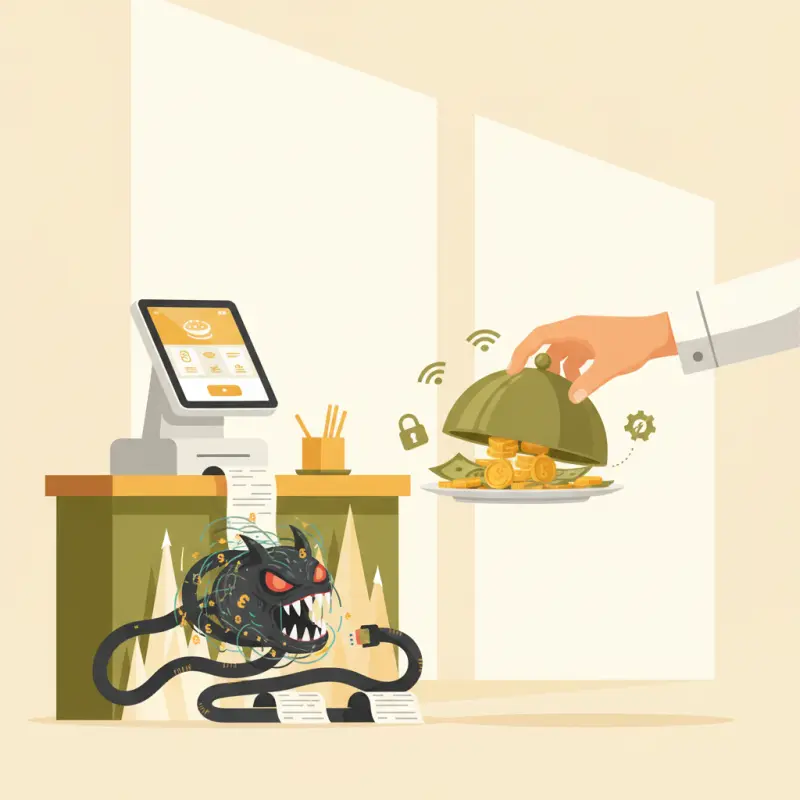
Restaurant EPOS systems typically cost three times their advertised price once you factor in hidden fees and mandatory add-ons. An EPOS system restaurant setup advertised at 500 MAD monthly becomes 1,200 MAD after adding payment processing, integrations, and support charges. Hardware requirements add another 18,500 MAD upfront for terminals, printers, and kitchen displays. Payment processing fees consume 2.8% of every transaction — costing a busy restaurant 72,800 MAD annually in Casablanca. Traditional providers like Square and Toast charge 100-500 MAD monthly for each third-party integration your restaurant needs. Commission-free platforms eliminate transaction fees entirely, letting restaurants keep 100% of their revenue while providing the same core functionality.
Table of Contents
Most restaurant owners discover their EPOS system's hidden costs after signing the contract. That £50 monthly fee becomes £250 once you add payment processing, support charges, and integration costs.
The Real Cost of Restaurant EPOS Systems Beyond the Sticker Price
Restaurant EPOS pricing follows a predictable pattern. The advertised price hooks you. The actual invoice shocks you. A typical EPOS system restaurant setup in Casablanca starts at 500 MAD monthly for basic features. Add payment processing at 2.8% per transaction. Tack on 200 MAD for each third-party integration. Include 150 MAD for priority support. Your "affordable" system now costs 1,200 MAD plus transaction fees.
The numbers get worse at scale. A restaurant processing 50,000 MAD weekly through card payments loses 1,400 MAD to processing fees alone. That's 72,800 MAD annually — enough to hire part-time staff or upgrade your kitchen equipment.
Hardware Requirements and Ongoing Costs
Traditional EPOS companies mandate specific hardware. A basic terminal costs 8,000 MAD. Add 3,000 MAD for a receipt printer. Include 2,500 MAD for a cash drawer. Factor in 5,000 MAD for a kitchen display screen. Your "cloud-based" system requires 18,500 MAD in hardware before processing a single order.
Hardware fails. Warranties expire. A restaurant in Marrakech recently spent 4,000 MAD replacing a two-year-old terminal that stopped reading cards. The manufacturer discontinued support for that model. The new terminal required a software upgrade, adding another 300 MAD monthly to their subscription.
Hidden Integration and Processing Fees
Modern restaurants need multiple systems talking to each other. Your EPOS must connect with delivery platforms, accounting software, and inventory management. Each integration costs extra. Billing petpooja style platforms charge 100-500 MAD per connection monthly. Need custom API access? That's another 1,000 MAD.
Payment processing remains the biggest hidden cost. Most EPOS providers partner with specific gateways, limiting your options. Their "competitive" 2.5% rate seems reasonable until you calculate the monthly damage. A busy restaurant in Agadir processing 300,000 MAD monthly loses 7,500 MAD to fees — 90,000 MAD yearly.
Platform comparison
Where does your money really go?
| Commission | 27% | 25% | 30% | 0% |
| Customer data | They own it | They own it | They own it | You own it |
| Your branding | Theirs | Theirs | Theirs | Yours |
| Payout cadence | Biweekly | Weekly | Biweekly | Weekly |
| Setup cost | Free | Free | Free | Paid |
Why Traditional EPOS Companies Follow the Same Broken Model
The EPOS industry profits from complexity. Toast POS company and similar providers bundle everything together, creating dependency rather than flexibility. You can't switch payment processors without changing your entire system. You can't export your data without paying extraction fees. You can't customize workflows without upgrading to enterprise tiers.
This isn't accidental. Vendor lock-in drives recurring revenue. The harder it becomes to leave, the more they can charge. Annual price increases of 10-15% are standard. Features that were included get moved to premium tiers. What starts as a partnership becomes a hostage situation.
The Subscription Trap
EPOS subscriptions follow telecommunications pricing. Low introductory rates. Automatic renewals. Price hikes after the honeymoon period. A restaurant owner in Rabat signed up for a "lifetime" 400 MAD monthly rate. Year two brought a 15% increase "due to infrastructure improvements." Year three added 20% for "enhanced security features" they never requested.
Feature limitations force constant upgrades. Basic plans cap monthly orders at 1,000. Growing restaurants hit limits and face ultimatums: upgrade or lose historical data. The petpooja billing model exemplifies this — affordable entry pricing that becomes expensive as you succeed.
Commission-Based Revenue Sharing
Some EPOS providers offer "free" systems funded by transaction commissions. Like traditional delivery platforms, they take 2-5% of every sale. A restaurant generating 500,000 MAD monthly gives away 10,000-25,000 MAD. That's 120,000-300,000 MAD annually — more than most subscription fees.
POS toast and similar systems blur the line between software provider and business partner. They profit when you process payments, incentivizing features that increase transaction volume over operational efficiency. Your success directly funds their growth.
EPOS System Restaurant Features:
What Actually Moves the Needle
Most EPOS features sound impressive but deliver minimal impact. AI-powered analytics mean nothing if your orders still get mixed up. Predictive inventory sounds futuristic until you realize it requires perfect data entry — something most restaurants struggle with daily.
Real operational improvements come from solving specific pain points. Order accuracy. Kitchen efficiency. Payment speed. Table turnover. Everything else is marketing noise.
Table Management and Order Flow
Manual order taking averages four minutes from greeting to kitchen ticket. Digital ordering through QR codes cuts this to 45 seconds. For a restaurant serving 200 covers nightly, that's 10.5 hours saved — equivalent to hiring an extra server.
| Order Method | Average Time | Error Rate | Customer Satisfaction |
|---|---|---|---|
| Manual (paper) | 4 minutes | 22% | 73% |
| Traditional EPOS | 2.5 minutes | 12% | 81% |
| QR + Digital KDS | 45 seconds | 5% | 92% |
Kitchen display systems improve accuracy from 78% with paper tickets to 95% digital. Fewer remakes. Happier customers. Lower food costs. A seafood restaurant in Agadir reduced remake costs by 8,000 MAD monthly after implementing digital kitchen displays.
Inventory and Cost Control
Real-time inventory tracking sounds obvious until you price it. Most EPOS systems charge extra for ingredient-level tracking. Recipe costing requires another upgrade. Supplier integration? Premium tier only.
Effective inventory management reduces waste by 15-20%. For a restaurant purchasing 150,000 MAD monthly in supplies, that's 22,500-30,000 MAD saved. Yet most systems make this basic feature prohibitively expensive, forcing restaurants to choose between profitability tools and affordable software.
The Morocco Restaurant Reality:
Why International Solutions Don't Fit
International EPOS systems assume American or European operating conditions. They prioritize card payments in a cash-heavy market. They default to English in a French/Arabic environment. They calculate taxes for systems that don't match Moroccan requirements.
Local Payment and Language Requirements
Cash represents 60% of restaurant transactions in Morocco. International EPOS systems treat cash as an afterthought, focusing on digital payments and complex reconciliation. Local restaurants need robust cash management, shift reports in Arabic, and receipts that comply with tax requirements.
Language switching must be seamless. A waiter taking orders in Arabic needs to send kitchen tickets in French for the Francophone chef. The cashier prints receipts in the customer's preferred language. International systems offer translation as an add-on, not a core feature.
Staffing and Training Considerations
Moroccan restaurants face 40% annual staff turnover. Complex EPOS systems requiring week-long training don't match this reality. New servers need to be productive within hours, not days.
Support matters more in emerging markets. When your EPOS crashes during Friday dinner rush in Fès, you need local support that understands your situation. International providers offer email tickets and callback queues. Local restaurants need immediate assistance in their language.
Zero-Commission Alternative: The OCHI Approach
OCHI eliminates the traditional EPOS system restaurant cost structure. Zero commission on orders. Zero subscription fees. Zero hidden charges. Restaurants keep 100% of their revenue while accessing professional tools that actually work for Moroccan operations.
Total Cost Comparison
Traditional EPOS total cost for a 100-order-per-day restaurant: 1,200 MAD base subscription + 600 MAD integrations + 3,500 MAD processing fees = 5,300 MAD monthly. Annual cost: 63,600 MAD minimum.
OCHI total cost for the same restaurant: Zero. Your branded subdomain (votrenom.ochi.ma) includes POS, kitchen displays, inventory tracking, delivery management, and customer loyalty programs. No setup fees. No transaction charges. No monthly bills.
Feature Parity Without the Lock-In
OCHI matches traditional EPOS features while eliminating vendor dependence. Export your data anytime. Integrate with any service through open APIs. Switch payment processors without changing systems. Your business, your choices.
The integrated approach means one login for everything. POS for counter service. QR ordering for dine-in. Online ordering through your subdomain. Delivery tracking for takeout. Inventory management with recipe costing. Staff scheduling with role management. All included, all free from commissions.
Traditional EPOS providers profit from your dependency. OCHI profits when restaurants succeed and expand to new locations. The alignment matters — your growth drives our growth, not your transaction fees.
See how OCHI transforms restaurant operations at ochi.ma/partners. Browse our blog for more insights on running a profitable restaurant in Morocco.
Frequently Asked Questions
What are the hidden costs of restaurant EPOS systems?
Hidden costs include payment processing fees (2.8% per transaction), integration charges (100-500 MAD per connection), priority support fees (150 MAD monthly), and mandatory hardware purchases (18,500 MAD minimum).
How much do EPOS system restaurants pay in processing fees?
A restaurant processing 50,000 MAD weekly through card payments loses 1,400 MAD to processing fees alone, totaling 72,800 MAD annually.
Do I need to buy specific hardware for my restaurant EPOS?
Traditional EPOS providers mandate specific hardware costing 18,500 MAD minimum for basic setup. This includes terminals, receipt printers, cash drawers, and kitchen display screens.
How much do EPOS integrations cost for restaurants?
Most EPOS providers charge 100-500 MAD monthly for each third-party integration. Custom API access typically adds another 1,000 MAD to your monthly bill.
Are there commission-free alternatives to traditional EPOS systems?
Yes, zero-commission platforms eliminate transaction fees entirely while providing POS functionality, online ordering, and delivery management in one dashboard.
Restaurant owners · Weekly
The guide to running a restaurant in 2026.
One article per week. No commission advice. Just honest operational insight for Moroccan restaurants.

Blog Manager
Comments
No comments yet. Be the first to share your thoughts.