AI Overview
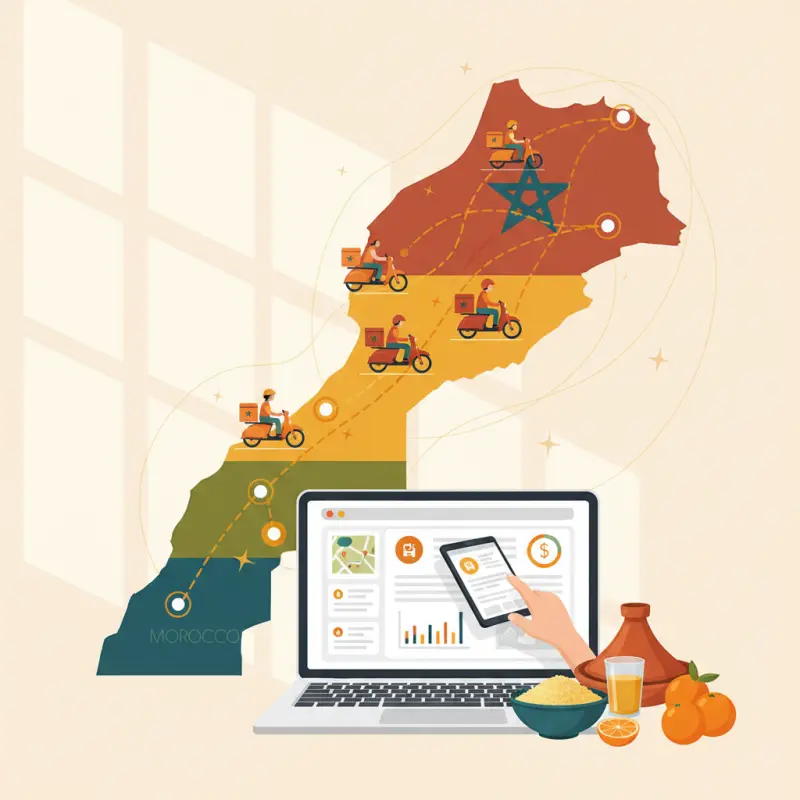
Effective food delivery fleet management starts with zone optimization rather than driver management or vehicle selection. Most Casablanca restaurants lose 15-20% on delivery orders because they use simple radius zones instead of polygon zones that follow actual street patterns and traffic flows. Restaurant Beldi in Maarif discovered their 4.8km deliveries to Ain Diab took 45 minutes during traffic while 2km Gauthier orders took 12 minutes — same flat 25 MAD price but vastly different operational costs. Polygon zones achieve 85-95% accuracy compared to 60-70% for radius zones by accounting for real delivery times rather than straight-line distances. Modern delivery management platforms like OCHI provide zone builders with real-time delivery estimates as you adjust boundaries. Start by mapping your actual delivery times for different neighborhoods, then create polygon zones that group areas with similar delivery costs and times.
Table of Contents
Most Casablanca restaurants lose 15-20% on every delivery order — not from food costs, but from poor food delivery fleet management. The problem isn't the drivers or the distances. It's the setup decisions made on day one.
Restaurant owners typically draw a circle on a map, add 30 MAD for delivery, and hope for the best. Six months later, they're bleeding money on long-distance orders while nearby customers complain about late deliveries. This guide shows you the math, the tools, and the exact setup that profitable restaurants use.
The Zone Setup Decision That Makes or Breaks Your Delivery Business
Your delivery zone determines everything: pricing, driver efficiency, customer satisfaction, and ultimately profit. Most restaurants guess. The successful ones calculate.
Take Restaurant Beldi in Casablanca's Maarif district. They started with a 5-kilometer radius zone charging flat 25 MAD delivery. After three months, they discovered orders to Ain Diab (4.8 km) took 45 minutes during traffic while Gauthier orders (2 km) took 12 minutes. Same price, vastly different costs.
Polygon vs. Radius Zones: The Hidden Cost Difference
Radius zones seem simple: draw a circle, done. But Casablanca isn't a perfect circle. Traffic patterns, bridges, and one-way streets create real delivery times that ignore your neat radius.
Polygon zones follow actual streets and neighborhoods. You draw boundaries based on real delivery times, not straight-line distances. A polygon zone might extend 7 km along Boulevard Zerktouni but only 3 km into the congested medina.
| Zone Type | Setup Time | Accuracy | Best For |
|---|---|---|---|
| Radius | 5 minutes | 60-70% | Rural areas, new restaurants testing |
| Polygon | 30 minutes | 85-95% | Urban areas, established routes |
Modern food delivery management software lets you draw polygons in minutes. OCHI's zone builder shows real-time delivery estimates as you adjust boundaries, turning guesswork into data-driven decisions.
Delivery Pricing Models That Actually Work in Morocco
Three pricing models dominate Moroccan restaurant delivery. Each serves different business models:
Flat rate: Simple 20-30 MAD everywhere. Works for dense urban areas where most deliveries stay under 3 km. Restaurant Milano in Agadir uses 25 MAD flat rate within Marina district — 90% of orders arrive within 20 minutes.
Distance-based: 15 MAD base + 5 MAD per kilometer. Fairest for customers, complex for operations. Requires precise zone setup and clear communication. Best for restaurants with wide delivery areas.
Zone-based: Different prices per neighborhood. Zone 1 (0-2 km): 20 MAD. Zone 2 (2-4 km): 30 MAD. Zone 3 (4-6 km): 40 MAD. Balances simplicity with fairness. Most Casablanca restaurants land here.
Driver Assignment Rules That Prevent Order Chaos
Manual driver assignment seems logical. Youssef knows Hay Hassani. Mohamed handles Ain Sebaa. Until Youssef calls in sick and nobody knows his routes.
Smart assignment rules in your restaurant delivery software handle reality: closest available driver, factor in current orders, respect zone preferences, balance order loads. The system assigns, managers override only when needed.
Food cost calculator
What’s your real margin?
Food cost
29.2%
Gross margin
70.8%
Profit / dish
85 MAD
Healthy · under 30%
Digitize your menu with OCHIWhy Auto-Assignment Beats Manual Driver Selection Every Time
Restaurant owners trust their gut over algorithms. "I know my drivers better than any computer," they say. Then they spend two hours daily on WhatsApp coordinating deliveries.
The True Cost of Manual Assignment (Real Numbers)
Restaurant Tagine Express in Marrakech tracked their manual assignment for one month. Results: 15 minutes daily on driver coordination, 3-4 assignment errors weekly, 20% longer average delivery times, one lost order per week from miscommunication.
Converting to auto-assignment through their online food ordering and delivery platform cut delivery times by 18% and eliminated assignment errors. The manager now spends those 15 minutes on customer service instead of logistics.
When Human Judgment Actually Matters
Auto-assignment handles 95% of decisions perfectly. Human override matters for: VIP customers with special instructions, large catering orders requiring experienced drivers, bad weather requiring local knowledge, and special events disrupting normal routes.
The key: let the system handle routine while managers focus on exceptions. OCHI's driver panel shows auto-assignments with one-tap override when needed.
Setting Up Smart Assignment Rules
Start simple: nearest available driver gets the order. Then add intelligence: maximum orders per driver (usually 2-3), zone preferences for experienced drivers, priority for time-sensitive orders, and automatic batching for nearby deliveries.
GPS Tracking: Beyond "Where's My Order?"
Customers expect tracking. But smart restaurants use GPS data for operations, not just customer satisfaction.
Real-Time Updates That Cut Support Calls by 60%
Pizza House Rabat implemented real-time tracking last year. Customer calls asking "Where's my order?" dropped from 40 daily to 15. Each call saved represents three minutes of staff time.
But the real value came from proactive communication. When GPS shows a driver stuck in traffic, the system sends automatic updates. Customers appreciate transparency more than speed.
Driver Performance Metrics That Matter
GPS tracking reveals patterns invisible to managers. Average speed per zone, time spent at delivery locations, route efficiency scores, and actual vs. estimated delivery times.
One Agadir restaurant discovered their fastest driver was actually their least efficient — he drove fast but took longer routes. Data beats assumptions every time.
Batch Delivery Optimization for Multiple Orders
Sending one driver with three orders sounds efficient until they deliver in the wrong sequence. Smart food ordering and delivery platform systems optimize multi-stop routes considering: pickup readiness times, delivery time windows, traffic patterns, and customer priority levels.
OCHI's batch delivery algorithm reduced average delivery times by 22% for restaurants handling multiple simultaneous orders.
The Commission Problem: Why Most Fleet Management Costs More Than You Think
Traditional platforms charge 25-30% commission plus delivery fees. A 200 MAD order yields 140 MAD to the restaurant. Now add your own delivery costs on top.
Hidden Costs in Traditional Delivery Platforms
Beyond commission: customer data stays with the platform, no control over delivery fees, surge pricing during peak hours, and marketing dependencies. You're renting access to customers, not building a business.
The Real ROI of Owning Your Fleet Management
Owning your delivery infrastructure means: keeping 100% of revenue, building direct customer relationships, controlling the entire experience, and accessing complete operational data.
| Cost Factor | Traditional Platform | Owned System |
|---|---|---|
| Commission on 10K MAD daily | 3,000 MAD | 0 MAD |
| Monthly platform fees | 0 MAD | 500-1,500 MAD |
| Net cost per month | 90,000 MAD | 1,500 MAD |
OCHI's Integrated Approach: One Dashboard, Zero Fees
OCHI combines ordering, delivery management, and operations in one platform. No commission on orders. Restaurants see every order, assign drivers, track deliveries, and keep all revenue. The same interface handles dine-in, takeaway, and delivery.
Visit ochi.ma/partners to see how integrated food delivery fleet management works without commission fees.
Setting Up Your First Delivery Zone in Casablanca: A Step-by-Step Walkthrough
Let's set up delivery for a restaurant in Casablanca's Bourgogne neighborhood. Real streets, real decisions, real numbers.
Zone Boundaries and Pricing Strategy
Start with your restaurant at Boulevard Rahal El Meskini. Draw your first zone covering immediate neighborhoods: Bourgogne, Val Fleuri, and Maârif. These areas share similar traffic patterns and represent 60% of potential orders.
Zone 1 (0-2.5 km): 20 MAD — covers dense residential areas with 15-minute average delivery. Zone 2 (2.5-4 km): 30 MAD — reaches Anfa and Gauthier, 25-minute average. Zone 3 (4-6 km): 40 MAD — extends to Ain Diab and Hay Hassani, 35-minute average.
Driver Scheduling and Peak Hour Management
Casablanca lunch rush hits 12:30-14:00. Dinner peaks 19:30-21:30. Schedule accordingly: two drivers for normal hours, four drivers during peaks, one dedicated to Zone 3 during peaks.
Use split shifts: drivers work lunch and dinner peaks, avoiding dead afternoon hours. This reduces labor costs while maintaining service levels.
Week One Metrics to Track
Your food delivery management software should track: average delivery time per zone, order volume per zone, driver utilization rates, and customer complaints per zone.
After one week, adjust. If Zone 2 averages 35 minutes instead of 25, either redraw boundaries or increase price. If drivers complete only 2-3 deliveries per hour, zones might be too large.
Smart food delivery fleet management isn't about complex algorithms or expensive consultants. It's about understanding your local market, setting up thoughtful zones, and using tools that give you control without taking your profits. Start with one zone, measure everything, and expand based on data, not dreams.
Ready to manage your delivery fleet without commission fees? Create your restaurant's branded ordering system at votrenom.ochi.ma.
Frequently Asked Questions
What is the difference between radius and polygon delivery zones?
Radius zones create circular delivery areas based on straight-line distance, while polygon zones follow actual street patterns and traffic conditions. Polygon zones achieve 85-95% delivery time accuracy compared to 60-70% for radius zones.
How much money do restaurants lose with poor delivery zone management?
Most Casablanca restaurants lose 15-20% on every delivery order due to inefficient zone setup. This happens when they use flat delivery pricing across areas with vastly different delivery times and operational costs.
Which delivery zone type works best for urban restaurants in Morocco?
Polygon zones work best for urban areas because they account for traffic patterns, bridges, and one-way streets that affect actual delivery times. Urban restaurants should avoid simple radius zones that ignore real street conditions.
How long does it take to set up proper delivery zones?
Radius zones take about 5 minutes to set up but lack accuracy. Polygon zones require 30 minutes of setup time but provide 85-95% accuracy by mapping real delivery routes and times.
What tools help restaurants optimize their delivery fleet management?
Modern delivery management platforms provide zone builders with real-time delivery estimates, allowing restaurants to create data-driven polygon zones instead of guessing with simple radius circles.
Restaurant owners · Weekly
The guide to running a restaurant in 2026.
One article per week. No commission advice. Just honest operational insight for Moroccan restaurants.

Blog Manager
Comments
No comments yet. Be the first to share your thoughts.