AI Overview
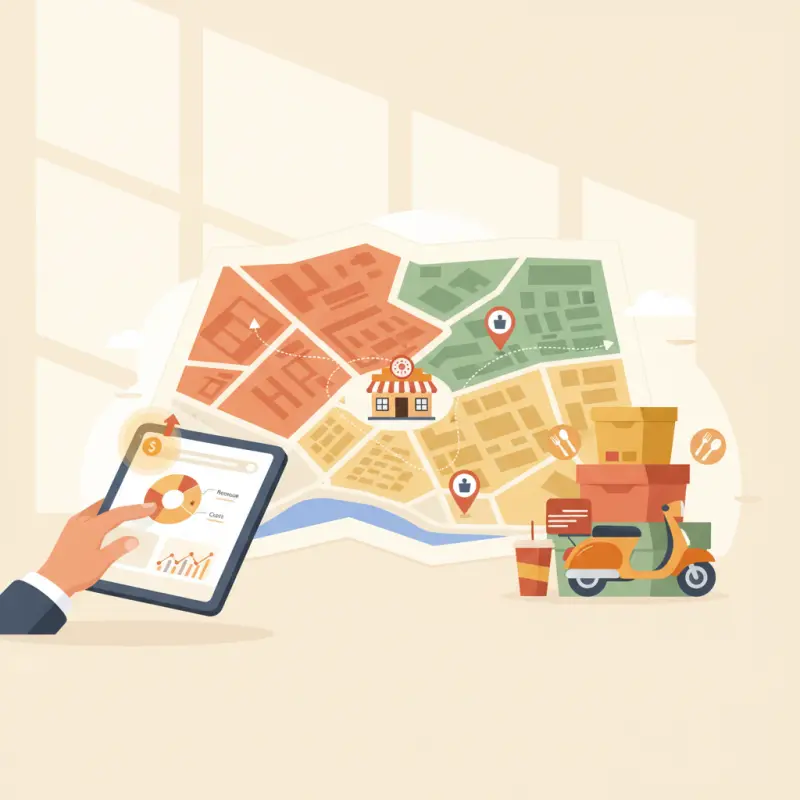
Effective online food delivery management hinges on precise delivery zone configuration that balances profit margins with operational efficiency. Most restaurants lose money on delivery by setting zones too large, creating 35-minute round trips that triple labor costs while degrading food quality. Online food delivery management success follows the 15-minute rule: French fries lose crispness after 12 minutes, pizza cheese congeals at 18 minutes, and Moroccan tagines separate after 25 minutes. Smart restaurants in Agadir's beach district limit delivery to 2.5 kilometers during lunch rush, while quieter residential areas can extend to four kilometers. Polygon zones outperform radius zones for irregular city layouts, allowing restaurants to exclude difficult areas while maintaining profitable coverage. Calculate your optimal zone by working backward from food quality constraints: subtract prep time and packaging time from your 15-minute window to determine maximum travel distance.
Table of Contents
A restaurant in Casablanca loses 3,500 MAD every month on delivery orders — not from refunds or mistakes, but from zones set up wrong. Online food delivery management starts with understanding this simple truth: your delivery radius directly impacts your profit margin.
Most restaurants draw a circle on a map and call it their delivery zone. They wonder why orders from distant neighborhoods cost more to deliver than they earn. They struggle with driver scheduling, arbitrary pricing, and customer complaints about cold food. This guide addresses the operational challenges that actually determine whether delivery adds to your bottom line or slowly bleeds it dry.
Why Zone Setup Makes or Breaks Your Delivery Profit
Your delivery zone is a profit equation, not a geography lesson. Every kilometer beyond your optimal radius costs you money — in fuel, time, and food quality. Yet shrink that zone too much and you cut off revenue streams.
The math is unforgiving. A 10-kilometer delivery radius sounds reasonable until you calculate that orders from the edge take 35 minutes each way. Your driver makes one delivery per hour instead of three. Your labor cost triples while your food sits in transit.
The 15-Minute Rule That Restaurants Get Wrong
Food quality degrades predictably after leaving the kitchen. French fries lose their crispness after 12 minutes. Pizza cheese congeals at 18 minutes. Moroccan tagines hold heat well but separate after 25 minutes of movement. The 15-minute delivery window isn't about customer expectations — it's about serving food worth eating.
Smart restaurants work backward from this constraint. If your average prep time is eight minutes and your packaging adds two minutes, you have exactly five minutes of travel time to maintain quality. In Agadir's beach district, that's a 2.5-kilometer radius during lunch rush. In quieter residential areas, you might stretch to four kilometers.
Polygon vs. Radius Zones: When Each Method Works
Radius zones create perfect circles on maps but imperfect coverage in reality. A three-kilometer radius from your restaurant might include the ocean on one side and dense residential blocks on the other. You're paying for coverage of fish while ignoring paying customers.
Polygon zones let you draw custom shapes that match actual delivery patterns. You can extend coverage along major roads where drivers move quickly, while excluding areas with poor access or low order density. A polygon zone typically captures 20% more orders than a radius zone of similar size because it follows human geography instead of mathematical ideals.
How Casablanca Traffic Patterns Should Shape Your Zones
Casablanca's Boulevard Mohammed V turns into a parking lot between 6 PM and 8 PM. A two-kilometer delivery that takes eight minutes at lunch requires 22 minutes during dinner rush. Your zones need to breathe with the city's rhythm.
Progressive restaurants run different zones for different times. Morning zones expand into business districts. Lunch zones contract to nearby offices and shops. Evening zones shift toward residential areas but shrink during peak traffic hours. This dynamic approach to zone management — available through any modern food delivery management software — increases successful deliveries by 30%.
Food cost calculator
What’s your real margin?
Food cost
29.2%
Gross margin
70.8%
Profit / dish
85 MAD
Healthy · under 30%
Digitize your menu with OCHIThe Real Cost of Driver Management (And How to Avoid It)
Manual driver assignment is expensive chaos disguised as control. Every phone call to check availability, every shuffle when someone doesn't show up, every dispute over fair distribution costs you money and sanity.
Why Manual Driver Assignment Costs You 200 MAD Per Day
Here's what manual assignment actually costs: Your manager spends 45 minutes each morning calling drivers and juggling schedules. That's 50 MAD in labor. Throughout the day, they spend another two hours coordinating changes, resolving conflicts, and filling gaps. Add 100 MAD. When orders pile up because you're manually matching drivers to deliveries, you lose at least one order per rush hour. There's another 50 MAD gone.
These hidden costs compound. Drivers argue over fair distribution. Good drivers leave for competitors with better systems. New drivers require constant oversight. The daily 200 MAD loss becomes 6,000 MAD monthly — enough to cover a full-time position or upgrade your entire delivery operation.
Auto-Assignment Logic: Distance vs. Driver Rating vs. Order Value
Effective auto-assignment weighs three factors in real-time. Distance determines base efficiency — the closest available driver usually gets priority. But driver ratings matter for high-value orders or VIP customers. A five-star driver traveling an extra kilometer often delivers better outcomes than a three-star driver nearby.
Order value creates another layer. A 500 MAD corporate catering order justifies sending your best driver across town. A single sandwich order needs the nearest available person. The algorithm balances these factors instantly, making decisions no human dispatcher could calculate quickly enough during rush periods.
The 3 AM Problem: When Your Regular Drivers Aren't Available
Late-night delivery presents unique challenges. Your regular team is asleep. Backup drivers charge premium rates. Order volume is unpredictable — dead quiet one night, surprisingly busy the next.
Successful late-night operations use hybrid models. Core drivers handle predictable volume. Overflow automatically routes to third-party services or on-demand drivers. This flexibility, built into platforms like OCHI's delivery management system, ensures you never turn away profitable orders while avoiding the cost of idle drivers.
Delivery Pricing That Actually Converts
Delivery pricing psychology trumps basic math. Customers will pay 25 MAD for "free delivery" on a 150 MAD order but balk at 15 MAD delivery fee on the same order. Understanding these quirks determines whether your delivery program attracts or repels customers.
The Rabat Restaurant That Lost 40% of Orders (Pricing Case Study)
A popular Rabat restaurant learned this lesson expensively. They calculated their average delivery cost at 18 MAD and set their fee at 20 MAD for a small profit. Orders dropped 40% overnight. Customers who previously ordered twice weekly disappeared entirely.
The fix came through restructuring, not discounting. They raised menu prices by 5% and dropped delivery fees to 10 MAD. Same net result, completely different customer perception. Orders recovered within two weeks and climbed 15% above original levels within a month.
Free Delivery Threshold: The Sweet Spot Formula
| Average Order Value | Optimal Free Delivery Threshold | Conversion Impact |
|---|---|---|
| 80 MAD | 120 MAD | +22% order value |
| 120 MAD | 180 MAD | +18% order value |
| 200 MAD | 280 MAD | +15% order value |
The sweet spot sits at roughly 1.5 times your average order value. Set it lower and you give away margin. Set it higher and customers won't stretch to reach it. This threshold turns delivery fees into an upselling tool — customers add that extra appetizer or dessert to qualify for free delivery.
Dynamic Pricing for Peak Hours: When It Works, When It Backfires
Dynamic pricing promises to maximize revenue during high-demand periods. The reality is more nuanced. Customers accept surge pricing from ride-sharing apps but expect consistent pricing from restaurants.
The successful approach uses incentives rather than penalties. Instead of charging extra during peak hours, offer discounts during slow periods. "Order between 2 PM and 5 PM for 20% off delivery" frames the same economic reality positively. Your online food ordering and delivery platform should support these time-based rules without manual intervention.
GPS Tracking: Beyond "Where's My Order?"
GPS tracking data tells stories that transform operations. Most restaurants see it as a customer service feature. Smart operators mine this data for insights that cut costs and improve service.
How Real-Time Tracking Data Reveals Your Delivery Blind Spots
Track your drivers for a week and patterns emerge. That supposedly 10-minute route to the medina takes 18 minutes on average. Your drivers consistently pause for five minutes at a particular intersection — there's nowhere safe to park. Orders to the hillside neighborhood always run late because GPS doesn't account for the steep grade.
These insights let you adjust prep times, modify zones, and set accurate customer expectations. One Marrakech restaurant discovered their drivers were taking a longer but faster route around the souk. They updated their estimates and complaints dropped 60%.
The Customer Communication Timeline That Prevents 90% of Complaints
Complaints follow predictable patterns. No news for 20 minutes creates anxiety. Vague updates frustrate. Surprise delays at the last minute infuriate. The solution is proactive communication triggered by GPS milestones.
When the driver leaves your restaurant, customers get a notification with realistic arrival time. If GPS shows unexpected delays, an automatic update adjusts expectations. When the driver is two minutes away, a final alert lets customers prepare. This communication cascade, standard in any serious restaurant delivery software, turns potential complaints into appreciation for transparency.
Using GPS Data to Negotiate Better Rates with Third-Party Drivers
Third-party drivers often charge flat rates based on distance. Your GPS data proves why that model overcharges you. Show them that deliveries to the business district average 12 minutes while residential deliveries take 19 minutes for the same distance. Negotiate time-based pricing that reflects reality.
Data also reveals driver performance objectively. That driver who always claims traffic delays? GPS shows he makes frequent unexplained stops. The one who seems slow but never has complaints? She takes optimal routes and maintains consistent speed. These insights let you reward efficiency and address problems with facts, not feelings.
Batch Deliveries: The Profit Multiplier Most Restaurants Ignore
Sending one driver with three orders instead of three drivers with one order each seems obvious. The execution is what separates profitable delivery operations from those just getting by.
When Grouping Orders Saves Money (And When It Doesn't)
Batch delivery works when orders share direction and timing. Three orders going to the same office building are perfect candidates. Three orders to different neighborhoods are disasters waiting to happen — someone gets cold food while the driver zigzags across town.
The decision matrix is straightforward. Orders within a 1.5-kilometer cluster with pickup times within 10 minutes can batch successfully. Beyond these parameters, customer satisfaction drops faster than delivery costs. Your food ordering and delivery platform should calculate these groupings automatically.
The Route Optimization Algorithm Your Drivers Need
Human drivers instinctively deliver to the closest address first. This often creates inefficient routes. The optimal path might deliver to the second-closest address first if it avoids a difficult left turn or positions the driver better for subsequent deliveries.
Modern route optimization considers turn restrictions, traffic patterns, and even customer preferences. Some customers are flexible about delivery times while others need precision. The algorithm weighs these factors to create routes that minimize total travel time while meeting service promises.
Multi-Stop Deliveries in Marrakech: A Profit Breakdown
A Marrakech restaurant shared their batch delivery numbers. Single deliveries average 24 MAD in driver and fuel costs. Two-order batches cost 32 MAD total — 16 MAD per order. Three-order batches cost 38 MAD total — 12.67 MAD per order.
The economics are compelling, but execution matters. They limit batches to three orders maximum, ensure all pickups happen within a five-minute window, and never batch orders with special handling requirements. This disciplined approach to batching increased their delivery profit margin from 8% to 19%.
Online food delivery management isn't about having the latest technology or the widest coverage area. It's about understanding the economics of each delivery and optimizing every step from order placement to customer door. Whether you're managing delivery operations manually or using an online food ordering and delivery platform, these principles determine profitability. The restaurants succeeding with delivery aren't necessarily the ones with the best food — they're the ones who've mastered the operational details that turn orders into profit.
Ready to implement professional delivery management without the complexity? See how OCHI's zero-commission platform handles zones, drivers, tracking, and batching at votrenom.ochi.ma.
Frequently Asked Questions
What is the optimal delivery zone size for restaurants?
The optimal delivery zone depends on your 15-minute food quality window minus prep and packaging time. Most profitable restaurants limit delivery to 2.5-4 kilometers, ensuring drivers complete three deliveries per hour instead of one.
Why do restaurants lose money on long-distance delivery orders?
Long-distance deliveries triple labor costs as drivers make one delivery per hour instead of three. Food quality also degrades beyond 15 minutes, leading to customer complaints and refunds.
Should restaurants use radius or polygon delivery zones?
Polygon zones work better for irregular city layouts, allowing restaurants to exclude difficult areas while maintaining coverage. Radius zones suit restaurants in uniform neighborhoods with consistent traffic patterns.
How does food quality affect delivery zone planning?
Different foods degrade at different rates: French fries lose crispness after 12 minutes, pizza cheese congeals at 18 minutes. Plan your maximum delivery distance to keep total transit time under 15 minutes.
What delivery management tools help optimize restaurant zones?
Modern restaurant platforms offer GPS tracking, polygon zone mapping, and delivery time analytics. These tools help restaurants identify profitable zones and adjust boundaries based on actual performance data.
Restaurant owners · Weekly
The guide to running a restaurant in 2026.
One article per week. No commission advice. Just honest operational insight for Moroccan restaurants.

Blog Manager
Comments
No comments yet. Be the first to share your thoughts.