Why Restaurant Inventory Management Only Works When Connected to Orders
Here's what the free software providers won't tell you: standalone inventory management is solving the wrong problem. You don't need better spreadsheets. You need orders that automatically update stock levels.
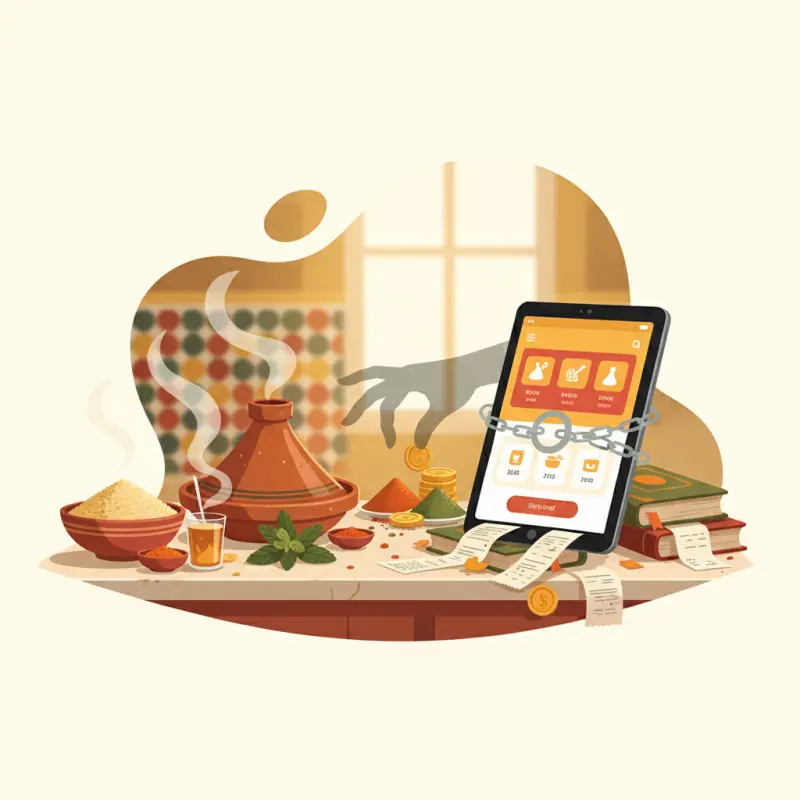
Consider two restaurants in Marrakech's medina. Restaurant A uses three separate systems — a traditional POS for in-house orders, a delivery platform that takes 30% commission, and a free inventory app. Their manager spends three hours daily reconciling data between systems. They discover stock-outs only when customers complain.
Restaurant B uses integrated restaurant management software where every order — whether from their dining room, QR table ordering, or online system — automatically deducts ingredients from inventory. They see real-time stock levels on the same dashboard where they manage orders. When tagine spice mix runs low, the system alerts them before it impacts service.
The Integration Problem Most Free Software Creates
Free tools create data silos. Your reservation system doesn't know your table capacity. Your inventory tracker doesn't see your sales patterns. Your POS can't predict tomorrow's prep needs based on today's reservations. Each system works fine alone but fails together.
This disconnection compounds during peak service. While you're managing a full dining room, you can't pause to update inventory sheets. By closing time, you're too exhausted for data entry. The gap between recorded and actual inventory widens daily until monthly counts reveal thousands in shrinkage.
What Happens When Your POS Doesn't Talk to Your Inventory System
Manual processes introduce errors that cascade through operations. A waiter forgets to log a modified order. The kitchen preps based on outdated pars. Your cost calculations assume ingredients that spoiled yesterday. These small mistakes compound into major losses — typically 3-5% of revenue for restaurants without integrated systems.
The Hidden Costs:
What "Free" Restaurant Management Software Really Costs You
Let's put real numbers to what "free" actually costs your restaurant:
| Cost Category |
Free Disconnected Systems |
Integrated Platform |
Annual Difference |
| Manual Data Entry (2 hrs/day @ 30 MAD/hr) |
21,900 MAD |
0 MAD |
21,900 MAD saved |
| Over-ordering (15% of 50K monthly food cost) |
90,000 MAD |
30,000 MAD |
60,000 MAD saved |
| Stock-out lost sales (5% of potential revenue) |
120,000 MAD |
24,000 MAD |
96,000 MAD saved |
| Software Cost |
0 MAD |
0 MAD* |
— |
| Total Annual Cost |
231,900 MAD |
54,000 MAD |
177,900 MAD saved |
*Based on zero-commission platforms that include all features
Time Costs: Hours Lost to Manual Updates
Restaurant managers spend 15-20 hours weekly on tasks that integrated systems automate. That's half a full-time position dedicated to moving numbers between screens. Time that could improve customer service, develop new menu items, or train staff instead goes to clipboard reconciliation.
Money Costs: Overstocking and Stock-Outs
Without real-time inventory tracking tied to sales, restaurants typically overstock by 15-20% "just in case." For a restaurant spending 50,000 MAD monthly on ingredients, that's 7,500-10,000 MAD in working capital tied up in excess inventory — often spoiling before use.
Opportunity Costs: What You Could Do Instead
The biggest cost is invisible: missed opportunities. While you're counting inventory manually, competitors analyze their food cost percentages in real-time. They adjust menu prices based on ingredient costs. They identify their most profitable items and promote them. They make data-driven decisions while you make educated guesses.
Traditional delivery platforms can't offer genuinely free restaurant management software because they need revenue. When they take 25-35% commission on orders, any "free" tools come with strings attached — usually locking you deeper into their ecosystem.
Zero-commission models flip this equation. Without commission pressure, platforms can include comprehensive features — inventory management, online ordering, table reservations — in one integrated system. The platform succeeds when restaurants succeed, not by extracting maximum fees per transaction.
Commission-based platforms offer "free" tools as loss leaders. Their inventory management connects only to their orders. Their reservation system works only through their app. Each feature deepens your dependence while they take nearly a third of every sale. You save on software but lose on every transaction.
What True Integration Looks Like:
One Dashboard, All Operations
Real integration means one source of truth. When a customer places an order — whether scanning a QR code at their table, booking through your website, or walking in — that order flows through your entire operation. Inventory updates automatically. Kitchen displays show real-time preparation status. Financial reports reflect accurate food costs.
Your online ordering system, free from commission fees, becomes the hub connecting every operational aspect. Your free table reservation system knows your real-time capacity. Your free restaurant reservation system syncs with kitchen prep schedules. Everything works together because it's designed as one system, not cobbled from disparate tools.
Building Your Free Restaurant Management System:
The OCHI Approach
Here's how Khalid, who owns a traditional Moroccan restaurant in Rabat's Kasbah, transformed his operations using integrated restaurant management software free from commission fees:
His restaurant now runs on a single platform accessible at khalidsrestaurant.ochi.ma. Every online order automatically updates inventory levels. When mint tea orders spike during Ramadan, the system alerts him before running out. His reservation system connects to table management — no more double-bookings or confused seating during iftar rush.
Setting Up Inventory That Updates Automatically
Khalid started by entering his recipes into OCHI's recipe builder. Each tagine variation lists its ingredients — lamb (200g), preserved lemons (30g), olives (50g). Now when someone orders lamb tagine through his online ordering system, those exact amounts deduct from inventory. No manual entry. No guesswork.
The system tracks multiple units (kilograms for meat, pieces for lemons, liters for oil) and converts automatically. Purchase orders go directly to suppliers. When deliveries arrive, one entry updates all connected systems.
Connecting Reservations, Orders, and Stock Levels
Friday couscous service used to be chaos. Now, Khalid's free restaurant reservation system shows him Thursday night that he has 47 couscous reservations for Friday lunch. The system calculates needed ingredients, checks current stock, and alerts him to order 12 additional kilograms of semolina.
His kitchen display system shows each order's status in real-time. Waiters see table availability on their phones. Customers track their delivery orders with live GPS. Everything connects through one platform.
Your Branded Online Presence:
Why yourname.ochi.ma Matters
Unlike marketplace platforms that hide your brand under theirs, integrated systems give you a professional digital presence. Khalid's customers visit khalidsrestaurant.ochi.ma — his brand, his prices, his direct relationship with guests. No commission markup means menu prices match in-house prices.
This branded approach extends throughout the experience. Emails come from Khalid's restaurant, not a third-party platform. Loyalty points accumulate in his program. Customer data stays in his control for targeted marketing campaigns.
Free restaurant inventory management only works when it's part of a complete operational system. Standalone tools create more problems than they solve. Integrated platforms that connect orders to inventory, reservations to capacity, and sales to profit give you the control successful restaurants need. See what truly integrated restaurant management looks like at ochi.ma/partners.