What Restaurant Owners in Casablanca Actually Need
Restaurant software isn't about taking orders — it's about running operations. The gap between what "free" platforms offer and what restaurants actually need explains why 70% of Moroccan restaurants still use paper and WhatsApp.
Beyond Order Taking:
Full Operations Control
Real restaurant operations require inventory tracking that syncs with your menu. When you sell the last portion of pastilla, your online ordering system free of inventory controls will keep accepting orders. Result: angry customers and damaged reputation.
Staff management means more than login credentials. You need eight different permission levels: admin, branch manager, POS operator, waiter, chef, delivery driver, cashier, and general staff. Each role sees only what they need. Your delivery drivers shouldn't access financial reports. Your waiters shouldn't modify menu prices.
Kitchen display systems transform order flow. Orders appear on screens, color-coded by preparation time. Chefs mark items as preparing, then prepared. No more lost tickets or shouting across the kitchen. This is what restaurant software free trials rarely include — but every busy kitchen needs.
Multi-Channel Integration Reality
Modern restaurants take orders from websites, QR codes at tables, phone calls, and walk-ins. Free platforms typically handle one channel. You end up juggling multiple tablets, entering orders twice, and reconciling sales across systems every night.
A unified dashboard changes everything. See all orders — online, table, takeaway — in one place. When table 12 scans your QR code and orders, it appears instantly in your POS and kitchen. No manual entry. No mistakes. This integration is what separates professional restaurant operations from chaos.
Real-time sync prevents the nightmare scenario: accepting an online order for an item you've already sold out in-store. Proper systems update inventory across all channels instantly. Your website, POS, and kitchen stay synchronized.
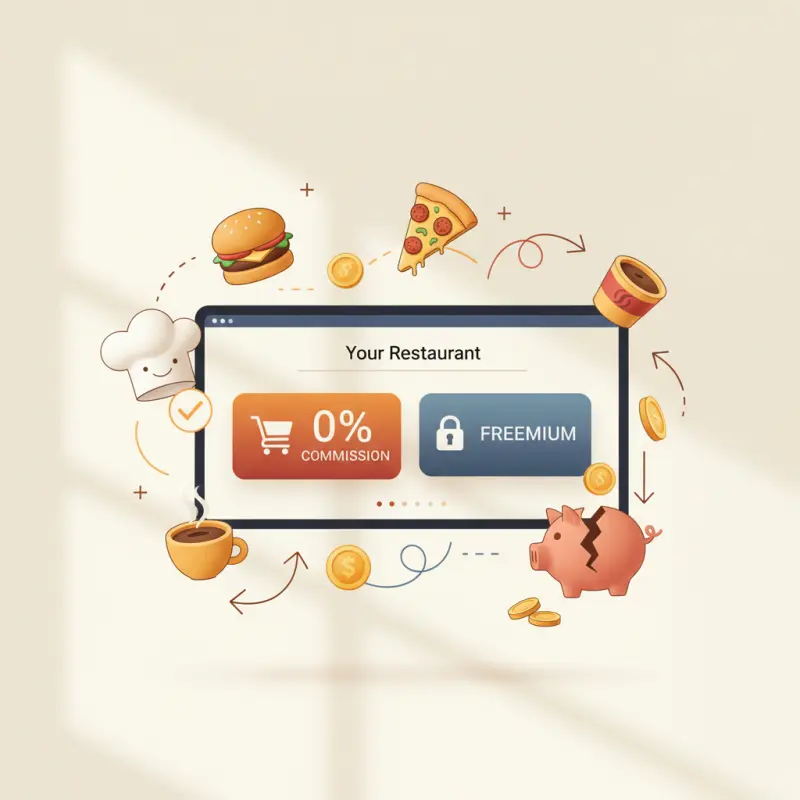
The Commission vs. Zero-Commission Business Model
Understanding how "free" platforms make money reveals why they can't actually be free. The business model determines everything: features, restrictions, and hidden costs.
Commission-based platforms take 15-30% of every order. On a 100 MAD meal, you receive 70-85 MAD. The platform pockets the rest. This model incentivizes them to maximize order volume, not restaurant profitability.
Premium subscriptions create artificial scarcity. Essential features like analytics, multi-branch support, and API access get locked behind "Enterprise" tiers costing 2,000+ MAD monthly. The free tier exists solely to upsell.
Customer data becomes another revenue stream. Platforms sell aggregated data to competitors, investors, and market researchers. Your customer list, ordering patterns, and revenue metrics become their product. You built it — they monetize it.
True Zero-Commission Model
Zero commission means the restaurant keeps every dirham of the menu price. No percentages. No calculations. A 50 MAD tagine brings you 50 MAD. This transparent model aligns platform success with restaurant growth.
Without commission pressure, platforms can offer all features upfront. No artificial restrictions. No feature gates. No upselling. The same powerful system works for a small café in Fès or a restaurant chain across Morocco.
Data ownership stays with you. Export customer lists, sales reports, and analytics anytime. Switch platforms without losing years of customer relationships. Your business data remains yours.
Evaluating Free Restaurant Management Software:
The Checklist
Before committing to any platform, run this evaluation. Most restaurants skip this step and pay for it later.
Technical Requirements Audit
API access determines integration possibilities. Can you connect your accounting software? Sync with your email marketing? Build custom integrations? Free platforms rarely offer API access — limiting your growth potential.
Uptime guarantees matter during dinner rush. 99.9% uptime means 8.76 hours of downtime annually. Sounds acceptable until it happens on a busy Friday night. Check the service level agreement carefully.
Data export capabilities protect your investment. Can you download customer data as CSV? Export sales reports to Excel? Backup your entire menu structure? Lock-in happens when platforms make data export impossible.
Cost Projection Over 12 Months
| Cost Category |
"Free" Platform |
Zero-Commission Platform |
| Monthly subscription after trial |
299 MAD (basic tier) |
0 MAD |
| Transaction fees (2.5% on 30K MAD/month) |
750 MAD |
0 MAD |
| Payment processing markup (1% extra) |
300 MAD |
0 MAD |
| Annual total |
16,188 MAD |
0 MAD |
These projections assume modest transaction volumes. Successful restaurants pay significantly more. A restaurant processing 100,000 MAD monthly loses 42,000+ MAD annually to "free" platform fees.
Operational Fit Assessment
Multi-branch support needs vary. Single locations might manage with basic systems. Restaurant groups need centralized reporting, shared customer databases, and unified inventory management. Free platforms rarely support true multi-branch operations.
Staff training complexity determines adoption success. Complicated interfaces mean longer training, more mistakes, and staff resistance. Test the system with your least tech-savvy employee. If they struggle, so will your team.
Customer support availability becomes critical during problems. Business-hours-only support doesn't help when your system crashes at 9 PM on Saturday. 24/7 support isn't optional for restaurant operations.
OCHI approaches restaurant technology differently. Built by restaurant operators, not Silicon Valley engineers, it addresses real operational needs without commission fees or feature restrictions.
Full-Feature Access Without Restrictions
Every OCHI restaurant gets unlimited menu items from day one. Add 200 dishes across 50 categories. Include modifiers, variations, and combo meals. No artificial limits blocking your menu creativity.
The analytics dashboard shows everything: hourly sales patterns, customer lifetime value, item profitability, and payment method breakdowns. Export any report to Excel. Build custom segments. Track performance across branches. This isn't a premium feature — it's standard.
Eight distinct staff roles provide precise access control. Your branch manager sees inventory and sales. Waiters see only their tables and orders. Delivery drivers track only their assigned deliveries. Kitchen staff focus on order preparation. Everyone gets exactly the access they need.
Zero Hidden Costs Structure
OCHI charges zero commission on orders. A 100 MAD order brings you 100 MAD. No percentages. No calculations. No surprises on your monthly statement. This applies to all orders: online, QR table ordering, phone orders entered manually.
Your branded subdomain (votrenom.ochi.ma) comes included. No extra hosting fees. No domain registration costs. No SSL certificate charges. Professional online presence without technical complexity or hidden expenses.
Every restaurant gets the same system. No feature tiers. No upgrade pressure. The sushi restaurant in Rabat uses the same powerful platform as the traditional Moroccan restaurant in Meknes. Success shouldn't depend on your software budget.
Ready to Start:
Your Free Table Reservation System
Setting up takes under 30 minutes. Upload your menu. Configure your dining areas. Set delivery zones. Your online ordering system free from commission fees goes live at votrenom.ochi.ma immediately.
The platform includes a free restaurant reservation system for table bookings. Customers reserve online. You manage availability by shift. Confirmations send automatically. No more phone tag or double bookings.
Visit ochi.ma/partners to see the complete platform. Watch video demos. Read case studies from Moroccan restaurants already using OCHI. Schedule a personalized demo with our Agadir team.
The question isn't whether you need restaurant technology — it's whether you'll pay hidden commissions forever or own your digital future with transparent, zero-commission pricing. Moroccan restaurants deserve better than the freemium trap. Your customers are waiting at votrenom.ochi.ma.