AI Overview
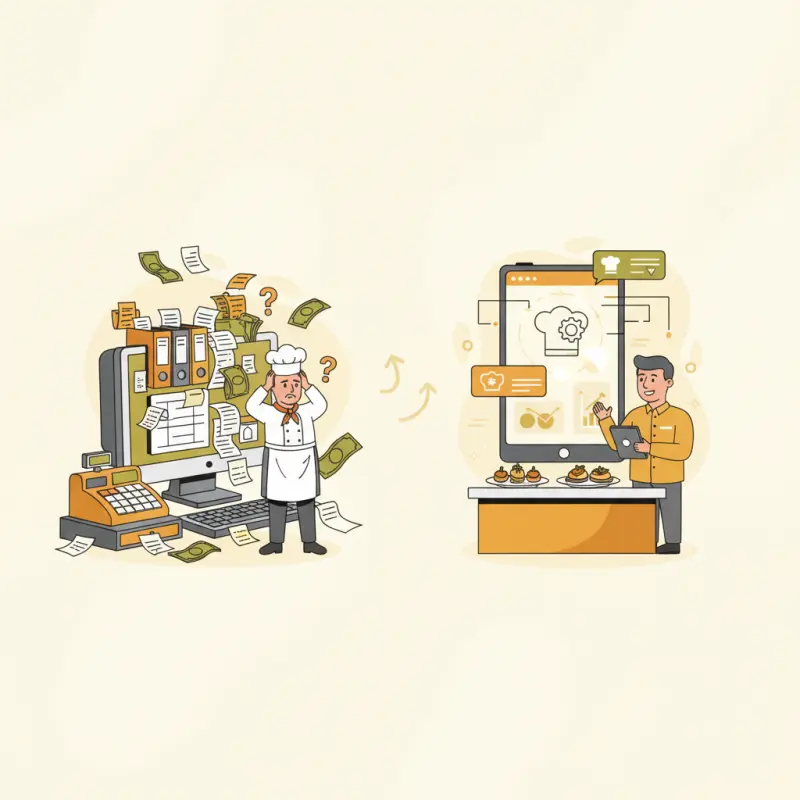
Traditional hr software for restaurants fails because it wasn't designed for restaurant operations. These systems track scheduling and payroll but miss the critical connection between staff actions and revenue loss. While your HR platform shows perfect attendance, your POS might reveal MAD 15,000 in unexplained discrepancies from employee transactions. Restaurant chains like McDonald's and Subway use integrated systems that link staff management directly to point-of-sale data. The disconnect between HR tracking and revenue control creates blind spots where cash disappears through voided transactions, unauthorized discounts, and missing audit trails. Your most urgent need isn't better scheduling software — it's operational control that connects every staff action to its financial impact in real time.
Table of Contents
Your head chef just quit mid-shift on Saturday night. Your POS shows MAD 3,000 missing from yesterday's cash drawer. Your new server gave himself a 50% staff discount on a MAD 800 order. These aren't HR problems — they're revenue problems disguised as staff issues.
Most restaurant owners search for "hr software for restaurants" after a crisis hits. They think they need better scheduling or payroll processing. What they actually need is operational control that prevents these crises from happening.
Why Restaurant HR Software Fails When You Need It Most
Traditional HR platforms weren't built for restaurants. They assume 9-to-5 schedules, monthly salaries, and desk-based work. Your reality? Split shifts, daily tips, and staff who handle cash every minute.
The disconnect becomes obvious during your busiest moments. Your "best restaurant scheduling software" can't adjust when three servers call in sick during Ramadan iftar rush. Your payroll system doesn't understand why your bartender worked 14 hours straight during a wedding reception.
The 3 AM Problem: When Your POS Shows Missing Revenue
Here's what happens at 3 AM in most Casablanca restaurants: the closing manager counts cash, notices a discrepancy, and shrugs. "We'll figure it out tomorrow." Tomorrow never comes. By month-end, you're missing MAD 15,000 with no audit trail.
Restaurant hr software promises to track employee hours. But can it tell you which waiter processed a MAD 500 refund at 11:47 PM? Can it show you who voided that table of eight after they left? Your HR system tracks attendance. Your POS tracks transactions. The gap between them is where revenue disappears.
Why "Best Restaurant HR Software" Lists Miss the Point
Search for restaurant workforce management software and you'll find dozens of options. They all promise the same features: scheduling, time tracking, payroll integration. None address the core issue: your staff directly impacts revenue through every action they take.
A server who forgets to charge for drinks costs you MAD 200. A kitchen manager who over-portions proteins costs you MAD 2,000 weekly. A cashier who pockets cash sales costs you MAD 500 daily. These aren't HR metrics — they're operational failures that HR software can't fix.
The Real Cost: Revenue Leaks vs. Software Subscriptions
Restaurant owners obsess over software costs. "MAD 500 monthly for scheduling software? Too expensive." Meanwhile, they lose MAD 20,000 monthly to staff errors, theft, and inefficiency.
| Revenue Leak Source | Monthly Cost (Average) | Detection Method |
|---|---|---|
| Unauthorized discounts | MAD 3,000 | POS audit trails |
| Cash drawer shortages | MAD 5,000 | Shift reports |
| Over-portioning | MAD 8,000 | Inventory tracking |
| Time theft | MAD 4,000 | Role-based access |
Stack audit
What do you currently use?
Tick what you have. We’ll show what OCHI replaces or connects to.
The 8-Role Framework: Beyond Manager and Server
Most restaurant software gives you two roles: admin and staff. Your restaurant has eight distinct job functions, each needing different system access. OCHI recognized this gap and built granular permissions that match restaurant reality.
Admin → Staff: The Permission Hierarchy That Prevents Theft
Your head chef shouldn't access cash reports. Your cashier shouldn't modify menu prices. Your delivery driver shouldn't process refunds. Yet most systems give everyone similar access levels.
OCHI's 8-role system mirrors restaurant operations: Admin, Branch Manager, POS Operator, Waiter, Chef, Delivery Boy, Cashier, and Staff. Each role has specific permissions. A waiter can take orders but can't void bills. A chef sees kitchen tickets but not payment methods. This isn't just security — it's operational clarity.
The Fake Refund Scenario: How Role-Based Access Caught a MAD 15,000 Loss
A Marrakech steakhouse discovered their evening cashier had processed 47 refunds over two months — all after 10 PM, all for cash orders, all without manager approval. Total loss: MAD 15,000.
They only caught it because their new system required manager PINs for refunds over MAD 200. The cashier had been refunding orders after customers left, pocketing the cash. With proper role restrictions, this theft becomes impossible. Every action leaves a digital signature.
Per-Employee Activity History: The Data Other Platforms Don't Track
Your best payroll software for restaurants tells you hours worked. OCHI tells you orders taken, refunds processed, voids approved, discounts given, tables served, and items removed. Per employee. Per shift. Per hour.
This isn't surveillance — it's accountability. When your food cost spikes, you can identify which server consistently forgets to charge for beverages. When customer complaints increase, you can see which chef marks orders ready before they're prepared.
Restaurant Workforce Management Software: Shifts vs. Scheduling
Scheduling isn't your problem. Managing what happens during those scheduled hours is. The best restaurant scheduling software means nothing if your Thursday lunch server handles 12 tables while your Friday dinner server struggles with six.
Why Your Restaurant Scheduling Software Needs POS Integration
Disconnected scheduling creates blind spots. Your scheduling app shows five servers for Saturday night. Your POS shows MAD 25,000 in sales. But can you answer: Which server generated the most revenue? Who had the highest average check? Which shift pattern drives better performance?
OCHI connects scheduling to outcomes. Schedule a server for Thursday lunch, then see their actual performance: 18 tables served, MAD 3,600 in sales, 22-minute average table time. Now you have data to optimize scheduling based on results, not just coverage.
The Marrakech Restaurant That Cut Labor Costs 23% With Smart Scheduling
Riad Kitchen in Marrakech analyzed six months of integrated POS and scheduling data. They discovered their highest-revenue server worked Tuesday and Wednesday nights — their slowest periods. Their weekend crew included two underperformers who averaged 40% less revenue per shift.
After restructuring shifts based on performance data, they reduced labor costs by 23% while increasing per-shift revenue by MAD 4,000. No new hires. No terminations. Just smarter deployment of existing staff.
Real-Time Adjustments: When Saturday Dinner Rush Extends to 11 PM
Your reservation system shows a slow Saturday. At 7 PM, three wedding parties arrive without bookings. Your scheduled closer leaves at 10 PM. Now what?
Integrated workforce management lets you extend shifts instantly, track overtime accurately, and document the decision. More importantly, it shows you the revenue impact: those three extra hours generated MAD 8,000. The MAD 400 in overtime costs becomes a clear investment.
The Payroll Reality: Tips, Cash, and Moroccan Labor Law
Generic payroll software calculates hours times rate. Restaurant payroll involves tips, cash handling, split shifts, meal deductions, and Moroccan labor law compliance. Miss any component and you face employee disputes or CNSS penalties.
Best Payroll Software for Restaurants: The Morocco-Specific Requirements
Moroccan restaurants face unique payroll challenges. Service charges must be distributed fairly. Cash tips need documentation. Split shifts require specific calculations. CNSS contributions vary by employee type.
Your payroll system must understand that a waiter working lunch (11 AM-3 PM) and dinner (7 PM-11 PM) isn't working eight hours — they're working two distinct shifts with different tip pools and break requirements.
Tip Distribution Algorithms: Fair vs. Performance-Based
The eternal restaurant debate: equal tip sharing or performance-based distribution? Most payroll systems force you to choose one method. Reality demands flexibility.
Your breakfast crew pools tips equally — they're a tight team handling high volume. Your dinner service rewards individual performance — servers compete for premium tables. Your bar staff uses a hybrid model — base pool plus personal tips. One system, multiple distribution methods, complete transparency.
Labor Cost Analysis: Your Actual Cost Per Order (Not Per Hour)
Hourly labor cost misleads restaurant owners. Your Tuesday lunch server costs MAD 50 per hour but serves 40 customers. Your Saturday night server costs MAD 70 per hour but serves 25 customers. Who's more expensive?
When you integrate HR data with order data, real patterns emerge. That "expensive" Saturday server generates MAD 180 average checks. The "cheap" lunch server averages MAD 65. Your actual labor cost per revenue dirham: 38% for lunch, 19% for dinner.
Why Your Next HR Software Should Start With Your POS
Here's the contrarian truth: don't shop for hr software for restaurants. Shop for operational control that includes HR features. Your POS touches every revenue moment. Your staff management should integrate with those moments, not exist separately.
The Integration Gap: Why Separate Systems Create More Problems
Every disconnected system creates a gap. Scheduling software that doesn't know sales data. Payroll that doesn't see tip reports. Time clocks that don't connect to roles. Each gap becomes a place where money disappears and problems multiply.
OCHI built differently. One login shows everything: who's working, what they're selling, how they're performing. Your morning manager sees last night's sales, reviews staff performance, adjusts today's schedule, and approves yesterday's tips. One system. Complete visibility.
From Order to Audit Trail: Complete Staff Accountability
Follow a single order through OCHI: Customer orders tagine at Table 12. Waiter Ahmed inputs order at 7:23 PM using his PIN. Chef Youssef marks it "preparing" at 7:26 PM. Kitchen display shows 18-minute prep time. Ahmed delivers at 7:44 PM. Customer pays MAD 120 cash. Cashier Fatima processes payment at 8:15 PM.
Every step tracked. Every person accountable. If the customer complains tomorrow, you have complete visibility. If money goes missing, you know exactly when and who touched it.
ROI Calculator: Zero Commission vs. Software Subscription Costs
Traditional platforms charge 25-30% commission plus software fees. A restaurant doing MAD 200,000 monthly pays MAD 50,000 in commissions. Add scheduling software (MAD 500), payroll platform (MAD 800), and HR system (MAD 600). Total monthly cost: MAD 51,900.
OCHI charges zero commission. Your MAD 200,000 stays yours. The integrated platform handles orders, staffing, scheduling, and reporting. Monthly cost: your chosen subscription tier. Monthly savings: tens of thousands of dirhams.
The math is clear. The question isn't whether you need better staff management. It's whether you'll solve it with another disconnected tool or an integrated platform that understands restaurants. Your next busy Saturday night will give you the answer.
Transform your restaurant operations with integrated staff management at ochi.ma/partners — where HR meets revenue reality.
Frequently Asked Questions
What makes restaurant HR software different from regular HR systems?
Restaurant HR software must handle split shifts, daily tips, cash handling, and real-time revenue impact from staff actions. Regular HR systems assume fixed schedules and desk-based work.
Can HR software prevent revenue loss from employee theft?
Most HR software only tracks attendance and schedules. You need systems that integrate with your POS to monitor transaction-level employee actions and identify unusual patterns in real time.
Why do restaurant managers still lose money despite having HR software?
HR software tracks when employees work but not what they do while working. Revenue disappears through voided orders, unauthorized discounts, and cash handling errors that HR systems can't monitor.
What should restaurants look for in staff management software?
Integration between HR functions and POS data, real-time transaction monitoring per employee, cash handling audit trails, and role-based permissions that prevent unauthorized actions.
Restaurant owners · Weekly
The guide to running a restaurant in 2026.
One article per week. No commission advice. Just honest operational insight for Moroccan restaurants.

Blog Manager
Comments
No comments yet. Be the first to share your thoughts.