AI Overview
Petpooja POS costs Moroccan restaurants far more than the advertised $49 monthly fee. The real first-year expense reaches 12,840 MAD when you include mandatory setup fees, hardware costs, and third-party payment gateway charges. Restaurants pay an additional 2.5% to 3.5% per transaction through required payment processors, plus $15 monthly for credit card integration and 2% commission on online orders. A Casablanca restaurant processing 100,000 MAD monthly loses 3,000 MAD to gateway fees alone. QuickBooks integration adds $29 monthly, while SMS notifications require separate Twilio charges. Indian-built systems like Petpooja often lack local Moroccan tax compliance and Arabic language support, creating operational gaps. Choose a POS system that clearly displays all costs upfront and includes payment processing without percentage-based fees.
Table of Contents
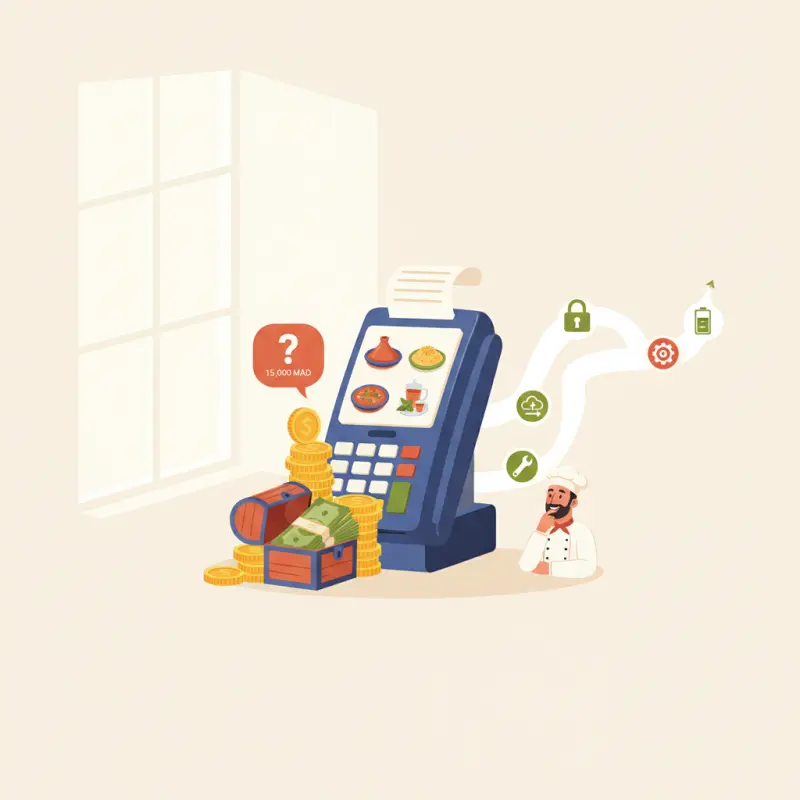
You're paying 15,000 MAD annually for Petpooja POS, but the real cost runs deeper. Most Moroccan restaurant owners discover the true price only after signing up — when transaction fees, integration charges, and missing features start eating into margins.
This review breaks down what Petpooja actually costs, what works for restaurants, and why Indian-built systems often fail in Morocco. No marketing fluff. Just the numbers and experiences that matter when choosing a POS system.
The Real Cost of Petpooja POS Beyond the Monthly Fee
Petpooja's pricing looks straightforward on their website. The reality? Your actual costs multiply quickly through add-ons and percentages most reviews conveniently skip.
Setup and Monthly Subscription Breakdown
The base subscription starts at $49 monthly for single outlets. But here's what they don't highlight upfront:
| Cost Component | Amount | Frequency |
|---|---|---|
| Base Subscription (Starter) | $49 | Monthly |
| Setup & Training | $299-$599 | One-time |
| Hardware (Tablet + Printer) | $400-$800 | One-time |
| Annual Support Fee | $120 | Yearly |
| Data Migration | $199 | One-time |
A restaurant in Casablanca recently shared their first-year invoice: 12,840 MAD total. That's nearly triple the advertised monthly rate when you factor in mandatory extras.
Transaction Fees and Payment Gateway Costs
Petpooja doesn't process payments directly. You'll need a third-party gateway, adding 2.5% to 3.5% per transaction. For a restaurant processing 100,000 MAD monthly, that's an extra 3,000 MAD disappearing from revenue.
Credit card integration? Another $15 monthly. Online ordering? That's 2% commission on every order. These percentages compound fast.
Third-Party Integration Expenses
Want to connect your accounting software? Add $29 monthly for QuickBooks integration. Need SMS notifications for orders? Twilio charges apply separately. Each integration carries its own fee structure, turning your "affordable" POS into a costly tech stack.
Stack audit
What do you currently use?
Tick what you have. We’ll show what OCHI replaces or connects to.
Petpooja Billing Features That Work (And Those That Don't)
Credit where due — Petpooja billing handles basic restaurant operations competently. But the gap between demo promises and daily reality frustrates many operators.
Kitchen Order Ticket (KOT) Management
The KOT system works well for straightforward orders. Items route to the correct kitchen station, and the interface displays order status clearly. Problems emerge with modifications and special requests — the system struggles with complex customizations common in Moroccan cuisine.
A tagine restaurant in Marrakech reported constant issues with modifier pricing. Their traditional recipes require numerous ingredient variations, but Petpooja's rigid structure forced them to create separate menu items for each combination.
Inventory Tracking Accuracy
Inventory management looks impressive during demos. Real-world accuracy? Around 85% according to user reports. The system tracks whole units well but struggles with partial quantities — problematic when you're measuring spices by the gram or oil by the milliliter.
Recipe costing exists but lacks the granularity needed for accurate food cost calculation. You can't track waste effectively or account for preparation loss.
Multi-Location Billing Limitations
Running multiple branches? Petpooja billing requires separate subscriptions per location. Consolidated reporting costs extra. Branch-to-branch inventory transfers need manual entry. For growing restaurant groups, these limitations create operational headaches.
Why Indian POS Systems Struggle in Morocco
Petpooja POS works brilliantly in Mumbai. In Morocco? Different story. The cultural and technical gaps most reviews ignore create real operational challenges.
Payment Gateway Compatibility Issues
Moroccan payment processors like CMI and Maroc Telecommerce aren't natively supported. You'll need workarounds through international gateways, adding complexity and cost. Local payment methods like Mobicash? Forget it.
One Agadir beachfront restaurant spent three months trying to integrate their local bank's payment terminal. They eventually gave up, running two separate systems — one for orders, another for payments.
Language and Currency Limitations
Arabic support exists but feels like an afterthought. Right-to-left text displays incorrectly on receipts. Kitchen displays show Arabic names in broken formatting. Staff often switch to English just to avoid the bugs.
Currency handling assumes you're working in round numbers. Moroccan dirham pricing with centimes creates rounding errors that accumulate over thousands of transactions.
Local Regulation Compliance Gaps
Moroccan tax reporting requirements differ significantly from Indian standards. Petpooja generates reports, but your accountant will need to manually reformat everything for local compliance. VAT calculations don't align with Moroccan tax brackets.
The system lacks built-in support for Moroccan fiscal regulations. No automatic ICE number validation. No native integration with tax authority systems.
Toast POS Company vs. Petpooja — The Commission Model Problem
Both Toast POS company and Petpooja share a fundamental flaw: they're built to extract ongoing revenue from your restaurant. The methods differ, but the result remains — less money in your pocket.
Hidden Revenue Sharing in "Free" Features
Toast POS advertises "free" hardware but locks you into processing fees averaging 2.99% plus $0.15 per transaction. Petpooja's "free" online ordering takes 2% commission. These platforms profit from your success through percentage-based fees.
Calculate it: 500,000 MAD annual revenue with 2% platform fees equals 10,000 MAD yearly. That's pure profit leaving your restaurant.
Third-Party Delivery Integration Costs
Connecting to delivery platforms? Both POS systems charge integration fees, then delivery platforms take their 15-30% cut. Your technology stack shouldn't compound the commission problem — it should solve it.
Why Zero-Commission Models Matter More
Every percentage point matters in restaurant margins. When your POS toast provider takes 2%, payment gateway takes 3%, and delivery platform takes 25%, you're losing nearly a third of revenue to middlemen.
Zero-commission platforms let you keep what you earn. No revenue sharing. No percentage fees. Your success doesn't inflate someone else's profits.
OCHI Alternative — Zero Commission, Zero Subscription for Moroccan Restaurants
While international platforms chase commissions, OCHI built differently. Zero commission on orders. Zero subscription fees. Built specifically for Moroccan restaurants.
Full Revenue Retention Model
OCHI charges nothing. No monthly fees, no setup costs, no commissions. A restaurant processing 200,000 MAD monthly keeps every dirham. Compare that to Petpooja's fees — you'd save 15,000-20,000 MAD annually.
The platform includes everything: POS, kitchen display, online ordering, QR table ordering, delivery management. All free. Revenue comes from optional premium features, not core operations.
Built-in Delivery and QR Ordering
Instead of integrating third-party services, OCHI includes native delivery zones, driver tracking, and customer apps. QR ordering works instantly — no separate subscriptions or integration headaches.
Restaurants report 40% higher margins on OCHI orders versus aggregator platforms. The math is simple: keeping 100% beats paying commissions.
Moroccan Market-Specific Features
Perfect Arabic support with proper RTL formatting. Native CMI and local payment integration. Automatic Moroccan tax compliance with proper VAT handling. Features built for how Moroccan restaurants actually operate.
Multi-branch support includes consolidated reporting, inter-branch transfers, and centralized menu management — all included free. No per-location charges.
The platform speaks your language, follows your regulations, and understands your market. Because it was built here, by people who understand Moroccan restaurant operations.
Choosing restaurant technology shouldn't mean choosing between features and profitability. The best POS system is the one that helps you grow without taking a cut of that growth. See how OCHI's zero-commission platform can transform your restaurant's margins at ochi.ma/partners.
Frequently Asked Questions
What is the real cost of Petpooja POS beyond the monthly subscription fee?
The actual first-year cost reaches approximately 12,840 MAD, nearly triple the advertised monthly rate. This includes mandatory setup fees of $299-$599, hardware costs of $400-$800, annual support fees, and transaction processing charges of 2.5% to 3.5% per payment.
Does Petpooja POS charge commission on online orders?
Yes, Petpooja charges 2% commission on every online order plus requires third-party payment gateway fees. Credit card integration adds another $15 monthly, making it significantly more expensive than zero-commission alternatives like OCHI.
How accurate is Petpooja's inventory tracking for restaurants?
User reports indicate Petpooja's inventory accuracy sits around 85%. The system handles whole units well but struggles with partial quantities like spices measured by gram or oil by liter, common in Moroccan restaurant operations.
Can Petpooja POS handle complex menu modifications for Moroccan cuisine?
Petpooja struggles with complex customizations typical in Moroccan restaurants. The rigid structure forces restaurants to create separate menu items for each variation rather than handling modifiers efficiently, as reported by tagine restaurants in Marrakech.
What are the main integration costs with Petpooja POS?
Third-party integrations carry separate fees including $29 monthly for QuickBooks, additional charges for SMS notifications through Twilio, and individual costs for each software connection. These fees compound quickly, significantly increasing your total POS expenses.
Restaurant owners · Weekly
The guide to running a restaurant in 2026.
One article per week. No commission advice. Just honest operational insight for Moroccan restaurants.

Blog Manager
Comments
No comments yet. Be the first to share your thoughts.