AI Overview
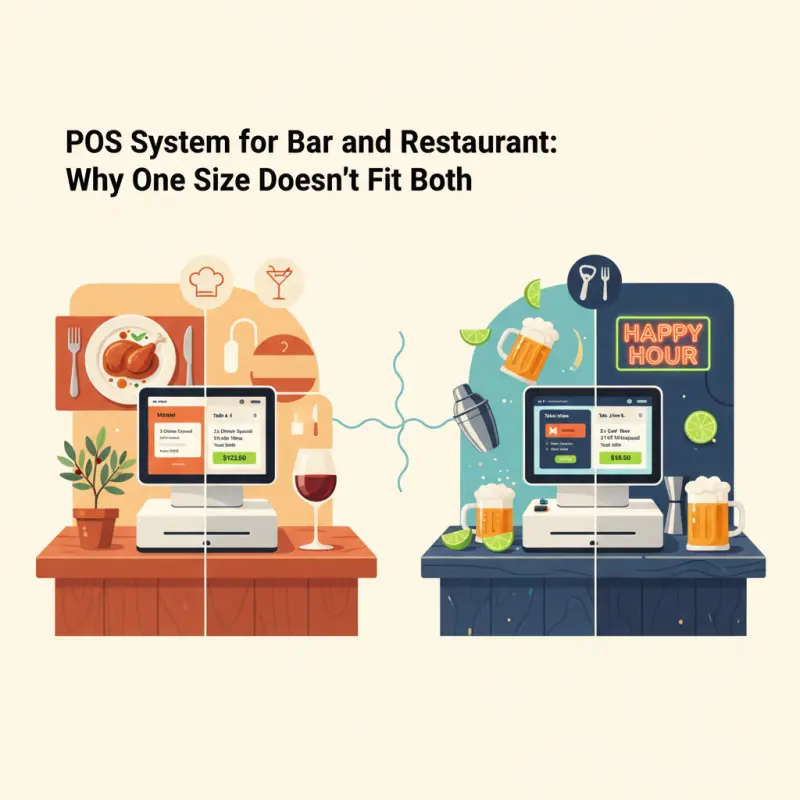
A unified POS system for bar and restaurant operations requires different optimization than traditional restaurant-only systems. Bar service demands 30-second transaction processing with complex tab management, while restaurant service needs detailed modification capabilities for 90-minute dining experiences. Generic POS systems optimize for one workflow, creating bottlenecks during peak hours when establishments in Casablanca and Marrakech run both operations simultaneously. The fundamental difference lies in transaction flow: bars handle immediate payment with frequent tab modifications, splits, and transfers, while restaurants follow predictable seat-order-serve-bill sequences. Morocco's hospitality establishments lose an estimated 15,000 MAD monthly when their POS system can't handle both workflows efficiently. Choose a POS system that adapts interface and functionality based on service type rather than forcing both operations through the same workflow constraints.
Table of Contents
You're losing 15,000 MAD monthly because your POS system treats your bar like a restaurant. That's the conservative estimate for a mid-sized Casablanca establishment running both bar service and table dining — and most operators don't realize it until they audit their workflows.
The problem isn't the technology. It's that most POS systems force you to choose: optimize for quick bar transactions or complex restaurant orders. Meanwhile, your Friday night reality demands both — simultaneously.
The Real Cost of POS Mistakes in Bar and Restaurant Operations
Here's what actually happens when you pick the wrong POS system for bar and restaurant operations. At 10 PM on a busy night in Marrakech, your bartender abandons three cocktail orders to help a server figure out table modifications. Those three customers wait. Two leave. You've just lost 450 MAD in immediate revenue plus their future visits.
This scenario repeats nightly across Morocco because operators underestimate the workflow differences between bar and restaurant service. Your bar processes 30-second transactions with immediate payment. Your restaurant manages 90-minute experiences with complex modifications. One POS system can't excel at both — unless it's built to adapt.
Why Bar Operations Break Generic Restaurant POS Systems
Tab management differs fundamentally from table service. A restaurant table follows a predictable flow: seat, order, serve, bill. A bar tab opens, modifies, splits, merges, and transfers throughout the night. Generic restaurant systems treat tabs like simplified tables. They crash when handling the complexity of real bar service.
Speed requirements tell the same story. Your bartender needs sub-30-second order entry for a beer. Your server needs detailed modification options for a tagine order. Traditional POS systems optimize for one or the other. During peak hours, this limitation costs you customers.
The Hidden Costs Competitors Don't Mention
Transaction fees hit differently when you're selling high-margin cocktails versus food items. A 2.9% fee on a 120 MAD cocktail with 80% margin hurts more than the same percentage on a 90 MAD meal with 30% margin. Over a month, these fees on alcohol sales alone can reach 8,000 MAD for a busy establishment.
Integration costs multiply when your POS doesn't communicate with inventory systems. Manual stock counts for both bar and kitchen inventory add four hours weekly of staff time. That's 3,200 MAD monthly in labor costs that automated systems eliminate.
| Hidden Cost Category | Monthly Impact (MAD) | Annual Loss |
|---|---|---|
| Transaction fees on high-margin items | 8,000 | 96,000 |
| Manual inventory reconciliation | 3,200 | 38,400 |
| Lost sales from workflow delays | 4,500 | 54,000 |
| Staff training on complex systems | 2,000 | 24,000 |
Stack audit
What do you currently use?
Tick what you have. We’ll show what OCHI replaces or connects to.
What Actually Matters:
Workflow-First POS Selection
Forget feature lists. Start with Friday night at 9 PM. Your bar has 15 active tabs. The restaurant has eight tables in various stages of service. Two servers called in sick. This is when your POS system either supports or sabotages your operation.
The right system adapts to your reality, not the other way around. It switches seamlessly between quick bar service and detailed table management. It handles both the speed of cocktail orders and the complexity of dinner modifications.
Peak Hour Reality Check
Processing 15 simultaneous bar orders requires different architecture than managing restaurant tables. Bar orders need instant entry, quick payment processing, and tab flexibility. Restaurant orders need course management, kitchen routing, and table status tracking.
Most operators discover this difference during their busiest hours. When your bartender can't quickly transfer a tab to a table, or your server can't process a standing bar order, you're losing money. Every workflow friction during peak hours translates to lost revenue.
The Cafe POS System Trap for Multi-Concept Operations
Cafe pos system solutions look attractive with their simplicity. They handle coffee orders brilliantly. Then dinner service arrives, and their limitations surface. No course management. Limited modification options. Basic reporting that misses the nuances of alcohol sales versus food revenue.
The trap deepens when you realize switching systems mid-day isn't viable. Your staff can't learn two interfaces. Your data gets fragmented. You end up forcing a square peg into a round hole, compromising both experiences.
POS Systems for Food Trucks vs. Fixed Locations:
The Mobility Question
Here's the surprise: pos systems for food trucks often handle bar rushes better than traditional restaurant systems. They're built for speed, reliability without constant internet, and high-volume transactions. These same qualities that make point of sale systems for food trucks essential for mobile operations translate perfectly to busy bar service.
Agadir's beachfront restaurants discovered this when adding mobile bars for summer events. Their traditional systems couldn't handle the portability requirements. Food truck-optimized systems worked flawlessly both at the permanent bar and beach locations.
When Your Restaurant Needs Food Truck Flexibility
Pop-up locations and catering extensions demand the same flexibility as food truck operations. Your POS needs offline functionality, battery operation, and cellular connectivity options. These aren't edge cases anymore — they're standard requirements for growing restaurants.
OCHI's approach recognizes this evolution. The same system that powers your main location works seamlessly at festival booths or private events. No data fragmentation. No learning curve. Just consistent operations wherever you serve.
The Integration Reality:
Why Your POS System Needs to Play Nice
Manual data entry between systems kills profitability. When your POS doesn't sync with cafe accounting software, you're paying someone to transpose numbers. That's three to four hours weekly of error-prone work that automation eliminates instantly.
The real cost appears in discrepancies. Your POS shows 2,000 MAD in wine sales. Your accounting shows 1,850 MAD. Someone spends hours hunting the difference. Meanwhile, inventory discrepancies compound because three systems don't communicate.
OCHI's Modular Approach to Bar and Restaurant Operations
Integration shouldn't be an afterthought. OCHI builds it into the foundation. Your POS, inventory, and accounting exist in one system. Bar sales automatically deduct from beverage inventory. Restaurant orders route to the appropriate kitchen stations. Everything syncs without manual intervention.
The zero-commission model matters especially for high-margin bar sales. Traditional platforms taking 25-30% commission on your cocktail revenue destroy profitability. OCHI's approach — you keep 100% of sales — makes the math work for both bar and restaurant operations.
The Morocco-Specific POS Challenge
International POS systems assume card-first payment cultures. In Morocco, cash remains king for many transactions, especially in bars. Your POS needs robust cash management, shift reconciliation, and multi-currency support for tourist areas.
Language switching mid-transaction isn't a nice-to-have — it's essential. Your Francophone customer expects French receipts. Your Arabic-speaking staff needs Arabic interfaces. Tourist areas require English options. Most international systems treat this as an afterthought.
Building for Casablanca vs. Agadir Operations
Casablanca's business lunch culture demands different POS workflows than Agadir's tourist-heavy evening service. Quick corporate billing, invoice generation, and expense account management matter in business districts. Tourist areas need multi-currency display, quick language switching, and simplified payment flows.
OCHI adapts to these regional differences. The same platform flexes to support rushed business lunches and leisurely tourist dinners. Your team uses one system. Your customers get the experience they expect.
Smart operators stopped choosing between bar and restaurant optimization. They demand systems that excel at both. See how OCHI adapts to your specific workflow at ochi.ma/partners. Your branded subdomain at votrenom.ochi.ma puts you in control without commission fees eating your margins.
Frequently Asked Questions
Can one POS system handle both bar and restaurant operations effectively?
Yes, but only if the system adapts its interface and workflow for each service type. Generic restaurant POS systems fail because they apply table service logic to bar operations, creating inefficiencies during peak hours.
What's the main difference between bar and restaurant POS requirements?
Bar operations need sub-30-second transaction processing with complex tab management features like splitting, merging, and transfers. Restaurant operations require detailed modification options and longer transaction flows for complete dining experiences.
How much revenue do dual operations lose with the wrong POS system?
Mid-sized establishments in Morocco typically lose around 15,000 MAD monthly due to workflow inefficiencies when using restaurant-optimized POS systems for bar service.
What features should I look for in a bar and restaurant POS system?
Essential features include adaptive interfaces for different service types, advanced tab management, quick-fire ordering for bar service, detailed modification capabilities for restaurant orders, and unified reporting across both operations.
Why do bartenders abandon orders when using restaurant POS systems?
Restaurant POS systems aren't optimized for the speed and tab complexity of bar service. Bartenders get pulled away from quick transactions to help servers navigate complex modification screens, causing customer wait times and lost sales.
Restaurant owners · Weekly
The guide to running a restaurant in 2026.
One article per week. No commission advice. Just honest operational insight for Moroccan restaurants.

Blog Manager
Comments
No comments yet. Be the first to share your thoughts.