POS System for Quick Service Restaurant: Why Generic Solutions Fail
Blog Manager
··5 min read
AI Overview
A pos system for quick service restaurant must process transactions in under 47 seconds to maintain profitability during peak hours. Generic POS solutions fail because they use central server architecture that creates bottlenecks when processing multiple orders simultaneously. In Morocco's QSR market, system delays of just 30 seconds per transaction cost operators 2,720 MAD daily in lost sales. Quick service operations require integrated Kitchen Display Systems, offline functionality, and real-time inventory tracking — features that traditional restaurant POS systems often lack. Restaurant owners need specialized QSR technology that handles high-volume transactions without performance degradation. The most critical requirement is choosing a system designed specifically for quick service operations rather than adapting fine-dining solutions.
Table of Contents
For restaurant owners
Start your restaurant in 60 minutes.
From signup to your first real order — no commission, no setup fee, no sales call.
Your restaurant's POS crashed during Friday lunch rush. Again. While customers waited, orders piled up, and your staff scrambled with handwritten tickets, you lost 4,200 MAD in just 90 minutes — the exact cost of a proper POS system for quick service restaurant operations.
Most restaurant owners discover their POS limitations only after losing money. The real question isn't whether you need a better system. It's understanding what makes QSR operations fundamentally different from traditional dining — and why generic POS solutions keep failing when it matters most.
Why Quick Service Restaurant POS Systems Fail During Peak Hours
The math of quick service is unforgiving. In a Casablanca QSR, average transaction time determines whether you serve 200 or 120 customers during lunch. At 47 seconds per transaction, you're profitable. At 90 seconds, you're watching customers walk away.
Here's what that means in real numbers. A typical QSR in Morocco Marina processes 180 transactions during peak lunch (12:00-14:00). When your POS adds just 30 seconds to each order through slow payment processing or system lag, you lose 32 potential sales. At an average ticket of 85 MAD, that's 2,720 MAD gone every single day.
But the visible losses tell only half the story. When systems slow down, kitchen errors increase by 23%. Staff stress triggers higher turnover — replacing a trained cashier costs 4,500 MAD in recruitment and training. Customer satisfaction drops, and unlike a fine dining restaurant where guests expect to wait, QSR customers simply don't return.
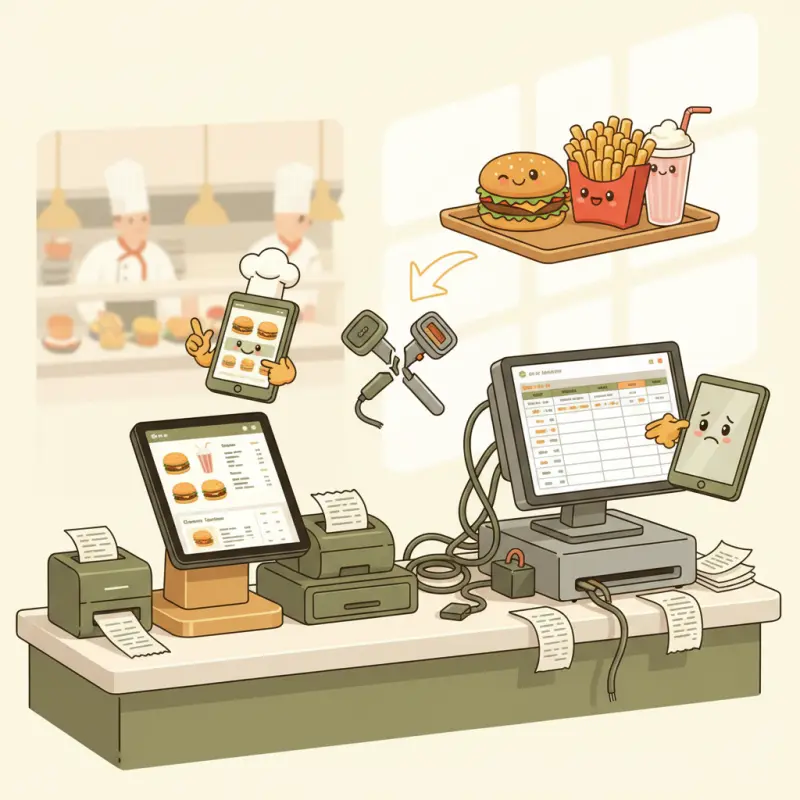
The breaking point comes from poor system architecture. Traditional POS systems process everything through a central server. During peak hours, every menu lookup, every payment authorization, every kitchen ticket creates a bottleneck. When 40 orders hit simultaneously, the system chokes.
Stack audit
What do you currently use?
Tick what you have. We’ll show what OCHI replaces or connects to.
The Three Non-Negotiable Features Your Cafe POS System Must Have
Kitchen Display System Integration
Paper tickets in a QSR are operational suicide. They get lost, smudged, or grabbed in the wrong order. A proper Kitchen Display System shows orders on screen, color-coded by preparation time. Items turn yellow at 5 minutes, red at 8 minutes. Your kitchen staff sees exactly what to prioritize.
The impact is measurable. Restaurants using OCHI's KDS report 23% fewer order errors and 4.2 minutes faster average completion time. For a cafe serving 300 orders daily, that's 21 hours saved per week — enough to eliminate one full staff shift.
Multi-Payment Processing for Moroccan Market
Morocco runs on cash, cards, and increasingly, mobile payments. Your cafe POS system must handle all three without switching screens or reopening orders. During morning coffee rush, a customer pays 45 MAD cash for their order, then realizes they want to add a pastry using their card. Can your system handle that in under 15 seconds?
Split payments matter even more for group orders. Four colleagues sharing lunch need individual receipts for expense claims. OCHI processes split payments with automatic receipt generation — each person gets their itemized bill instantly via SMS.
Real-Time Inventory Alerts
Nothing kills QSR momentum like discovering you're out of a popular item mid-rush. Real-time inventory tracking prevents the dreaded "sorry, we don't have that" conversation. Set alerts at ingredient level — when chicken stock drops below 5kg, your kitchen manager gets notified before it impacts service.
Integration with cafe accounting software takes this further. Every sale automatically updates food costs, showing real-time margins. You'll know if that 55 MAD sandwich actually makes money after ingredient price changes.
Food Truck POS Systems vs. Fixed Location — The Overlooked Differences
Food trucks face unique challenges that brick-and-mortar QSRs never consider. Your POS systems for food trucks must survive without reliable power or internet while handling the same transaction volume as a fixed location.
Requirement
Fixed QSR
Food Truck
Battery Life
N/A (plugged in)
8+ hours minimum
Internet Backup
Fiber + 4G
Dual SIM 4G required
Hardware Size
Standard terminal
Compact/tablet-based
Weather Rating
Indoor only
IP54 water resistant
GPS Integration
Fixed address
Live location tracking
Point of sale systems for food trucks need offline capability. When you're serving at Agadir beach and 4G drops, orders must continue processing locally, then sync when connection returns. OCHI maintains full functionality offline — orders, payments, inventory updates all queue automatically.
Location matters for food trucks. Customers finding you through the OCHI marketplace see your real-time GPS position. Park at a new spot? Your location updates instantly. Set up delivery zones that move with your truck — a 2km radius from wherever you're currently serving.
The Hidden Costs of "Free" POS Systems — A Moroccan Restaurant Owner's Breakdown
Khalid runs a popular shawarma QSR in Agadir. His "free" POS system seemed perfect until he calculated the real costs. Transaction fees of 2.9% plus 3 MAD per order. Monthly software suddenly costing 450 MAD after the trial. Integration fees of 1,200 MAD for accounting software. Commission on delivery orders at 30%.
His monthly breakdown shocked him. Processing 4,000 transactions averaging 75 MAD, he paid 8,700 MAD in transaction fees alone. Add software, integrations, and delivery commissions — his "free" system cost 14,800 MAD monthly.
Compare that to OCHI's zero-commission model. Same 4,000 transactions, but you keep every dirham. No percentage cuts, no hidden fees. Even accounting for OCHI's transparent monthly platform fee, Khalid saves over 12,000 MAD monthly — enough to hire two additional staff members.
The savings compound when you factor in operational efficiency. Faster checkout means more customers served. Accurate inventory reduces waste. Integrated systems eliminate manual data entry. Real restaurants report 15-20% revenue increase just from operational improvements.
How OCHI's Modular Platform Adapts to Your QSR Type
Every quick service format has different needs. OCHI's modular approach means you activate only what serves your operation, keeping the interface clean and training simple.
Counter service setups focus on speed. Customers scan table QR codes to browse and order while queuing. By the time they reach the counter, payment processes instantly. Your screen shows only active orders — no cluttered interface slowing decisions. The KDS displays orders by pickup time, ensuring hot food stays hot.
Drive-through operations need different workflows. Orders flow from the ordering point to kitchen to pickup window. OCHI tracks timing at each stage, showing bottlenecks in real-time. If kitchen prep averages 3.5 minutes but car queue time is 6 minutes, you know to add a second order-taker, not kitchen staff.
Multi-location restaurant groups get centralized control without losing local flexibility. Set company-wide pricing from one dashboard while allowing branches to manage daily specials. View consolidated reports across all locations or drill into single-branch performance. Staff permissions follow — a branch manager in Marrakech can't accidentally change Casablanca's menu.
Your existing systems don't become worthless. OCHI integrates with major cafe accounting software platforms through automated exports. Daily sales, inventory changes, and payment reconciliations flow directly to your accounting system. No double entry, no manual uploads.
The question isn't whether you need a better POS system for quick service restaurant operations. It's whether you'll make the change before or after your next costly crash. Smart operators don't wait for failure — they prevent it.
Configure your POS at votrenom.ochi.ma — see exactly how it works for your restaurant type before committing.
Frequently Asked Questions
What makes a POS system suitable for quick service restaurants?
A QSR POS system must process transactions in under 47 seconds, integrate with Kitchen Display Systems, and maintain performance during peak hours when handling 40+ simultaneous orders.
How much revenue do QSR operators lose with slow POS systems?
A 30-second delay per transaction costs Moroccan QSRs approximately 2,720 MAD daily in lost sales during peak lunch hours.
Why do traditional restaurant POS systems fail in quick service environments?
Traditional POS systems use central server architecture that creates bottlenecks during high-volume periods, causing system slowdowns when processing multiple orders simultaneously.
What are the essential features for a quick service restaurant POS?
Essential features include Kitchen Display System integration, offline functionality, real-time inventory tracking, and the ability to maintain sub-50-second transaction times during peak hours.
How does POS system performance affect QSR profitability?
Transaction speed directly impacts customer volume — serving 200 customers versus 120 during lunch rush depends on maintaining 47-second average transaction times.
Restaurant owners · Weekly
The guide to running a restaurant in 2026.
One article per week. No commission advice.
Just honest operational insight for Moroccan restaurants.
Blog Manager
Comments
No comments yet. Be the first to share your thoughts.