AI Overview
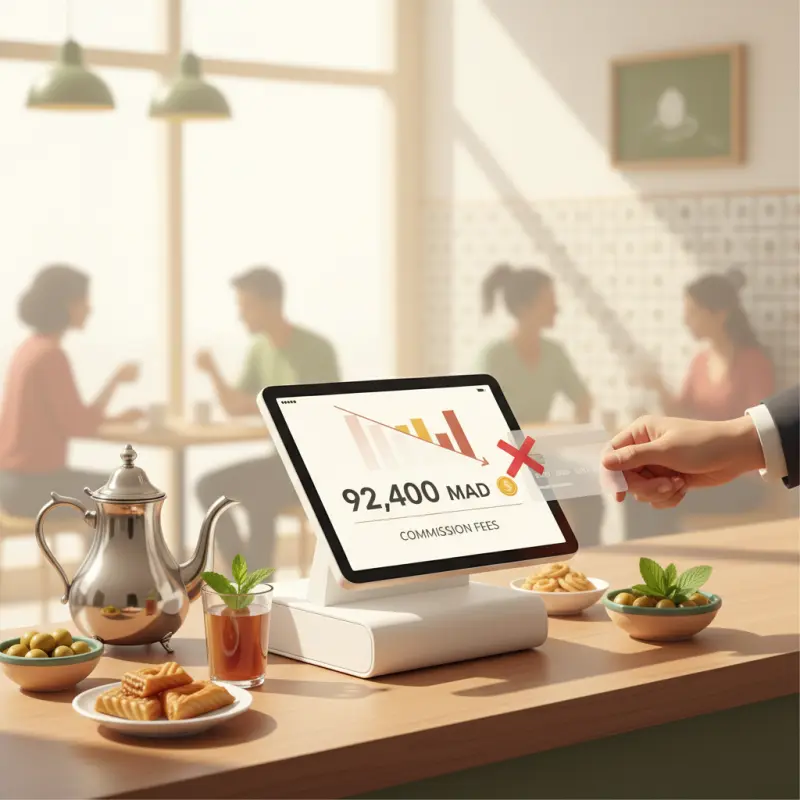
Commission-based cafe pos system platforms cost Moroccan cafes 92,400 MAD annually through 3% transaction fees and subscription tiers. A typical Casablanca cafe processing 100 daily orders at 80 MAD average loses 7,200 MAD monthly to commissions alone. Traditional systems like Square and Toast charge additional fees for essential features including inventory tracking, loyalty programs, and multi-device support. Fixed-cost alternatives eliminate commission fees entirely while providing integrated POS, inventory management, and delivery tracking in one dashboard. Café Venezia in Marrakech exemplifies the multi-platform chaos — using separate systems for dine-in, delivery, and inventory led to stock shortages and operational confusion. Calculate your current commission costs by multiplying monthly order volume by average ticket size, then by 3% — this reveals your annual drain.
Table of Contents
Every morning at 6 AM, Ahmed opens his cafe in Casablanca's Maarif district and watches 8,760 MAD disappear from his monthly revenue. Not from theft or waste — from commission fees on his cafe POS system. This silent profit drain affects thousands of Moroccan cafe owners who chose the wrong platform.
The Hidden Cost Crisis:
Why Your Cafe POS System Might Be Bleeding Money
Traditional platforms charge 3% commission on every order. For a typical Casablanca cafe processing 100 daily orders at 80 MAD average, that's 240 MAD vanishing daily. Monthly? 7,200 MAD. Add payment processing fees at 2.5%, and you're at 8,760 MAD — enough to hire another barista.
The math gets worse when you factor in subscription tiers. Most cafe POS systems start cheap — 299 MAD monthly for "basic" features. But basic doesn't include inventory tracking. Or loyalty programs. Or multi-device support. By the time you add essentials, you're paying 1,499 MAD monthly plus commissions.
Commission Fees vs. Fixed Costs:
The 12-Month Math
Here's what cafe owners rarely calculate:
| Cost Type | Commission Model (3%) | Fixed Cost Model | Annual Difference |
|---|---|---|---|
| Monthly Orders | 3,000 × 80 MAD | 3,000 × 80 MAD | — |
| Commission | 7,200 MAD | 0 MAD | 86,400 MAD saved |
| Platform Fee | 1,499 MAD | 999 MAD | 6,000 MAD saved |
| Payment Processing | 1,560 MAD (2.5%) | 1,560 MAD (2.5%) | — |
| Total Monthly | 10,259 MAD | 2,559 MAD | 92,400 MAD saved/year |
That's 92,400 MAD annually — enough to open a second location or upgrade equipment. Yet most cafes stick with commission-based systems because switching seems complex.
The Multi-Platform Trap
Walk into any busy cafe and you'll see the chaos: one tablet for dine-in orders, another for delivery platforms, a third for inventory. Each system has its own login, its own reports, its own way of tracking stock.
Café Venezia in Marrakech learned this lesson painfully. They used three separate systems — losing track of coffee bean inventory across platforms. Result? Running out of their signature blend during Friday rush hour, twice monthly. The real cost wasn't just lost sales; it was customer trust.
Platform comparison
Where does your money really go?
| Commission | 27% | 25% | 30% | 0% |
| Customer data | They own it | They own it | They own it | You own it |
| Your branding | Theirs | Theirs | Theirs | Yours |
| Payout cadence | Biweekly | Weekly | Biweekly | Weekly |
| Setup cost | Free | Free | Free | Paid |
Cafe Operations vs. Restaurant Operations:
The Workflow Difference
Most POS guides treat cafes like small restaurants. Wrong approach. A restaurant serves 15-minute meals; cafes serve 2-minute coffees. This speed difference changes everything about your POS needs.
The Speed Problem:
2-Minute Average vs. 15-Minute Dine-in
Restaurant POS systems assume table service workflows. Cafes need queue management. When five customers order simultaneously during morning rush, your system must handle rapid customizations — extra shot, oat milk, half sweet, extra foam — without slowing down.
Split payments compound the problem. Four friends, four different payment methods, one order. Restaurant systems make this a five-tap nightmare. Proper cafe POS systems handle it in two taps.
Coffee variations multiply complexity. A pizza has maybe 20 topping combinations. A coffee menu? Try 200+ when you factor size, milk type, shots, syrups, temperature preferences. Your POS must make these modifications instant, not buried in menus.
Inventory Complexity: Managing Perishables and Portions
Coffee bean tracking differs fundamentally from pizza ingredient management. A pizzeria tracks mozzarella by kilogram. Cafes track beans by shot — 18 grams per double espresso, varying by grind and humidity.
Daily waste calculations reveal profit leaks. Milk expires. Pastries go stale. Syrups crystallize. Without real-time tracking, a cafe loses 5-8% revenue to preventable waste. Integration with cafe accounting software transforms guesswork into data-driven decisions.
Portion control matters more in cafes than restaurants. Over-pour milk by 20ml across 100 lattes daily? That's 60 liters monthly — 1,200 MAD in hidden costs.
The Feature Hierarchy:
What Actually Matters First
Cafe owners get sold on AI analytics before they have working payment processing. Here's what actually matters, in order.
Tier 1: Must-Have Before You Open
Payment processing that works offline tops the list. Moroccan internet isn't perfect. When connection drops during rush hour, you need transactions to queue and sync later. Lost sales from "sorry, system down" kill cafes.
Basic inventory alerts prevent the nightmare scenario: running out of coffee at a coffee shop. Set minimum levels. Get notifications. Simple.
Staff time tracking seems boring until you calculate labor costs. Knowing that Tuesday 2-4 PM needs one barista, not two, saves 2,400 MAD monthly.
Tier 2: Growth Features (Month 6+)
Customer loyalty programs make sense after establishing operations. Points per purchase, tier rewards, birthday bonuses — but only after your basics run smoothly.
Advanced reporting reveals patterns. Which pastries sell with morning coffee? Which afternoon drinks have highest margins? Data drives menu decisions.
Multi-location management becomes critical when expanding. Centralized inventory, shared customer database, comparing branch performance — essential for growth.
Tier 3: Nice-to-Have (Year 2+)
AI analytics can predict tomorrow's milk needs based on weather. Marketing automation can text customers their favorite drink is back. Complex integrations can sync with accounting systems. Nice features — after mastering operations.
Mobile Operations: When Your Cafe Becomes a Food Truck
The lines between fixed cafes and mobile operations blur. Today's successful cafes expand to events, festivals, pop-ups. Your POS must follow.
POS Systems for Food Trucks vs. Fixed Location
Internet connectivity becomes critical for mobile operations. Food truck POS systems need robust offline modes with automatic sync when connection returns. Battery life matters — 8-hour minimum without charging.
Hardware durability changes for mobile use. Dust, heat, movement — point of sale systems for food trucks endure conditions that would destroy regular tablets. Protective cases and backup units become essential.
Location tracking helps analyze event profitability. Which festivals generate highest sales? Which neighborhoods order most? Mobile POS data reveals expansion opportunities.
Event and Pop-Up Considerations
Pop-ups need instant setup. Pre-loaded menus, quick staff training, immediate payment acceptance. The same system running your main cafe should power your music festival booth.
Inventory synchronization prevents overselling. If your food truck sells 50 iced coffees, main location inventory should reflect those beans and milk used. Real-time sync prevents stockouts.
Some cafes evolve into specialized concepts. Pizza restaurant POS systems share surprising overlap with cafe needs — speed, customization, portion tracking. Choose platforms that adapt as you grow.
The OCHI Approach:
Modular POS Without the Markup
OCHI built differently. Zero commission. Modular features. You pay for what you use, keep what you earn.
Real Cafe Scenario:
Café Atlas in Agadir
Café Atlas processes 150 orders daily at 75 MAD average. Traditional platforms would charge 337.50 MAD daily in commissions — 10,125 MAD monthly. Annual commission cost: 121,500 MAD.
With OCHI, Café Atlas pays fixed monthly platform fees. No percentage cut. Those 121,500 MAD stay in their account, funding expansion to Agadir beach with a mobile coffee cart.
Their branded domain — cafeatlas.ochi.ma — maintains professional presence. Customers order directly, no app downloads. Same menu prices online and in-store. Transparency builds trust.
Modular Features That Scale with Growth
Start simple. Basic POS, payment processing, inventory alerts. Add delivery zones when ready. Enable loyalty programs after establishing customer base. Integrate accounting when complexity demands it.
Branch management activates when you expand. Table ordering turns on for dine-in service. Kitchen display systems help when food menu grows. Pay for features when you need them, not before.
The platform adapts to concept changes. Start as a cafe, add pizza? The infrastructure supports pizza restaurant POS systems requirements. Expand to events? Mobile capabilities activate instantly.
Every successful cafe in Morocco faces the same choice: accept commission fees as "cost of business" or find platforms that respect your margins. The math is clear. The decision is yours.
See how OCHI transforms cafe operations at ochi.ma/partners — where your revenue stays yours.
Frequently Asked Questions
How much do commission fees cost cafes in Morocco?
A typical Moroccan cafe processing 3,000 monthly orders at 80 MAD average pays 7,200 MAD monthly in 3% commission fees, totaling 86,400 MAD annually.
What hidden costs do cafe POS systems charge?
Beyond base subscription fees, most cafe POS systems charge extra for inventory tracking, loyalty programs, multi-device support, and advanced reporting. These add-ons can increase monthly costs from 299 MAD to 1,499 MAD.
Can cafes eliminate commission fees entirely?
Yes, fixed-cost POS platforms charge a flat monthly fee with zero commission on orders. This saves cafes 86,400 MAD annually in commission fees alone.
Why do cafes use multiple POS systems?
Many cafes use separate tablets for dine-in orders, delivery platforms, and inventory management because their primary POS system lacks integration. This creates operational chaos and inventory tracking problems.
What features should a cafe POS system include?
Essential features include integrated ordering, inventory tracking, payment processing, staff management, and delivery coordination. The best systems combine all functions in one dashboard without per-transaction fees.
Restaurant owners · Weekly
The guide to running a restaurant in 2026.
One article per week. No commission advice. Just honest operational insight for Moroccan restaurants.

Blog Manager
Comments
No comments yet. Be the first to share your thoughts.