AI Overview
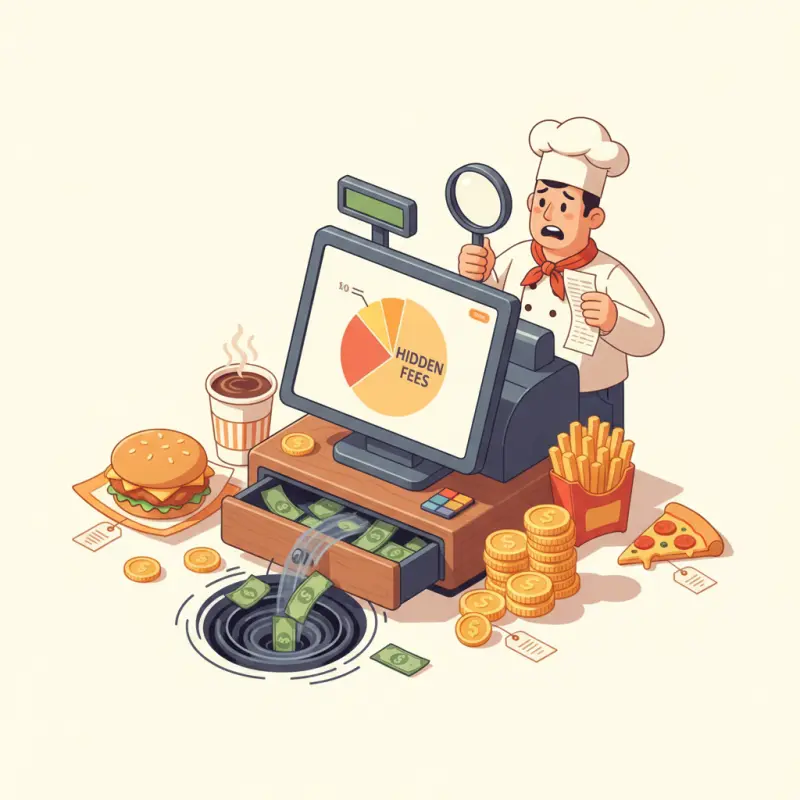
Quick service point of sale software often carries hidden costs that exceed advertised monthly fees by 300-400%. Traditional POS systems charge restaurants in Morocco base fees of 500-2,000 MAD monthly, plus transaction fees of 2.5-3.5%, delivery integration fees of 2-5%, and additional charges for SMS notifications at 0.30 MAD each. A restaurant processing 200 daily orders at 50 MAD average pays 9,000 MAD monthly in transaction fees alone — equivalent to one full employee's salary. Standard restaurant POS software assumes 45-minute table service cycles but quick service operates on 30-second decisions and two-minute fulfillment windows. This mismatch creates operational chaos during peak hours when customers order custom combinations requiring multiple screen taps. Calculate total cost per transaction rather than monthly subscription fees when evaluating quick service POS systems.
Table of Contents
The Hidden Cost Problem:
Why "Fast" POS Systems Actually Slow Down Your Profits
Every quick service restaurant owner in Morocco knows this scene: a vendor promises their quick service point of sale software costs just 500 MAD per month. Three months later, you're staring at an invoice showing thousands in transaction fees, integration charges, and "premium feature" upgrades.
The real cost of restaurant technology isn't in the monthly subscription. It's in the invisible percentages that compound with every sale. When your cafe in Casablanca processes 200 orders daily at 50 MAD average, a 3% transaction fee quietly removes 9,000 MAD from your monthly revenue. That's a full employee's salary disappearing into processing fees.
Traditional platforms layer costs at every level. Base software: 500-2,000 MAD. Payment processing: 2.5-3.5%. Third-party delivery integration: another 2-5%. SMS notifications: 0.30 MAD each. Staff training modules: 100 MAD per user. By month six, that "affordable" system consumes 8-12% of gross revenue.
Smart operators calculate total cost per transaction, not monthly fees. A food truck processing 50 orders daily needs to factor every swipe fee, every SMS alert, every support ticket. The math changes your entire evaluation framework.
Stack audit
What do you currently use?
Tick what you have. We’ll show what OCHI replaces or connects to.
Quick Service Workflows That Break Standard POS Systems
Standard restaurant POS software assumes table service with 45-minute dining cycles. Quick service operates on 30-second decisions and two-minute fulfillment windows. The mismatch creates operational chaos during peak hours.
Watch a lunch rush at any popular sandwich shop in Marrakech. Customers order combinations that don't exist on the preset menu — extra sauce, no tomatoes, half portions, custom wraps. Each modification requires multiple screen taps on traditional systems. Kitchen staff receive tickets showing base items without the critical customization details that define the actual order.
Peak performance demands specific design choices. Touch targets sized for speed. Single-screen order flow. Modification buttons that don't require menu diving. Real-time kitchen display updates showing exact prep status. These aren't luxury features — they're operational requirements when your average order window is under 90 seconds.
The Food Truck Reality Check
Point of sale systems for food trucks face unique constraints that brick-and-mortar restaurants never consider. Your POS runs on battery power, connects through unstable mobile networks, and processes payments in locations without reliable internet.
Agadir's food truck operators tell consistent stories. Standard cloud-based systems fail when parked in beach areas with poor cell coverage. Orders pile up in offline mode, then flood the kitchen when connection returns. Payment terminals lose sync with the main system, creating reconciliation nightmares.
Successful pos systems for food trucks maintain local data sync, process offline transactions, and handle GPS-based delivery zones. They track fuel costs per location, monitor generator usage, and calculate true profit margins including mobility expenses. Integration with route planning and customer location services transforms a mobile kitchen into a data-driven operation.
Cafe Accounting Software Integration
Cafe accounting software for quick service needs real-time visibility, not nightly batch reports. When your morning coffee rush depletes milk inventory at 10x normal rate, waiting until closing to update stock levels means running out during tomorrow's peak.
Modern cafe pos system platforms track ingredient depletion per item sold. Order a cappuccino: deduct 200ml milk, 18g coffee, one cup. Real-time margin analysis shows which drinks generate profit and which popular items actually lose money after factoring true ingredient costs.
The integration extends beyond inventory. Labor cost per item, utility usage during peak periods, waste tracking by shift — these metrics drive pricing decisions and menu optimization. Quick service thrives on tiny margins multiplied by high volume. One percentage point improvement in food cost saves thousands monthly.
The Commission vs. Subscription Model:
Real Numbers from Morocco's Restaurant Scene
Restaurant owners assume commission-based platforms reduce risk because they avoid upfront costs. The mathematics tell a different story once you move beyond 50 orders monthly.
| Monthly Orders | Average Order (MAD) | 15% Commission Cost | Flat Rate (1,500 MAD) | Monthly Savings |
|---|---|---|---|---|
| 50 | 60 | 450 MAD | 1,500 MAD | -1,050 MAD |
| 200 | 60 | 1,800 MAD | 1,500 MAD | 300 MAD |
| 500 | 60 | 4,500 MAD | 1,500 MAD | 3,000 MAD |
| 1,000 | 60 | 9,000 MAD | 1,500 MAD | 7,500 MAD |
The break-even point hits around 100 orders — less than four daily for most cafes. Beyond that threshold, commission fees compound into serious revenue loss. A busy food truck processing 30 orders daily loses 90,000 MAD annually to commission fees versus flat-rate alternatives.
Hidden costs amplify the difference. Commission platforms often charge extra for marketing features, analytics dashboards, and multi-location support. Subscription models include these capabilities in the base price, providing predictable operational costs regardless of sales volume.
OCHI's Modular Approach:
Building Your Quick Service Stack
OCHI adapts to quick service operations through modular components rather than forcing preset packages. Start with core POS and payment processing. Add kitchen display systems when order volume justifies dedicated prep screens. Enable delivery zones once mobile orders exceed walk-in traffic.
The platform's zero-commission model means growth doesn't increase costs. Process 50 orders or 5,000 — the restaurant keeps every dirham. Your branded subdomain (votrenom.ochi.ma) provides professional online presence without marketplace fees. QR table ordering for quick-casual dining requires no app downloads, reducing friction for impulse purchases.
Real-time capabilities distinguish the approach. Orders flow directly to kitchen displays with accurate prep times. Delivery tracking shows customer location and driver status. Inventory updates reflect each sale immediately, preventing stockouts during rush periods. Multi-branch operators view consolidated performance across locations while maintaining individual store autonomy.
Integration happens at the platform level. Connect your cafe accounting software once — data flows automatically. Payment processing, inventory management, customer communications all share the same data foundation, eliminating duplicate entry and synchronization errors.
Implementation Timeline: From Setup to Full Operation
Quick service restaurants can't afford extended deployment periods. Revenue stops for nobody. Here's what actual implementation looks like for a typical cafe or food truck operation.
Day one focuses on core setup. Create your branded subdomain, configure tax rates, establish payment processing. Upload your menu with prices, photos, and modifiers. Most operators complete basic configuration in three hours with clear documentation.
Days two through four cover staff training. POS operators learn order entry and payment flows. Kitchen staff practice with display screens. Delivery personnel understand dispatch and routing. Quick service succeeds through muscle memory — repetition during slow periods prevents mistakes during rush hours.
Week two introduces advanced features. Inventory tracking, automated marketing, loyalty programs. These enhance operations without disrupting core service. Common bottlenecks include payment gateway verification (start early) and menu photography (hire a professional for one day).
By week three, data patterns emerge. Which items sell fastest. Peak hour staffing needs. Ingredient depletion rates. This intelligence drives menu optimization and operational improvements that traditional systems can't provide.
The modular approach means starting simple and expanding based on actual needs. A single food truck might never need table management. A busy cafe might prioritize queue displays. Build the system your operation requires, not what vendors assume you need.
Quick service point of sale software determines whether your restaurant thrives or merely survives. The right platform multiplies efficiency, reduces costs, and provides intelligence for growth. The wrong choice creates friction that compounds into failure. Choose systems designed for your reality, not generic solutions dressed up with quick service marketing. See how OCHI's modular platform adapts to your specific quick service needs at ochi.ma/partners.
Frequently Asked Questions
What are the hidden costs in quick service point of sale software?
Hidden costs include transaction fees (2.5-3.5%), third-party delivery integration fees (2-5%), SMS notification charges (0.30 MAD each), staff training modules (100 MAD per user), and premium feature upgrades that can total 8-12% of gross revenue.
How much do transaction fees cost Moroccan restaurants monthly?
A restaurant processing 200 orders daily at 50 MAD average with 3% transaction fees pays 9,000 MAD monthly in processing costs alone. This equals one full employee's salary disappearing into fees.
Why do standard POS systems fail in quick service restaurants?
Standard POS software assumes 45-minute table service cycles while quick service requires 30-second decisions and two-minute fulfillment. Custom orders need multiple screen taps and kitchen tickets often miss critical modification details.
How should restaurants evaluate quick service POS costs?
Calculate total cost per transaction including all fees, not just monthly subscription rates. Factor transaction fees, integration costs, SMS charges, and support fees to determine true operational expense.
What features do quick service restaurants need in POS software?
Quick service needs fast order customization, clear kitchen display systems, real-time inventory tracking, and workflows designed for high-volume transactions with minimal processing time per order.
Restaurant owners · Weekly
The guide to running a restaurant in 2026.
One article per week. No commission advice. Just honest operational insight for Moroccan restaurants.

Blog Manager
Comments
No comments yet. Be the first to share your thoughts.