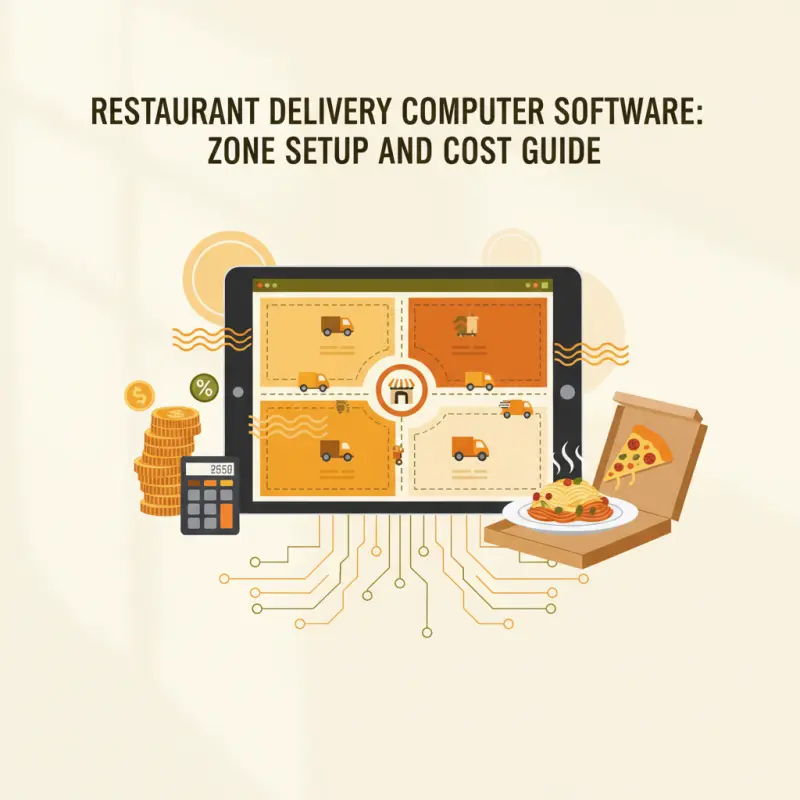
Restaurant Delivery Computer Software: Zone Setup and Cost Guide
Blog Manager
··4 min read
AI Overview
Restaurant delivery computer software offers two main zone models: polygon zones for precise neighborhood boundaries and radius zones for simple circular coverage. Polygon zones let restaurants like those in Marrakech's Gueliz district exclude problem intersections while targeting profitable areas street by street. Radius zones work better for uniform areas like university campuses where demographics and order patterns stay consistent. Traditional platforms charge 15-30% commission plus hidden fees that can reach 8% extra, while zero-commission platforms like OCHI cost MAD 399 monthly regardless of order volume. Smart zone configuration affects delivery times and profitability — a Hivernage restaurant can guarantee 25-minute delivery to luxury hotels while filtering out low-value orders. Choose polygon zones for complex urban areas with varied traffic patterns and radius zones for uniform coverage areas.
Table of Contents
For restaurant owners
Start your restaurant in 60 minutes.
From signup to your first real order — no commission, no setup fee, no sales call.
Most restaurant delivery computer software defaults to simple radius zones — draw a circle, call it done. But if you've ever tried delivering to Casablanca's Ain Diab during summer traffic, you know distance means nothing. The real question is which streets your drivers can actually reach in 30 minutes.
Polygon zones let you draw precise boundaries around neighborhoods. You trace Gueliz in Marrakech street by street, excluding that one intersection where drivers get stuck for 20 minutes. Radius zones work differently — they create perfect circles from your restaurant. A 5km radius sounds clean until half that circle is the Atlantic Ocean or industrial zones where nobody orders tagine.
The choice affects your bottom line. A Hivernage restaurant using polygons can guarantee 25-minute delivery to luxury hotels while excluding budget neighborhoods that expect free delivery on small orders. A campus pizzeria near Université Hassan II might prefer a simple 3km radius — students everywhere, similar order sizes.
OCHI's zone builder shows real streets on an interactive map. You click points to create polygons or drag to adjust radius. Each zone gets its own delivery fee and minimum order. The system remembers which zones perform best — if Anfa generates 40% of revenue but only covers 2km², you'll see it in the data.
Stack audit
What do you currently use?
Tick what you have. We’ll show what OCHI replaces or connects to.
The Real Cost Breakdown: What Software Actually Costs You
Traditional online food ordering and delivery platforms hide their true cost behind percentage fees. They advertise "only 15% commission" but the math tells a different story. Payment processing adds 2.5%. Marketing fees take another 3%. Tablet rental runs MAD 200 monthly. Photography services cost MAD 2,000 upfront.
Platform Type
Base Commission
Hidden Fees
Monthly Cost (50 orders)
Annual Impact
Traditional Aggregator
15-30%
5-8% extra
MAD 3,750
MAD 45,000
OCHI Zero-Commission
0%
0%
MAD 399
MAD 4,788
For a restaurant in Agadir processing 50 delivery orders monthly at MAD 150 average, commission platforms extract MAD 3,750. That's rent money. OCHI charges MAD 399 flat — you break even at 15 orders. Everything after is pure margin.
The math shifts at scale. Process 500 orders monthly and commission fees hit MAD 37,500. That's a full-time employee's salary disappearing into platform pockets. The zero-commission model keeps that money in your business — invest in better ingredients, delivery fleet expansion, or just healthier profits.
Auto-Driver Assignment: Why Most Systems Fail During Rush Hours
Friday night, 8 PM, Ramadan. Orders flood in. Your food delivery management software assigns based on distance — driver closest to restaurant gets the order. Sounds logical until that driver is stuck in Maarif traffic while another sits idle in Bourgogne. By the time reassignment happens, food's cold.
Pure algorithmic assignment ignores human factors. Ahmed knows every shortcut in Hay Riad. Youssef speaks English for hotel deliveries. Fatima has the gate codes for secured compounds. Distance means nothing if the wrong driver gets the wrong zone.
Smart assignment needs override options. OCHI shows driver locations on a real-time map with status indicators — delivering, returning, break. Click any order, see available drivers sorted by actual delivery time (not distance), reassign in two clicks. The system learns patterns — if you manually assign Ahmed to Hay Riad orders five times, it suggests him automatically.
The hybrid approach works because rush hours aren't predictable. A football match, sudden rain, or local festival changes everything. Automatic systems handle routine. Manual control handles chaos.
GPS Tracking and Batch Deliveries: Operations That Scale
Customers track everything now — their Amazon packages, their Careem rides. Restaurant delivery demands the same transparency. But there's a balance. Update too frequently and you annoy. Update too rarely and phones ring asking "where's my food?"
Effective tracking shows three things: driver assigned, driver en route, driver nearby. Each triggers one notification. The "nearby" alert matters most — customers prepare to receive, reducing handoff time. OCHI's tracking includes ETA countdown based on real traffic data, not optimistic estimates.
Batch deliveries transform economics. Two orders heading to Palmier? One trip, 40% cost reduction. But geography alone doesn't determine good batches. Order timing matters — combine orders placed within 10 minutes. Food type matters — don't batch ice cream with hot pizza.
The food ordering and delivery platform must show drivers their full route upfront. Hidden batch assignments create problems. Drivers need to see both addresses, optimize their route, communicate if delays occur. Transparency prevents the 45-minute delivery disaster that generates bad reviews.
Choosing Software for Your Rabat Restaurant: Decision Framework
Before evaluating restaurant delivery software, project realistic numbers. Year one might bring 20 daily orders. Year two could hit 50. Your software must handle both without platform switches or data migration nightmares.
Integration complexity determines implementation time. Standalone ordering means double entry — orders into the tablet, then into your POS. Native integration syncs automatically. OCHI connects with existing systems through webhooks, updating inventory and sales reports in real-time.
Staff comfort predicts success more than features. A overcomplicated system with 50 options overwhelms. Clean interfaces with clear actions work. Your team needs five functions: view orders, update status, assign drivers, process payments, handle problems. Everything else is nice-to-have.
OCHI Implementation Timeline
Day 1: Upload your menu, set delivery zones using the map interface. Your votrenom.ochi.ma subdomain goes live immediately. Test orders confirm setup.
Day 3: Train staff on order flow. Kitchen learns the KDS display. Drivers download the mobile app. Run 10 test deliveries to nearby addresses. Fix what breaks.
Day 7: Launch to customers. Monitor first real orders closely. Adjust zone boundaries based on actual delivery times. Customer feedback reveals what marketing misses.
Week 2: Patterns emerge. Peak hours crystallize. Driver preferences become clear. The system learns your operation while you keep 100% of revenue.
Restaurant delivery computer software isn't about features — it's about fitting your actual operation. Moroccan restaurants need systems built for Moroccan realities: neighborhood-based zones, commission-free economics, and Friday night chaos management. See how OCHI handles your specific delivery challenges with zero commission fees.
Frequently Asked Questions
What's the difference between polygon and radius delivery zones?
Polygon zones let you draw precise boundaries around neighborhoods street by street, while radius zones create perfect circles from your restaurant location. Polygon zones work better for complex urban areas with traffic variations.
How much does restaurant delivery computer software really cost?
Traditional platforms charge 15-30% commission plus hidden fees totaling 5-8% extra, averaging MAD 3,750 monthly for 50 orders. Zero-commission platforms like OCHI charge flat MAD 399 monthly regardless of volume.
Which delivery zone type works best for Moroccan restaurants?
Urban restaurants in cities like Casablanca and Marrakech benefit from polygon zones to avoid traffic bottlenecks. Campus or suburban locations with uniform coverage areas work well with simple radius zones.
Can restaurants set different delivery fees per zone?
Modern restaurant delivery computer software allows unique delivery fees and minimum orders per zone. This lets restaurants charge premium rates for distant areas while offering competitive pricing in high-volume neighborhoods.
Restaurant owners · Weekly
The guide to running a restaurant in 2026.
One article per week. No commission advice.
Just honest operational insight for Moroccan restaurants.
Blog Manager
Comments
No comments yet. Be the first to share your thoughts.