AI Overview
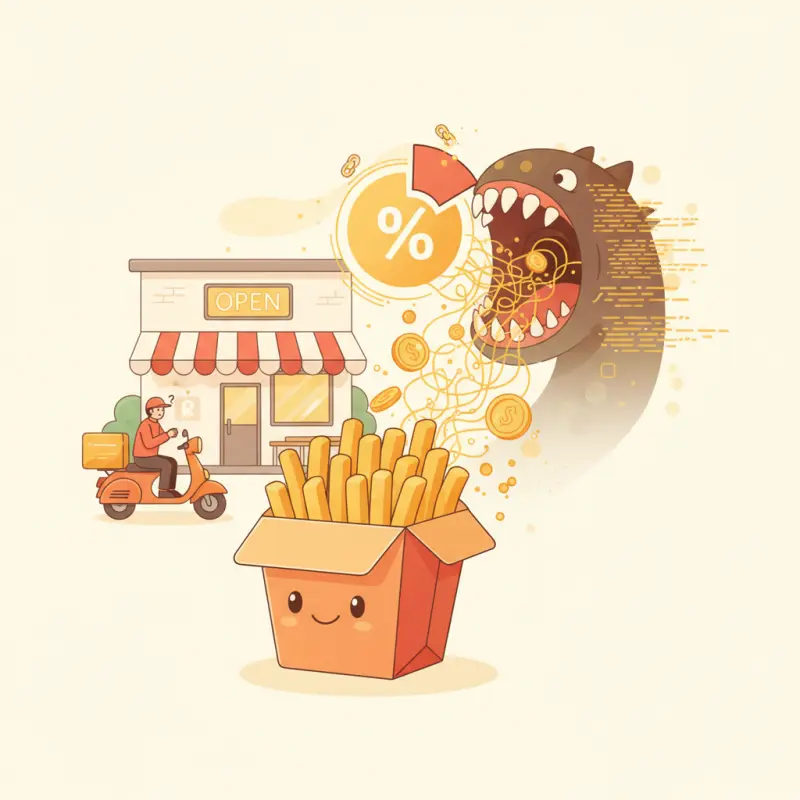
Restaurant delivery software pricing deliberately obscures total costs through layered commission structures and hidden fees. While platforms advertise 15% commissions, additional payment processing fees, monthly platform charges, and per-order costs typically push total expenses to 22% or higher. A MAD 5,000 monthly revenue restaurant can lose MAD 16,188 annually to these combined charges. Marrakech and Casablanca restaurant owners report discovering multiple unnamed transaction fees totaling 8% per order beyond advertised commissions. Free setup promotions often compensate through higher long-term commission rates locked into multi-year contracts. Calculate all fees including payment processing, monthly platform charges, and per-order costs before choosing any delivery platform.
Table of Contents
A restaurant in Casablanca's Maarif district was bleeding MAD 12,000 monthly through delivery commissions — money that should have gone toward a second chef. This is the reality of restaurant delivery software pricing: the math is designed to hide the true cost.
Most online food ordering and delivery platforms make their money through commissions, not software fees. Understanding this distinction changes everything about how you evaluate platforms.
Why Most Restaurant Delivery Software Pricing Is Designed to Confuse You
The confusion starts with the pitch: "Only 15% commission!" What they don't mention is the 3% payment processing fee, the MAD 299 monthly "platform fee," and the MAD 2.50 per-order "service charge." By the time you calculate everything, that 15% becomes 22%.
The Real Numbers Behind Commission Models
Here's what actually happens to a MAD 5,000 monthly revenue stream on a typical food delivery management software platform:
| Fee Type | Amount (MAD) | Annual Impact |
|---|---|---|
| 15% Commission | 750 | 9,000 |
| Payment Processing (3%) | 150 | 1,800 |
| Monthly Platform Fee | 299 | 3,588 |
| Per-Order Charges (60 orders) | 150 | 1,800 |
| Total Monthly Loss | 1,349 | 16,188 |
That's MAD 16,188 annually — enough to hire part-time staff or upgrade your kitchen equipment.
Transaction Fees That Aren't Called Transaction Fees
Food ordering and delivery platforms have mastered the art of renaming fees. "Platform maintenance" charges are transaction fees. "Order processing" fees are transaction fees. Even "driver insurance contributions" often get passed to restaurants as per-order costs.
One Marrakech restaurant owner discovered she was paying four different types of transaction fees, totaling 8% per order — on top of the advertised 20% commission.
Why "Free" Setup Usually Costs More Later
Platforms offering free setup compensate through higher commissions or locked-in contracts. A "free" MAD 5,000 setup becomes expensive when you're paying 25% commission instead of 15% for two years. The math is simple: 10% extra commission on MAD 20,000 monthly revenue costs MAD 48,000 over two years.
Platform comparison
Where does your money really go?
| Commission | 27% | 25% | 30% | 0% |
| Customer data | They own it | They own it | They own it | You own it |
| Your branding | Theirs | Theirs | Theirs | Yours |
| Payout cadence | Biweekly | Weekly | Biweekly | Weekly |
| Setup cost | Free | Free | Free | Paid |
Setting Up Delivery Zones: The Decision That Makes or Breaks Your Margins
Your delivery zone strategy determines three critical factors: delivery costs, customer satisfaction, and driver utilization. Most software for food delivery treats this as an afterthought. That's a mistake.
Polygon vs. Radius Zones: When Each Makes Sense
Radius zones work for restaurants in open areas with uniform road access — think nouvelle ville districts in Rabat or Agadir's tourist zone. Draw a 5km circle, and you're done.
Polygon zones make sense everywhere else. In Casablanca's old medina, a 3km radius might include areas that take 25 minutes to reach due to one-way streets. A polygon lets you follow actual road patterns, excluding hard-to-reach neighborhoods while including accessible areas further away.
OCHI's polygon zone builder lets you draw custom shapes on a map, adjusting for natural boundaries like the Bouregreg River in Rabat or major highways that split neighborhoods.
Driver Assignment Logic That Actually Works
Smart driver assignment considers three factors: current location, active orders, and return route efficiency. A driver finishing a delivery in Guéliz should get the next Guéliz order, not one across Marrakech.
The best restaurant delivery software calculates total route time, not just distance. In cities like Fès, where the medina's narrow streets slow delivery, time-based assignment prevents customer frustration and driver burnout.
Why Your Competition's 15km Delivery Zone Is Probably Wrong
Large delivery zones seem attractive — more potential customers. But delivering 15km away in Casablanca during rush hour means 45-minute delivery times, cold food, and negative reviews. Your actual serviceable area is smaller than you think.
Analyze your delivery data: 80% of orders likely come from within 5km. Focus on serving this core area well rather than stretching resources thin.
The GPS Tracking Problem: Real-Time vs. "Real-Time"
Not all tracking is created equal. Some platforms update location every two minutes and call it "real-time." Others ping every five seconds, draining driver batteries and overwhelming servers.
What 30-Second Updates Actually Cost You
Frequent GPS updates consume three resources: battery life, data bandwidth, and server processing. A delivery driver working eight hours with 5-second GPS updates needs two phone charges. That's lost delivery time and frustrated drivers.
OCHI uses adaptive tracking: updates every 30 seconds when moving, every two minutes when stationary. This balance provides accurate tracking without the resource drain.
When Customers Stop Caring About Location Pings
Customer research shows tracking value follows a curve. Customers check obsessively for the first five minutes, then again when delivery is imminent. The 15 minutes in between? They're doing something else.
This is why smart platforms send push notifications at key moments — "driver assigned," "driver nearby" — rather than constant updates.
Battery Drain and Driver Smartphone Requirements
High-frequency tracking means drivers need expensive phones with large batteries. This limits your driver pool and increases operational costs. One Agadir restaurant had to provide power banks to all drivers when their tracking app drained batteries in four hours.
Batch Deliveries: The Feature That Separates Profitable Restaurants From Busy Ones
Single-order dispatch is simple but expensive. Batch delivery — sending drivers with multiple orders — transforms delivery economics.
Order Density and Delivery Economics
Here's the math: A driver costs MAD 25-30 per delivery in wages, fuel, and vehicle wear. Sending them with one order to Hay Hassani costs the same as sending them with three orders to the same area.
Batch delivery turns that MAD 30 cost into MAD 10 per order. For 50 daily deliveries, that's MAD 1,000 saved — every single day.
Multi-Order Route Planning in Moroccan Cities
Route optimization in Moroccan cities requires local knowledge. Casablanca's Boulevard Zerktouni might be the shortest route, but traffic makes backstreets faster during lunch rush.
Good food delivery management software learns these patterns, suggesting routes based on time of day and traffic patterns. OCHI's system factors in prayer times, market days, and local events that affect traffic flow.
Driver Capacity Management During Peak Hours
Friday lunch in Ramadan. Saturday dinner in summer. Every restaurant has peak periods where order volume exceeds driver capacity. Smart batching increases capacity without adding drivers.
Set rules: maximum three orders per batch, maximum 20-minute route time, priority for orders going stale. This framework prevents overloading drivers while maximizing efficiency.
How Zero-Commission Changes Your Restaurant's Financial Model
Let's talk specifics. Tajine Express in Agadir processes 200 monthly delivery orders at MAD 120 average order value. That's MAD 24,000 in monthly delivery revenue.
Monthly P&L Impact of Commission-Free Ordering
| Metric | With 20% Commission | With OCHI (0% Commission) | Difference |
|---|---|---|---|
| Monthly Revenue | 24,000 | 24,000 | — |
| Commission Paid | 4,800 | 0 | +4,800 |
| Platform Fee | 299 | 0 | +299 |
| Net Revenue | 18,901 | 24,000 | +5,099 |
| Annual Savings | — | — | +61,188 |
That's MAD 61,188 staying in the restaurant's account annually.
Reinvestment Opportunities With Saved Commission
MAD 5,000 monthly buys significant improvements: professional food photography for your entire menu, social media advertising to acquire direct customers, or upgraded packaging that reinforces your brand.
One restaurant used their commission savings to hire a dedicated social media manager. Direct orders through their OCHI storefront increased 40% in three months.
Customer Data Ownership and Repeat Business Value
When customers order through commission platforms, the platform owns the relationship. They have the email, the phone number, the order history. You get an order notification.
Owning customer data means you can send targeted offers, recognize VIP customers, and build genuine loyalty. A repeat customer ordering directly is worth 5-10x more than one ordering through commission platforms.
The choice is clear. Restaurant delivery software should amplify your business, not tax it. OCHI gives you professional tools — polygon delivery zones, intelligent driver assignment, GPS tracking, batch deliveries — without taking a cut of your success. Your menu prices are your customer prices. Your revenue stays yours. See what commission-free ordering looks like for your restaurant at ochi.ma/partners.
Frequently Asked Questions
What hidden fees do restaurant delivery software platforms charge beyond commissions?
Common hidden fees include payment processing charges (typically 3%), monthly platform fees (often MAD 299), per-order service charges, and driver insurance contributions. These can add 7-10% to advertised commission rates.
How much do commission-based delivery platforms actually cost restaurants?
While platforms advertise 15-20% commissions, total costs including all fees typically reach 22-28%. A restaurant with MAD 5,000 monthly revenue can lose over MAD 16,000 annually to these combined charges.
Why do delivery platforms offer free setup if their software costs money?
Free setup is compensated through higher commission rates or longer contract terms. A free MAD 5,000 setup often means paying 25% commission instead of 15% for multiple years.
What should restaurants calculate before choosing delivery software?
Calculate total monthly costs including commission percentage, payment processing fees, monthly platform charges, per-order fees, and any setup or contract penalties. Compare annual totals, not just advertised commission rates.
Restaurant owners · Weekly
The guide to running a restaurant in 2026.
One article per week. No commission advice. Just honest operational insight for Moroccan restaurants.

Blog Manager
Comments
No comments yet. Be the first to share your thoughts.