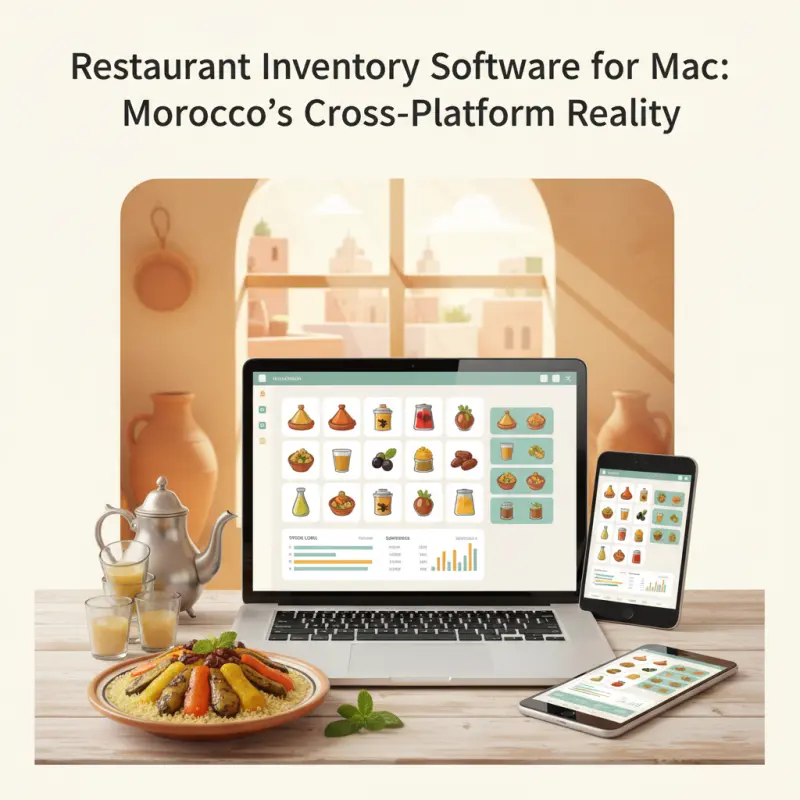
Restaurant Inventory Software for Mac: Morocco's Cross-Platform Reality
Blog Manager
··5 min read
AI Overview
Restaurant inventory software for Mac in Morocco faces three critical challenges that Windows-focused solutions ignore completely. Most restaurant inventory software for Mac turns out to be web applications running in Safari rather than native Mac programs. Restaurant owners using MacBooks and iPad POS systems encounter data export incompatibilities, requiring manual CSV transfers that cost managers 10 hours monthly in pure administrative work. Cloud-based solutions advertised at 299 MAD monthly often hide integration middleware costs of 150 MAD additional plus internet dependency risks during Maroc Telecom outages. Mac users in Casablanca and Agadir restaurants struggle with limited Mac-specific technical support when systems fail during peak service hours. The ecosystem integration Apple promises breaks down when restaurant software vendors prioritize Windows compatibility over native Mac functionality. Choose integrated platforms that handle both POS and inventory natively rather than cobbling together separate Mac-incompatible systems.
Table of Contents
For restaurant owners
Start your restaurant in 60 minutes.
From signup to your first real order — no commission, no setup fee, no sales call.
Your Mac sits open on the restaurant counter, Safari tabs multiplying as you search for inventory software that actually works. Most restaurant inventory software for Mac turns out to be just web apps wearing native clothing. Here's what nobody tells Mac-using restaurant owners in Morocco: you're not choosing between features — you're choosing between fundamentally different ways of running your business.
Why Mac Restaurant Owners Face Different Inventory Challenges
Walk into any modern restaurant in Casablanca and you'll spot the pattern: MacBooks at the manager's desk, iPads at the POS stations, iPhones in every server's pocket. The Apple ecosystem promises seamless integration. The reality? Your restaurant stock management software probably can't talk to any of it.
Mac users encounter three specific roadblocks that Windows-dominated restaurant software ignores. First, the "Mac-compatible" label usually means "runs in Chrome." Second, your sleek iPad POS system exports data in formats that traditional inventory programs can't read. Third, when something breaks at 8pm on a Friday, Mac-specific support doesn't exist.
The Hidden Costs of Cross-Platform Compatibility
That browser-based restaurant software inventory system charges 299 MAD monthly. Seems reasonable until you factor in the real costs: constant internet dependency means one Maroc Telecom outage stops your stock counts. Cloud storage fees climb as your recipe database grows. Integration middleware to connect your Mac systems adds another 150 MAD monthly that nobody mentioned during the sales demo.
When Your POS and Inventory Don't Speak the Same Language
A restaurant owner in Agadir recently showed me their "solution": manually exporting sales data from their iPad POS as CSV files, then uploading to their inventory system every night. Twenty minutes daily becomes 10 hours monthly of pure data shuffling. At Morocco's average restaurant manager salary, that's 2,500 MAD in labor costs just to make two systems communicate.
Stack audit
What do you currently use?
Tick what you have. We’ll show what OCHI replaces or connects to.
Native Mac Apps vs. Cloud-Based Restaurant Stock Management Software
The choice between native Mac applications and browser-based solutions isn't about preference — it's about operational reality. Native apps process data locally, meaning your inventory counts continue even when the internet doesn't. Browser-based systems offer accessibility from any device but require constant connectivity and suffer from lag during peak hours.
Performance Reality: Local Processing vs. Internet Dependency
Test this yourself: open your current inventory system during Friday dinner rush when every device hammers your WiFi. Native Mac apps maintain sub-second response times because calculations happen on your machine. Cloud systems? Watch your staff wait 3-5 seconds per inventory lookup while orders pile up in the kitchen.
Operation
Native Mac App
Cloud-Based System
Inventory count (500 items)
2 minutes
8-12 minutes
Recipe cost calculation
Instant
2-4 second delay
Works offline
Yes
No
Monthly data usage
0 GB
15-20 GB
Data Control: What You Own vs. What You Rent
Your recipes, supplier contracts, and cost data represent years of refinement. With native restaurant inventory management software, this data lives on your Mac — you control backups, access, and security. Cloud systems hold your data hostage: miss a payment, lose access. Switch providers, face export fees. One Marrakech restaurant group discovered their "free data export" came as 47 separate CSV files requiring manual reassembly.
The Real Cost Breakdown: Beyond Monthly Subscription Fees
Software companies advertise monthly fees. They don't advertise the 15,000-25,000 MAD you'll spend in the first year on hidden costs. Here's what a 50-seat restaurant in Casablanca actually pays to implement restaurant inventory program systems:
Integration Costs That Software Companies Don't Advertise
Cost Category
Amount (MAD)
When You Pay
Base software monthly
299-899
Monthly
POS integration setup
3,000-5,000
Once
Data migration
2,500-4,000
Once
Staff training (20 hours)
2,000-3,000
Year 1
Custom reports setup
1,500-2,500
As needed
Annual "support" fees
3,600
Yearly
Training Time: Hours Your Staff Spends Learning New Systems
The average restaurant needs 20-30 hours of staff training for new inventory software. In Morocco, that translates to 2,000-3,000 MAD in wages — before anyone tracks a single tomato. Complex systems require refresher training every few months as staff turnover brings new faces who need system access.
Traditional restaurant software treats inventory as an isolated system. You track ingredients in one program, ring up sales in another, pay commissions to delivery platforms from a third. This fragmentation hides the real economics of your operation.
OCHI approaches inventory differently: when commission fees disappear, your ingredient costs become your primary controllable expense. The platform's gram-level tracking connects directly to your POS, meaning every sale automatically deducts exact ingredient quantities. No manual entry. No synchronization delays.
The Commission Trap: How Third-Party Fees Distort Inventory Decisions
A tagine that costs 35 MAD in ingredients sells for 120 MAD on your menu. After 30% delivery commissions, you net 84 MAD — barely 2.4x markup. This forces restaurants into a deadly spiral: use cheaper ingredients to maintain margins, watch quality drop, lose customers. When you keep 100% of revenue through commission-free ordering, that same tagine delivers 85 MAD profit — enough margin to use quality ingredients and still profit.
Gram-Level Tracking That Actually Pays for Itself
OCHI's recipe builder tracks ingredients by exact weight, automatically calculating costs as supplier prices change. When chef adds extra chicken to a salad, the system knows. When prep cook over-portions rice, you see it immediately. This granular tracking typically reduces waste by 25% within three months — that's 12,500 MAD monthly savings for an average Moroccan restaurant.
Implementation Roadmap for Moroccan Restaurants
Success with restaurant inventory software for Mac depends on methodical implementation. Rush the process and you'll join the 60% of restaurants that abandon their inventory systems within six months. Follow this Morocco-specific timeline instead:
Week 1: Baseline Your Current Waste (Before Any Software)
Weigh your trash for seven days. Separate food waste from packaging. Most Moroccan restaurants discover they discard 15-30% of purchased ingredients. One Rabat restaurant found they threw away 3 kg of bread daily — 90 kg monthly worth 450 MAD. Without this baseline, you can't measure improvement.
Document your current ordering process. How long does inventory counting take? How often do you run out of key ingredients? How much time does purchase order creation consume? These metrics become your comparison points.
Month 3: Measuring Your 25% Waste Reduction Target
After 12 weeks using proper restaurant stock management software, remeasure everything. Well-implemented systems show 20-30% waste reduction, 50% faster inventory counts, and near-elimination of stockouts. One OCHI partner in Fès reduced monthly food costs from 47,000 MAD to 35,000 MAD — paying for their entire technology stack through waste reduction alone.
The key indicator: your chef stops calling suppliers for emergency orders. When inventory alerts trigger automatic purchase orders based on par levels and lead times, crisis management transforms into smooth operations.
Mac users in Morocco's restaurant industry don't need another feature comparison chart. You need inventory software that respects your existing workflow while delivering measurable waste reduction. The mathematics are straightforward: eliminate commission fees, add gram-level tracking, watch your profit margins expand. Learn how other Moroccan restaurants made the switch.
See how OCHI's integrated inventory system works with your Mac at ochi.ma/partners.
Frequently Asked Questions
Does restaurant inventory software for Mac work offline?
Most restaurant inventory software for Mac requires internet connection since they're web applications running in browsers. True offline functionality is rare and typically limited to basic data entry that syncs when connection returns.
Can Mac inventory software integrate with iPad POS systems?
Integration depends on the specific software combination. Many Mac inventory programs can't directly import iPad POS data, requiring manual CSV exports and uploads that consume significant manager time daily.
What hidden costs exist with Mac restaurant inventory software?
Cloud storage fees increase with recipe databases, integration middleware costs 150 MAD monthly for system connections, and internet dependency during outages can halt operations. Browser-based solutions also consume more system resources than native apps.
Is Mac-specific support available for restaurant inventory software?
Mac-specific technical support is limited since most restaurant software companies focus on Windows environments. Support teams often lack Mac troubleshooting expertise, creating delays during system failures.
Why do Mac users face different inventory management challenges?
Mac users encounter compatibility issues with Windows-focused restaurant software, data format conflicts between Apple devices and traditional inventory systems, and limited native Mac applications in the restaurant technology market.
Restaurant owners · Weekly
The guide to running a restaurant in 2026.
One article per week. No commission advice.
Just honest operational insight for Moroccan restaurants.
Blog Manager
Comments
No comments yet. Be the first to share your thoughts.