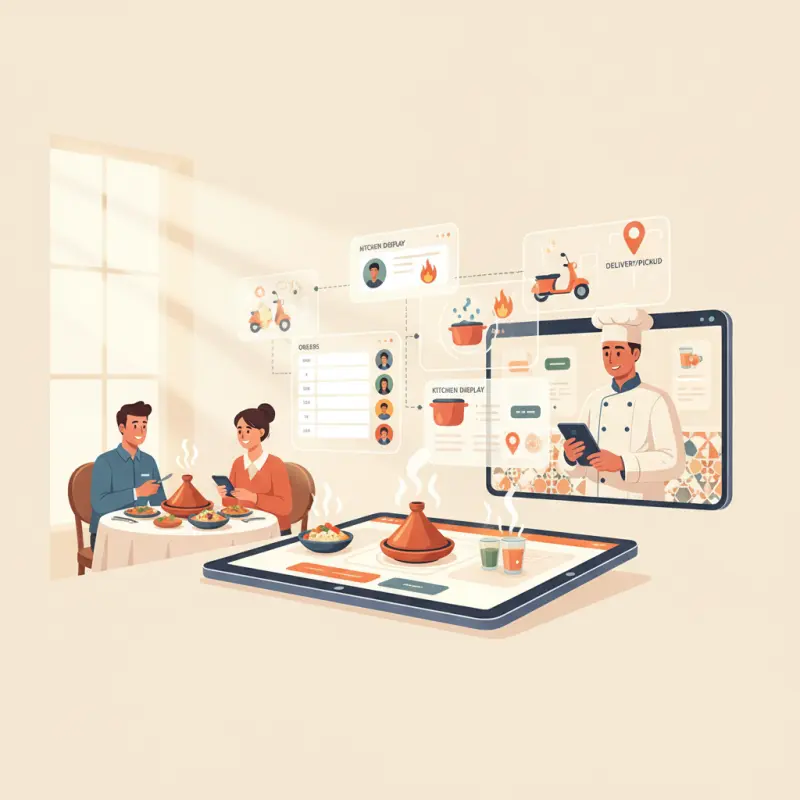
Restaurant Order Management System: Beyond POS in Morocco
Blog Manager
··5 min read
AI Overview
A restaurant order management system coordinates orders from all channels — phone, delivery apps, walk-ins, and table service — into one unified stream. Most restaurant POS systems only process payments, leaving owners juggling multiple tablets, phones, and manual entry systems that create costly inefficiencies. In Casablanca and Agadir, restaurants using fragmented ordering lose 21 hours weekly coordinating orders across channels. Phone interruptions cost five minutes of kitchen productivity each time, while third-party apps like Talabat and Jumia Food charge 15-30% commission without customer data access. Manual entry between systems introduces errors that compound during rush hours. A unified order management system eliminates these silos by routing all orders through one dashboard, reducing staff coordination time and improving accuracy. Choose a platform that integrates phone orders, QR table ordering, and delivery management without commission fees.
Table of Contents
For restaurant owners
Start your restaurant in 60 minutes.
From signup to your first real order — no commission, no setup fee, no sales call.
Most restaurant owners think their POS handles order management. It doesn't. Your POS processes payments — but real order management starts when a customer decides to order and ends when they're savoring their meal. The gap between these two moments? That's where restaurants lose money, time, and customers.
In Casablanca's competitive dining scene, a typical restaurant juggles phone calls, delivery apps, walk-ins, and table orders. Each channel operates in its own silo. Orders get lost in translation between the phone and kitchen. Staff manually enter delivery orders into the POS. The result? Operational chaos that costs you more than you realize.
The Hidden Costs of Fragmented Ordering
Walk into any busy restaurant kitchen in Morocco at 8 PM. You'll see the same scene: a waiter shouting a phone order while the chef checks three different tablets for delivery orders. Meanwhile, the cashier manually enters everything into the POS, hoping nothing gets missed.
This isn't just inefficient. It's expensive.
When Orders Come From Everywhere
Your restaurant order management system should unite all order sources into one stream. Instead, most restaurants operate like air traffic controllers, managing multiple incoming flights with outdated equipment. Phone calls interrupt kitchen flow — studies show each interruption costs five minutes of productivity. Third-party delivery apps take 15-30% commission while giving you zero control over the customer relationship. Manual entry between systems introduces errors that compound during rush hours.
The average restaurant in Agadir receives orders through four different channels. Without a unified system, staff spend their shift juggling tablets, phones, and POS terminals instead of serving customers.
The Real Cost: Time and Mistakes
Let's quantify the damage. The average restaurant loses two to three hours daily just coordinating orders across channels. That's 21 hours per week — essentially a part-time employee's salary wasted on inefficiency.
Order errors hurt even more. When staff mishear a phone order or enter the wrong item from a delivery tablet, it costs 12-18% of that ticket's value. Factor in the remake cost, the delayed service for other tables, and the damaged reputation — one error ripples through your entire operation.
Order Source
Error Rate
Average Cost per Error
Monthly Impact (200 orders)
Phone Orders
8%
75 MAD
1,200 MAD
Manual Delivery Entry
6%
95 MAD
1,140 MAD
Integrated Digital Orders
2%
75 MAD
300 MAD
Stack audit
What do you currently use?
Tick what you have. We’ll show what OCHI replaces or connects to.
Why QR Ordering Beats Apps (The Numbers Don't Lie)
Every tech company wants restaurants to build mobile apps. They're wrong. QR code ordering delivers better results for both restaurants and customers — and the data proves it.
The App Download Problem
Here's what app evangelists won't tell you: 80% of diners refuse to download another restaurant online ordering system app. Your customers already have 40-60 apps on their phones. Unless you're McDonald's, they won't add yours.
Building a decent restaurant app costs 15,000 to 50,000 MAD. Maintaining it costs another 2,000 MAD monthly. Updates break things. Operating systems change. Customers complain about bugs. Meanwhile, QR codes work instantly on any phone — no download, no storage space, no friction.
OCHI's QR Performance Data
Restaurants using OCHI's QR table ordering see average order values increase 15-22%. Why? Customers browse at their own pace. They discover items they'd miss on a paper menu. They add desserts and drinks without feeling rushed.
The entire process — scan, browse, order, pay — takes under 90 seconds. With full Arabic, French, and English support, you capture every customer regardless of language preference. No app can match this conversion rate.
The Branded Storefront Advantage: yourname.ochi.ma
Generic ordering pages hurt your brand. When customers see "order.delivery-platform.com/restaurant/12345," they lose trust. When they see "votrenom.ochi.ma," they know they're ordering directly from you.
Why Branding Matters for Orders
Your online food ordering system for restaurants should reinforce your brand, not hide it. Customers trust yourrestaurant.ochi.ma because it carries your name. These branded URLs appear in Google searches under your restaurant's name, driving organic traffic.
Guest checkout removes the final friction point. Customers order without creating accounts, entering passwords, or confirming emails. One study found forced registration causes 34% cart abandonment. OCHI eliminates this entirely.
Revenue Impact
Restaurants with branded ordering storefronts see 23% higher repeat order rates compared to generic platforms. Why? Customers remember where they ordered. They bookmark your page. They share it with friends.
More importantly: direct orders through your branded storefront cost zero commission. Every dirham stays in your pocket.
Integration Reality Check: What Actually Works
Software companies promise the moon. Restaurant owners need Earth-based solutions. Here's what actually matters for your food ordering system online.
Must-Have Features (Day One)
Start with the basics that transform operations immediately. You need a single dashboard showing all orders — phone, QR, online, delivery — in one view. Your kitchen needs a real-time display system (KDS) that shows order status and timing. Inventory must update automatically across all channels. Staff roles require proper management — OCHI provides eight different access levels from admin to delivery staff.
Nice-to-Have Features (Later)
Advanced analytics help once you've mastered operations. Marketing automation drives growth after you've stabilized service. Multi-branch management matters when you expand. Webhook APIs enable custom integrations for specific needs. But none of these matter if your core ordering process remains broken.
The Integration Test
Ask three questions to evaluate any food online ordering system. Can you see phone orders and online orders side-by-side in real-time? Does inventory automatically adjust when orders come through any channel? Can kitchen staff clearly see order timing, modifications, and special requests without switching screens?
If the answer to any question is no, you don't have order management — you have order chaos.
Making the Switch: A Casablanca Restaurant's Real Experience
Theory means nothing without results. Let's examine how Restaurant Riad Atlas transformed their operations with proper order management.
Before: Operational Chaos
Riad Atlas epitomized the modern restaurant struggle. Three different ordering systems created daily confusion. Delivery platforms consumed 25% of revenue through commissions. Staff errors affected 8% of all orders — nearly one in twelve customers received something wrong.
The owner spent nights reconciling orders across systems. The chef complained about unclear modifications. Waiters stressed over juggling multiple devices during rushes.
After: Unified System
OCHI consolidated everything into one dashboard. Phone orders, QR orders, and online orders appeared instantly in the kitchen display. The zero-commission model meant keeping 100% of revenue from all channels.
Order errors dropped to 2% — a 75% reduction. Kitchen staff saw clear order details with dietary restrictions highlighted automatically. The integrated POS eliminated manual entry entirely.
The Numbers
Results came quickly. Monthly revenue increased 18%, primarily from eliminated commission fees. Order processing time dropped 40%, allowing staff to handle 20% more orders during peak hours. Customer satisfaction scores climbed from 3.8 to 4.6 stars.
Metric
Before OCHI
After OCHI
Improvement
Commission Fees
25,000 MAD/month
0 MAD
100% savings
Order Error Rate
8%
2%
75% reduction
Processing Time
3.5 minutes
2.1 minutes
40% faster
Customer Rating
3.8/5
4.6/5
21% increase
The transformation took two weeks from signup to full implementation. No expensive hardware. No complex training. Just a better way to manage orders.
Your restaurant deserves the same transformation. Stop losing money to commissions and inefficiency. Start keeping 100% of your revenue while delivering better service. Explore more insights on modern restaurant management at our blog, then see exactly how votrenom.ochi.ma can transform your operations at ochi.ma/partners.
Frequently Asked Questions
What's the difference between a POS system and a restaurant order management system?
A POS system processes payments and tracks sales. A restaurant order management system coordinates orders from all channels — phone, delivery apps, walk-ins, and table service — into one unified stream before they reach your POS.
How much time do restaurants waste without unified order management?
The average restaurant loses 21 hours per week coordinating orders across different channels. That's equivalent to a part-time employee's salary spent just on order coordination.
Can I integrate my existing POS with an order management system?
Yes, most modern order management systems integrate with existing POS systems through APIs. This lets you keep your current payment processing while unifying all order channels.
What order channels should a restaurant management system handle?
A complete system should manage phone orders, walk-in orders, table service, QR code ordering, delivery apps, and online ordering through one dashboard. This eliminates the need to juggle multiple tablets and manual entry systems.
How do commission-free order management systems work in Morocco?
Commission-free platforms in Morocco charge a flat monthly fee instead of taking percentage cuts from each order. Restaurants keep 100% of their revenue while getting unified order management, branded online ordering, and delivery coordination.
Restaurant owners · Weekly
The guide to running a restaurant in 2026.
One article per week. No commission advice.
Just honest operational insight for Moroccan restaurants.
Blog Manager
Comments
No comments yet. Be the first to share your thoughts.