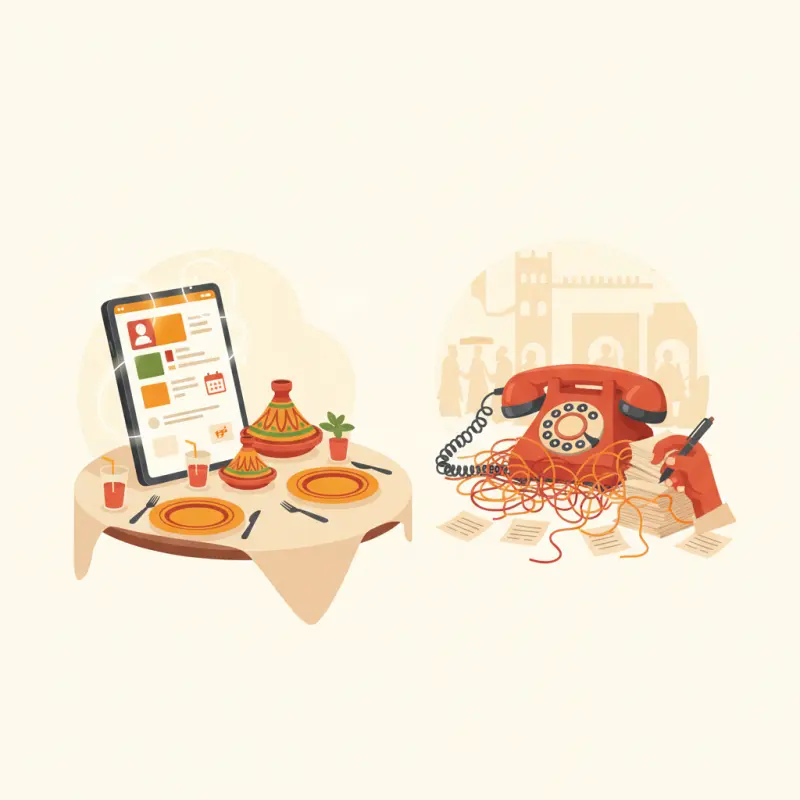
Restaurant Reservation Software vs. Table Booking Systems: The Critical Difference
Most Moroccan restaurants choose reservation tools that solve the wrong problem. Basic booking software captures names and times but ignores table turnover, party sizes, and dining areas. Real restaurant booking software integrates with your operations — from host stand to kitchen to payment.
Simple booking widgets work for cafes with 10 tables and two-hour service windows. They break in real restaurant environments where you juggle multiple dining areas, varied party sizes, and different service speeds. A eight-top celebration dinner takes three hours. A business lunch for two takes 45 minutes. Basic tools treat both identically.
Stand-alone systems also create data fragmentation. Your reservations live in one system, sales in another, customer preferences in a third. When a regular guest who spends 2,000 MAD monthly calls, your host has no visibility into their history or preferences.
POS-Integrated Systems: Why Your Reservation Data Should Live Where Your Sales Data Lives
Integrated restaurant reservation software connects bookings to actual revenue. You see which reservation sources drive highest check averages, which time slots generate maximum revenue per seat, and which customers deserve VIP treatment based on spending history.
OCHI's approach puts reservations inside your POS workflow. When guests arrive, their reservation appears on your host screen with preferences, past orders, and loyalty status. Your servers see table assignments in real-time. Your kitchen knows when large parties require prep time. Everything connects.
The Integration Test: If It Takes More Than 10 Minutes to Set Up, Walk Away
Complex reservation systems requiring weeks of training defeat their purpose. Your team needs tools that work immediately. Test any restaurant booking software with this question: can your newest host manage bookings after 10 minutes of training?
Watch for red flags: separate logins for each feature, manual data entry between systems, IT consultants for basic setup. The right solution feels obvious from first use — like OCHI's single dashboard where reservations, orders, and payments live together.
Global reservation platforms assume Western dining patterns: credit card deposits, two-hour slots, four-person averages. Moroccan restaurant culture operates differently. Family gatherings bring 12 people. Business dinners stretch four hours. Ramadan shifts everything.
Arabic Interface Requirements (Not Just Translation)
Google Translate Arabic doesn't work for restaurant operations. Your staff needs proper right-to-left interfaces with local terminology. "Reservation" translates differently for fine dining versus casual restaurants. Date formats, phone number structures, and name conventions require local understanding.
Most international platforms offer "Arabic support" that reads like robot speech. Your Tangier customers expect natural language in booking confirmations. Your Fès staff needs interfaces matching how they actually speak. OCHI built its Arabic interface with Moroccan restaurant teams from day one.
Cash-First Culture vs. Credit Card Deposits
Western reservation systems demand credit card deposits to prevent no-shows. In Morocco, where 70% of restaurant transactions happen in cash, this requirement blocks bookings. Demanding card details for a family iftar reservation feels insulting to guests who've dined with you for years.
The solution requires flexibility: optional deposits for high-demand slots, reputation-based booking privileges for regular guests, and alternative confirmation methods like WhatsApp verification. Your restaurant table reservation software must adapt to local payment culture, not force change.
Iftar Reservations: Handling Ramadan Rush Without System Crashes
Standard reservation systems crash during Ramadan when 200 families try booking iftar tables simultaneously. The platforms can't handle everyone wanting the same 7:30pm slot. Their "evenly distributed" algorithms don't understand that breaking fast happens at one specific moment.
Moroccan-built systems understand these patterns. They handle surge capacity, allow flexible party sizes (because aunts and cousins always join last minute), and integrate with kitchen prep schedules. OCHI processes thousands of simultaneous Ramadan bookings without slowdowns.
OCHI's Table Reservation System: Built for Moroccan Restaurant Operations
OCHI started by asking Agadir restaurant owners what actually broke in their daily operations. The answer wasn't features — it was integration. Reservations disconnected from orders. Tables separated from revenue. Customer data scattered across notebooks.
Free Setup at {restaurantname}.ochi.ma
Every restaurant gets their branded reservation portal at their own subdomain. Guests book directly without downloading apps or creating accounts. You control the experience: your logo, your colors, your messaging. Zero commission on every booking.
The setup process takes 48 hours. Day one: map your tables and dining areas. Day two: train staff on the unified interface. Week one: soft launch with regular customers. No IT consultants, no complex migrations, no multi-month implementations.
QR Code Integration: Turn Reserved Tables Into Ordering Stations
Reserved tables display QR codes linking to your digital menu. Guests browse and order from their phones while waiting for friends. Orders flow directly to your kitchen with table assignment. When the party completes, everything appears on one bill.
This integration eliminates order confusion. Your servers know exactly what each table wants. Your kitchen sees proper timing. Your guests feel in control. The average check increases 23% when reservations connect to QR ordering.
Real Numbers: Average 23% Revenue Increase in First 90 Days
OCHI restaurants report consistent metrics: 23% revenue growth in three months, 40% reduction in no-shows, 60% less time managing bookings. A Casablanca seafood restaurant went from 300,000 MAD to 369,000 MAD monthly revenue just by eliminating double bookings and capturing walk-in data.
| Metric |
Before OCHI |
After 90 Days |
Improvement |
| Monthly Revenue |
300,000 MAD |
369,000 MAD |
+23% |
| No-Show Rate |
15% |
9% |
-40% |
| Booking Management Time |
5 hours/day |
2 hours/day |
-60% |
| Customer Database |
0 |
1,200 profiles |
+1,200 |
Implementation Timeline: 48 Hours to Live Reservations
Moving to professional restaurant reservation software doesn't require months of planning. OCHI's implementation follows a proven 48-hour timeline that gets you operational without disrupting service.
Day 1: System Setup and Table Mapping
Morning: Create your floor plan in OCHI's visual editor. Drag tables to match your actual layout. Define dining areas — main room, terrace, private spaces. Assign capacity and default turn times. Lunch takes two hours to configure completely.
Afternoon: Set booking rules. Which tables combine for large parties? What's your cancellation window? When do you stop accepting same-day reservations? Build special rules for Ramadan, weekends, and holidays. Everything saves to your account for instant updates.
Day 2: Staff Training (2 Hours Maximum)
Your team learns three screens: host view for arrivals, server view for table status, manager view for availability. OCHI's interface mirrors natural workflow — no complex navigation or menu hunting. Most staff master basics within 30 minutes.
Practice scenarios matter more than features. Run mock reservations: party of six arriving late, VIP wanting specific table, walk-ins during full booking. Your team builds confidence handling real situations, not memorizing button sequences.
Week 1: Soft Launch with Existing Customers
Start with regulars who forgive small hiccups. Send WhatsApp messages announcing online booking at {yourrestaurant}.ochi.ma. Monitor their experience closely. Gather feedback about the booking flow. Adjust timing rules based on actual turnover.
Track key metrics from day one: booking completion rate, no-show percentage, and average party size. OCHI's dashboard shows real-time statistics. You'll spot patterns immediately — like Thursday bookings needing longer slots for business dinners.
Month 1: Optimization Based on Booking Patterns
After 30 days, data reveals optimization opportunities. Maybe your 8pm slot stays empty while 9pm overbooks. Adjust availability to match demand. Perhaps large parties cluster on weekends — modify table combinations accordingly.
Your reservation system becomes smarter each week. Customer preferences build automatically. Regular guests see their favorite tables suggested. Staff anticipates needs based on booking history. The platform learns your restaurant's rhythm.
The right restaurant reservation system transforms operations in weeks, not months. OCHI proves this daily across Morocco — from Agadir beachfront restaurants to Marrakech riads to Casablanca business district venues. See what zero-commission reservations look like at ochi.ma/partners.