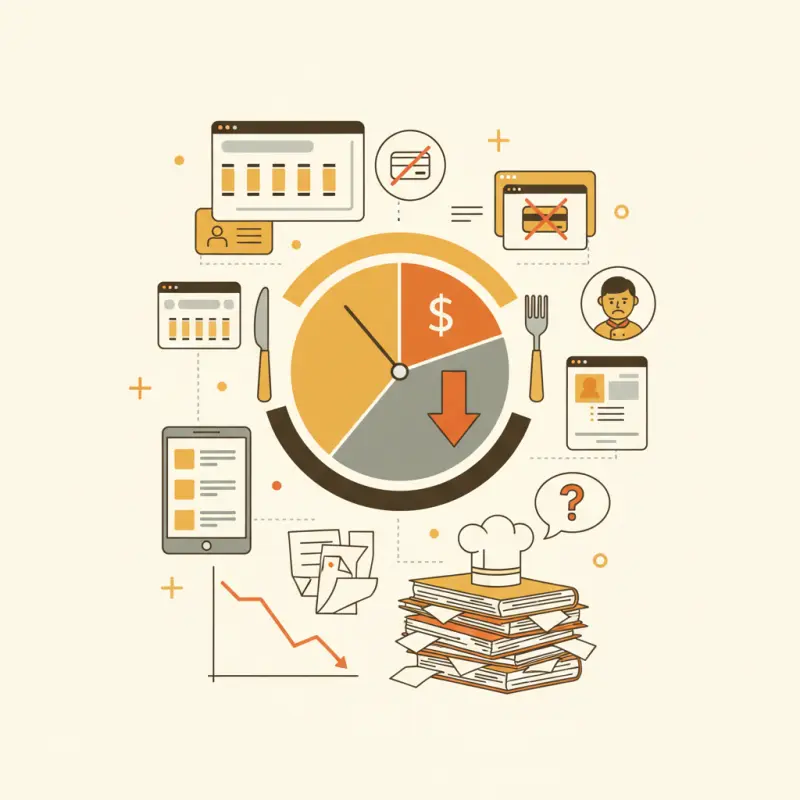
What Restaurant Booking Software Actually Needs to Do
Forget the feature lists and marketing speak. Effective table reservation software solves three core problems: maximizing seat utilization, reducing friction for staff, and maintaining service quality.
Core Functions That Move Revenue
Real-time availability means more than showing open time slots. Your system needs to understand table combinations, party size flexibility, and peak-time optimization. A four-top shouldn't sit empty waiting for a party of four when two couples are waiting.
Party size validation starts at booking. Smart restaurant reservation software requires credit card holds for large parties and implements sliding scale deposits based on group size and time slot value.
Walk-in integration determines whether your software helps or hinders operations. A reservation system that doesn't communicate with your host stand creates double-booking chaos. Your team needs one source of truth, not multiple screens showing different information.
Waitlist automation that works means more than collecting phone numbers. It means calculating realistic wait times based on current table status, automatically notifying guests when tables approach availability, and giving your host tools to optimize seating without playing Tetris.
The POS Integration Reality Check
Standalone reservation systems create data silos. Your reservations live in one system, orders in another, and customer data scattered between both. This fragmentation costs more than money — it costs opportunities.
Double-booking happens when your restaurant booking software doesn't talk to your POS. A table marked available in reservations but occupied in reality creates service disasters that damage reputation more than any negative review.
Staff workflow suffers when they juggle multiple interfaces. A host checking reservations on a tablet while entering walk-ins on a different system while answering phones creates errors. Those errors compound during rush periods when precision matters most.
Major reservation platforms advertise "free" services, then reveal the catch: commission on every booking, fees for premium placement, or forced integration with their delivery services. The math never favors the restaurant.
Hidden Costs in Popular Systems
Commission structures vary, but the pattern remains consistent. Cover fees range from 10-50 MAD per reservation. Premium features like SMS confirmations add another 2-5 MAD. Busy restaurants pay thousands monthly for "free" software.
Data ownership becomes the larger issue. When reservation platforms control your customer data, they control your marketing. They decide which restaurants to promote, often favoring those who pay for visibility or use their full suite of services.
Customer relationships get intermediated. Instead of building direct connections with your diners, you're renting access through a platform that might promote your competitor tomorrow.
The True Cost Calculation
A 100-seat restaurant in Agadir averaged 300 reservations monthly through a "free" platform. The real cost breakdown:
| Cost Item |
Monthly Amount |
Annual Impact |
| Cover fees (15 MAD × 300) |
4,500 MAD |
54,000 MAD |
| SMS confirmations |
600 MAD |
7,200 MAD |
| Premium placement |
2,000 MAD |
24,000 MAD |
| Staff time (dual systems) |
1,500 MAD |
18,000 MAD |
| Total |
8,600 MAD |
103,200 MAD |
OCHI's Approach: Reservations Without the Revenue Tax
OCHI integrates table reservation system for restaurants directly into your restaurant operating system. No separate login, no duplicate data entry, no commission fees. Your reservation data flows seamlessly into POS, kitchen displays, and customer profiles.
Built Into Your Restaurant Operating System
When a customer books through your OCHI storefront (yourrestaurant.ochi.ma), their reservation appears instantly across all systems. Table assignment happens automatically based on your configured rules. Party size, special requests, and dietary preferences flow to the kitchen.
QR ordering at reserved tables creates a closed loop. Customers scan, order, and pay without waiting for service. Their order history builds their profile for future visits. You keep 100% of the revenue and 100% of the data.
A seafood restaurant in Rabat's Agdal district implemented OCHI's integrated reservations last quarter. Results: no-show rates dropped to 7% with automated SMS reminders, table turnover improved by 20%, and monthly reservation fees dropped from 6,000 MAD to zero.
Real Numbers from Partner Restaurants
The integrated confirmation system sends SMS reminders two hours before reservation time, requiring active confirmation. No response triggers automatic cancellation, releasing tables for walk-ins.
Table turnover improvements come from better data. When your restaurant reservation software knows actual dining times by party size and day, it suggests optimal booking windows. A steakhouse in Casablanca discovered their four-tops averaged 95 minutes on weekends but only 75 minutes weekdays, allowing them to adjust slots accordingly.
Revenue retention speaks for itself. Every dirham stays with the restaurant. No cover fees, no commissions, no premium placement charges. Just clean, efficient table management integrated with your existing operations.
Setting Up Your Reservation System: The 48-Hour Plan
Implementation doesn't require months of planning. With the right restaurant table reservation software, you can accept online bookings within 48 hours.
Week One Priorities
Start with accurate table layouts. Map every table with correct capacity, preferred combinations, and service zones. This foundation determines everything else.
Assign staff roles based on actual responsibilities. Your host needs reservation management access. Servers need table status visibility. Managers need override capabilities. Get the permissions right from day one.
Create customer communication templates that reflect your brand voice. Confirmation messages, reminder texts, and waitlist notifications set expectations and reduce no-shows.
Measuring What Matters
Track three metrics from day one: no-show rate, table utilization during peak hours, and average turn time by party size. These numbers tell you if your reservation system helps or hurts.
Monthly benchmarks depend on your restaurant type, but patterns emerge quickly. Fine dining accepts longer turns for higher checks. Casual concepts need volume. Your sweet spot lies between the two extremes.
Adjust booking windows based on data, not assumptions. If Friday nights consistently run long, extend time slots. If Tuesday lunches turn quickly, pack more reservations. Let performance guide policy.
The best restaurant table reservation software disappears into your operations. It doesn't add complexity — it removes friction. When integrated properly, reservations become just another order channel, as simple as a walk-in but more predictable. See how OCHI's integrated reservation system can transform your table management.