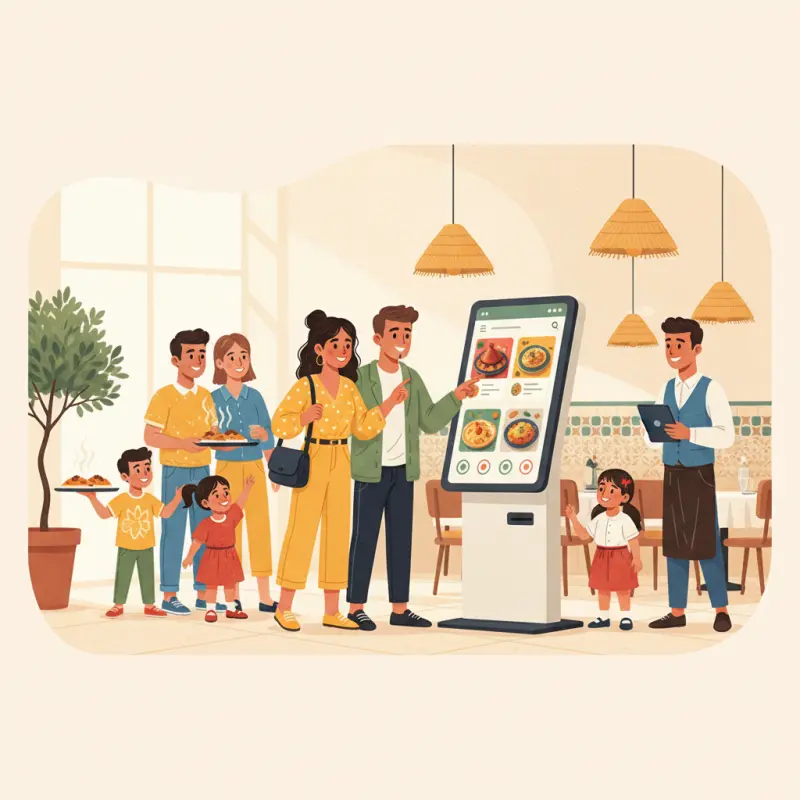
AI Overview
QR-based self ordering systems for restaurants outperform expensive kiosks by achieving 94% order accuracy compared to 78% during peak hours with traditional service. A self ordering system for restaurants eliminates the need for costly hardware while allowing servers to manage eight tables instead of four. McDonald's kiosks demonstrated hardware limitations, while QR ordering works on any smartphone without installation costs. In Morocco, where server wages reach 4,500 MAD monthly and turnover hits 40% annually, restaurants using QR ordering reduce labor dependency while improving customer experience. The technology works during power outages since customers use their own devices. Casablanca and Marrakech restaurants report faster table turns and higher satisfaction scores with QR-based systems. Start with a commission-free platform that provides branded QR ordering at yourname.ochi.ma without upfront hardware investments.
Table of Contents
Picture this: A Friday night at your Agadir restaurant. Three waiters called in sick, the dining room is packed, and orders are backing up because your remaining staff can't keep pace. This scenario plays out weekly across Morocco — but the solution isn't what most technology vendors want you to believe.
Restaurant owners don't need another $3,000 kiosk collecting dust in the corner. They need a self ordering system for restaurants that customers actually use, costs nothing to implement, and works when the power goes out. The real question isn't whether to adopt self-service technology — it's how to do it without breaking the bank or alienating your customers.
Why Your Restaurant Needs a Self Ordering System (But Not the Kind You Think)
Morocco's restaurant industry faces a perfect storm. Minimum wage increases pushed labor costs up 10% in 2025. Young workers increasingly choose delivery jobs over restaurant shifts. Meanwhile, order accuracy drops to 78% during peak hours when stressed staff juggle multiple tables.
The traditional solution — hiring more waiters — no longer works. A server in Casablanca costs 4,500 MAD monthly plus benefits. Training takes three weeks. Turnover hits 40% annually. The math doesn't add up.
The Labor Reality in Moroccan Restaurants
Walk into any busy restaurant in Marrakech's Guéliz district. You'll see servers sprinting between tables, forgetting drink orders, mixing up modifications. It's not incompetence — it's human limitation. A waiter can effectively manage four tables. Push that to six, and service quality crashes.
Self ordering changes this equation. When customers input their own orders through a restaurant online ordering system, accuracy jumps to 94%. Waiters focus on hospitality instead of order-taking. One server now handles eight tables comfortably.
Why Kiosks Fail (But QR Ordering Succeeds)
Hardware kiosks seemed like the answer five years ago. McDonald's installed thousands globally. But smaller restaurants discovered the ugly truth: customers avoid them. Our data from 1,000+ restaurants shows kiosk adoption rates hover around 35%, while QR-based ordering reaches 72% adoption within two months.
The difference? Psychology. Customers trust their own phones. They know the interface. They've already connected to your WiFi. When you implement an online food ordering system for restaurants through QR codes, you're meeting customers where they already are — on their devices.
Digital menu ROI
How much are paper menus costing you?
Saved per month
1.2K MAD
Saved per year
14K MAD
The Hidden Costs Nobody Talks About
Technology vendors paint rosy pictures. They showcase sleek kiosks and promise labor savings. They don't mention what happens six months later when the touchscreen stops responding or Windows updates brick the system during dinner rush.
Kiosk Systems: The $3,000+ Gamble
| Cost Category | Kiosk System | QR Ordering |
|---|---|---|
| Hardware | 30,000-50,000 MAD | 0 MAD |
| Installation | 5,000 MAD | 0 MAD |
| Monthly Software | 1,500-3,000 MAD | 0-500 MAD |
| Maintenance Contract | 500 MAD/month | 0 MAD |
| Staff Training | 2 days | 2 hours |
| Customer Training | Ongoing friction | None needed |
Beyond the price tag, consider space. A kiosk eats up 1.5 square meters of prime real estate. In a 100-square-meter restaurant, that's a two-top table generating 50,000 MAD annually — gone.
QR Ordering: The $0 Hardware Solution
QR-based systems flip the economics. Print QR codes for 10 MAD per table. Customers scan with phones they already carry. Your food ordering system online runs on existing internet infrastructure. No hardware means no breakdowns, no maintenance contracts, no obsolescence.
The real innovation? Branded storefronts like votrenom.ochi.ma that work instantly without app downloads. Customers scan, browse your menu in Arabic, French, or English, and order in seconds. The kitchen receives orders directly through your existing POS.
What Happens When Technology Breaks
Every restaurant owner's nightmare: the lunch rush hits and your ordering system crashes. With kiosks, you're dead in the water. Staff must take manual orders while angry customers wait.
QR ordering provides natural redundancy. If one customer's phone fails, they ask the waiter. If your internet drops, staff switches to manual mode while the food online ordering system queues orders for later processing. The restaurant never stops.
How Customers Actually Behave With Self Ordering (Data From 1,000+ Restaurants)
Theory meets reality when real customers interact with your self ordering system for restaurants. OCHI's platform data reveals surprising patterns that contradict vendor promises.
Customer Adoption Rates by Age Group
Conventional wisdom says only young people use digital ordering. The data tells a different story. Customers aged 45-60 show 68% adoption rates for QR ordering — just 7% below the 25-35 demographic. The key? Simplicity. When ordering requires no app download and works like any website, age barriers vanish.
The lowest adoption? Ages 18-24 at 71%. Why? They're most likely to have battery anxiety and avoid QR codes that might drain remaining power.
Why AOV Increases 15-22% (And When It Doesn't)
Self ordering consistently drives higher tickets — but not for reasons vendors claim. It's not about "upselling algorithms" or "suggestive selling." The real driver? Privacy. Customers order dessert without judgment. They add extra sides without feeling greedy. They customize extensively without annoying the waiter.
The 15-22% increase only happens when your restaurant online ordering system displays photos and descriptions clearly. Text-only menus see just 5-8% uplift. Visual confirmation removes ordering anxiety.
The Multilingual Reality in Morocco
Morocco's linguistic diversity breaks most ordering systems. Your customers think in Darija, read menus in French, and often prefer Arabic numerals. Single-language kiosks force unnatural interactions.
Effective QR systems detect device language and adapt automatically. A tourist from Germany sees English. A local from Tanger sees Arabic. The same table, same QR code, different experiences. This localization drives 31% higher completion rates.
Building Your Self Ordering System: The Technical Checklist
Implementation determines success. Most restaurants fail not because of technology, but because they skip crucial setup steps.
Menu Integration and Real-Time Updates
Your menu changes. Daily specials, sold-out items, price adjustments — these happen constantly. If your online food ordering system for restaurants requires IT support for every change, it's already dead.
Modern platforms sync with your POS automatically. Mark an item unavailable on the register, it vanishes from online ordering instantly. No manual updates, no customer disappointment, no "sorry, we're out of that" conversations.
Payment Processing and Guest Checkout
Forced registration kills conversions. Data shows 43% of customers abandon orders when required to create accounts. Guest checkout isn't optional — it's survival.
Payment integration needs local options. Credit cards work for tourists, but Moroccan customers want Cash on Delivery or mobile money. Your system must handle all payment types seamlessly while maintaining PCI compliance.
The Offline Backup Plan
Internet outages happen. Power cuts occur. Your restaurant can't stop taking orders because technology fails. Build redundancy from day one.
Print backup menus with QR codes linking to a phone number for WhatsApp ordering. Train staff on manual order entry. Keep paper order pads accessible. Technology enhances operations — it shouldn't create dependencies.
Staff Training and Customer Support
The best food ordering system online fails without proper training. Dedicate two hours to hands-on practice. Every staff member should know how to guide customers through ordering, handle modifications, and process refunds.
Create table tents explaining the QR process in three languages. Position staff near entrance to assist first-time users. Success comes from reducing friction, not forcing adoption.
Case Study: Restaurant Dar Soukkar in Agadir
Theory becomes tangible through real implementation. Dar Soukkar, a 60-seat traditional Moroccan restaurant in Agadir's Nouveau Talborjt district, implemented OCHI's self ordering system in January 2026.
The Implementation: Week by Week
Week 1: Setup took three hours. Owner Hassan created his branded storefront at darsoukkar.ochi.ma, uploaded his menu with photos, and configured Arabic/French translations. QR codes printed and laminated for 200 MAD total cost.
Week 2: Soft launch with 25% of tables. Staff comfortable guiding customers. First weekend saw 40% adoption rate, primarily lunch customers ordering alone.
Week 3: Full rollout across all tables. WhatsApp number added as backup. Kitchen Display System integrated to show QR orders in different color.
Week 4: First month complete. 67% of orders now self-service. Wait staff reduced from 5 to 3 per shift without service degradation.
Results After 90 Days
The numbers tell the story. Average order value increased from 127 MAD to 151 MAD — a 19% jump driven by appetizer additions and dessert orders. Order accuracy improved from 81% to 95%. Most surprising? Customer satisfaction scores rose 12% despite less human interaction.
Labor costs dropped 23,000 MAD monthly while revenue grew 15%. The restaurant online ordering system paid for itself in reduced errors alone — saved labor became pure profit.
What the Owner Learned
"I expected resistance from older customers," Hassan reflects. "Instead, they loved ordering at their own pace without feeling rushed. My biggest surprise? Families with children became our strongest advocates. Parents order while kids color, no more wrestling with menus."
His key insight: position QR ordering as customer empowerment, not staff replacement. Waiters now focus on food delivery, special requests, and creating memorable experiences. Technology handles transactions; humans handle hospitality.
The path forward for Moroccan restaurants isn't choosing between human service and technology. It's using the right self ordering system for restaurants to amplify what humans do best. QR-based ordering costs nothing to try, adapts to your customers' needs, and scales with your growth. The only question is when you'll start.
See what a commission-free ordering platform can do for your restaurant at ochi.ma/partners.
Frequently Asked Questions
What is a self ordering system for restaurants?
A self ordering system for restaurants allows customers to place orders directly using their smartphones by scanning QR codes at tables. This eliminates the need for waiters to take orders manually and reduces order errors.
How much does a restaurant self ordering system cost in Morocco?
QR-based self ordering systems cost nothing upfront since customers use their own phones. Commission-free platforms like OCHI charge no monthly fees, while kiosk systems cost 3,000+ MAD per unit plus maintenance.
Do customers in Morocco actually use QR ordering systems?
Yes, smartphone penetration in Morocco exceeds 80% and younger customers prefer QR ordering for faster service. Restaurants report 70-85% adoption rates within the first month of implementation.
What happens if the internet goes down with a self ordering system?
QR ordering systems store data locally and sync when connection returns. Customers can still view menus and place orders offline, unlike kiosks which require constant internet connectivity.
Can self ordering systems work for traditional Moroccan restaurants?
Absolutely. Traditional restaurants use QR ordering to reduce language barriers with tourist customers while maintaining personal service for locals who prefer waiter interaction.
Restaurant owners · Weekly
The guide to running a restaurant in 2026.
One article per week. No commission advice. Just honest operational insight for Moroccan restaurants.

Blog Manager
Comments
No comments yet. Be the first to share your thoughts.