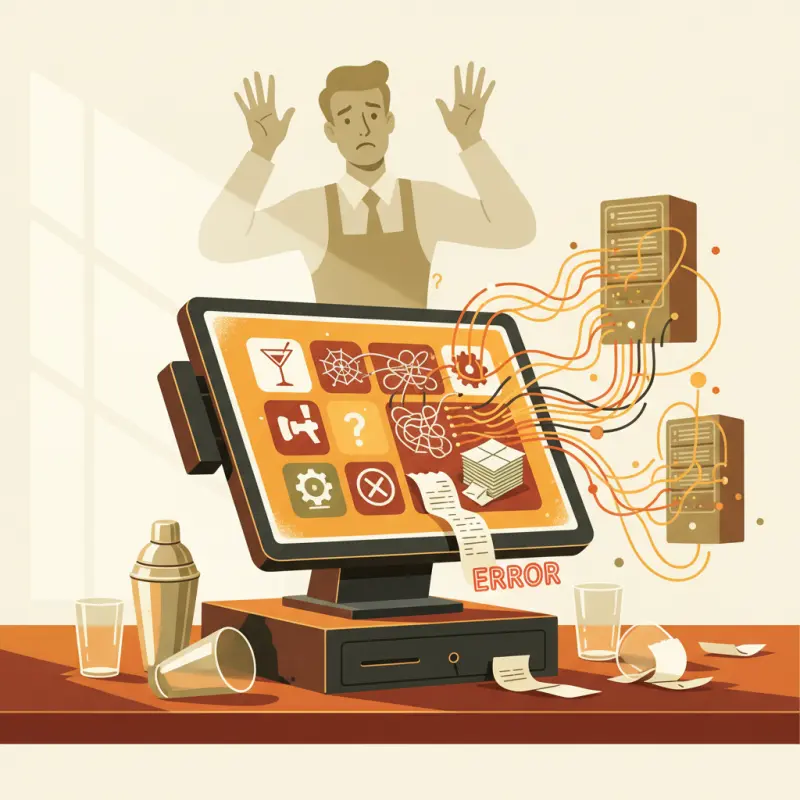
The Hidden Costs of Wrong Bar Software POS Choices
Bad software doesn't just frustrate staff. It hemorrhages money in ways most bar owners never calculate. The real costs hide in transaction delays, inventory gaps, and the compound effect of operational friction.
Transaction Time Impact:
30 Seconds = Lost Revenue
Here's the math most vendors won't show you:
| Metric |
Efficient POS |
Standard POS |
Weekly Loss |
| Average transaction time |
15 seconds |
45 seconds |
- |
| Transactions per bartender/hour |
240 |
80 |
- |
| Average transaction value |
120 MAD |
120 MAD |
- |
| Revenue per bartender/shift |
28,800 MAD |
9,600 MAD |
134,400 MAD |
A 30-second difference in transaction time costs a three-bartender bar over 134,000 MAD per week in lost capacity. That's before considering abandoned orders from customers who gave up waiting.
Inventory Blind Spots Cost 8-12% Monthly
Manual inventory counts at closing time miss the real losses. Over-pours during rushes. Comped drinks without records. Staff drinks that never get rung up. Without real-time tracking integrated into your POS, bars typically lose 8-12% of inventory monthly — invisible until the monthly stocktake reveals the damage.
Modern systems track every pour, flag unusual patterns, and alert managers to discrepancies before they become habits. One Marrakech nightclub recovered 40,000 MAD monthly just by implementing pour tracking.
Staff Training Downtime During Peak Season
Complex systems need complex training. A new bartender in peak summer season might need three full shifts to learn the system — 2,400 MAD in wages plus lost productivity. Intuitive interfaces cut this to hours, not days. Visual layouts that match your actual bar setup. Common operations in obvious places. Smart onboarding that gets staff productive fast.
Essential Bar POS Features That Actually Matter During Rush Hours
Forget the 50-page feature lists. Five capabilities separate functional bar software POS systems from operational nightmares when 200 people want drinks simultaneously.
One-Touch Round Repeats
Same group, same drinks, different round. One button to duplicate the entire previous order. Sounds simple until you realize most systems make you re-enter every item. In high-volume bars, round repeats account for 40% of orders. One touch vs. 12 touches adds up fast.
Visual Tab Management
Names on a list don't work when you're serving 80 open tabs. Visual systems show tabs as cards, color-coded by time open, payment method, or server. Spot the three-hour tab instantly. Identify cash-only customers at a glance. Mental load drops dramatically when information presents visually.
Instant Payment Splitting
Not calculator splitting. Visual splitting. Drag drinks between payment methods. See the split amounts update live. Process multiple cards simultaneously without re-entering amounts. The difference between annoyed customers and smooth operations.
Real-Time Inventory Alerts
Running out of house vodka on Saturday night kills revenue and reputation. Smart systems track pours against stock levels, alerting managers before critical items run low. Set reorder points. Get notifications on your phone. Never face an empty shelf during rush hour.
Multi-User Conflict Resolution
Two bartenders, one tab, simultaneous modifications. Most systems lock the second user out or worse — lose data. Modern architecture handles conflicts gracefully. Real-time sync. Visual indicators of who's modifying what. No lost orders, no double charges, no confusion.
How Food Truck and Cafe POS Systems Compare to Bar Needs
The POS landscape fragments by venue type, each with distinct operational patterns. Understanding these differences helps bar owners identify which features translate and which become liabilities.
Mobile vs. Fixed Terminal Requirements
POS systems for food trucks prioritize portability and connection redundancy. Everything runs on tablets, switches between WiFi and cellular, and survives power fluctuations. Bars need speed over portability — fixed terminals with dedicated connections and instant response times. The mobility features that make food truck systems excellent become unnecessary overhead in bar environments.
That said, mobile capabilities matter for terrace service and events. The sweet spot? Fixed main terminals with supplementary mobile options, not mobile-first architecture.
Inventory Complexity: Drinks vs. Food vs. Both
A cafe POS system tracks coffee beans by weight, milk by liters, pastries by unit. Bar inventory involves bottles, pours, garnishes, and complex recipes where one bottle creates 25 different cocktails. Point of sale systems for food trucks handle simple inventory — burger patties and buns. Bar software needs ingredient-level tracking with automatic depletion based on recipes.
Cafe accounting software excels at cost calculations for consistent products. Bar systems need dynamic costing that accounts for pour variance, happy hour pricing, and promotional drinks. The math gets exponentially more complex.
Peak Time Patterns Across Venue Types
Cafes see predictable morning rushes. Food trucks hit lunch peaks. Bars face compressed chaos — dead until 21:00, then 300% capacity until 02:00. This compression breaks systems designed for steady flow. Queue management, staff scheduling, and payment processing must handle extreme spikes without degradation.
OCHI's Modular Approach to Bar Operations in Casablanca
OCHI wasn't built as bar-specific software. It was built as a platform that adapts to how each venue actually operates. For Casablanca's thriving bar scene, this flexibility translates to configurations that match real workflows, not vendor assumptions.
Peak Hour Scenario:
200 Customers in 3 Hours
Le Zinc Bar in Casablanca faces this every weekend. Three bartenders, two barbacks, one manager, 200 thirsty customers between 22:00 and 01:00. Here's how OCHI handles it:
Each bartender operates their own terminal with shared visibility of all tabs. Visual tab display shows open duration and running totals. One-touch round repeats cut order time to seconds. QR codes on tables let groups add to tabs directly from phones — no flagging down busy staff. The kitchen display system routes food orders automatically while drink orders appear on bar screens instantly.
Real-time analytics show the manager drink velocity, allowing dynamic staff deployment. When the terrace hits capacity, they shift resources before complaints start. Every transaction processes at full speed because OCHI doesn't charge per terminal — bars add stations without calculating ROI on each screen.
Multi-Station Setup Without Per-Terminal Fees
Traditional bar software POS vendors charge 500-1,500 MAD per terminal monthly. A proper bar setup needs six to eight terminals minimum. Do the math — you're paying 12,000 MAD monthly before selling a single drink.
OCHI charges per location, not per device. Add terminals as operations demand. Dedicated stations for each bar area. Roaming tablets for table service. Manager overrides from phones. Cashier stations separate from order entry. Build the configuration your bar needs without subscription multiplication.
Integration with Existing Bar Equipment
Bars invest heavily in specialized equipment. Draft systems with flow meters. Liquor dispensers with portion control. Sound systems that need volume coordination. OCHI's webhook architecture connects these systems without custom development. Draft pours automatically deplete keg inventory. Playlist changes trigger happy hour pricing. Equipment talks to software seamlessly.
The branded subdomain (votrenom.ochi.ma) gives bars professional online presence instantly. Customers browse the drink menu, place pickup orders, or reserve tables without downloading apps. Same system, multiple customer touchpoints, zero channel confusion.
Running a bar means managing controlled chaos with precision tools. The right bar software POS doesn't just process payments — it understands that Friday night success depends on speed, clarity, and systems that enhance rather than impede human judgment. Choose software built for how you actually work, not how vendors think you should. Set up your Casablanca bar at votrenom.ochi.ma — zero commission means every dirham from that busy Friday night stays with you.