Why Most Independent Restaurants Outgrow Lightspeed's Complexity
Restaurant owners report spending 15-20 hours learning Lightspeed's interface — time better spent serving customers. The system includes over 200 features, yet daily operations require fewer than 40.
The iPad Dependency Problem
Lightspeed runs primarily on iPads, creating vulnerabilities independent restaurants can't afford. When the iPad fails, the entire operation stops. Internet outages mean no order processing, despite "offline mode" promises that rarely work smoothly.
Staff turnover compounds the problem. Training new servers on complex interfaces costs restaurants 10-15 hours per employee. Simpler alternatives like billing petpooja face similar challenges — the issue isn't unique to Lightspeed but inherent in overcomplicated systems.
Feature Overload vs. Daily Operations
Advanced inventory forecasting sounds impressive until you realize most Moroccan restaurants order supplies based on relationships with local vendors, not algorithmic predictions. Menu engineering analytics matter less than knowing your regular customers prefer their tagine with extra preserved lemons.
Toast POS company solutions demonstrate the same pattern — powerful features that independent restaurants never touch. The complexity tax isn't worth paying when basic order management, simple reporting, and reliable payment processing cover 95% of actual needs.
The Commission vs. Subscription Trap Most POS Reviews Miss
Traditional reviews compare subscription costs without examining the fundamental model. They assume paying monthly beats paying commissions — but the math tells a different story.
The Hidden Math of "Low Monthly Fees"
| Monthly Orders |
Lightspeed Total Cost |
15% Commission Platform |
Zero-Commission Model |
| 100 orders |
$892 |
$225 |
$0 |
| 500 orders |
$1,142 |
$1,125 |
$0 |
| 1,000 orders |
$1,642 |
$2,250 |
$0 |
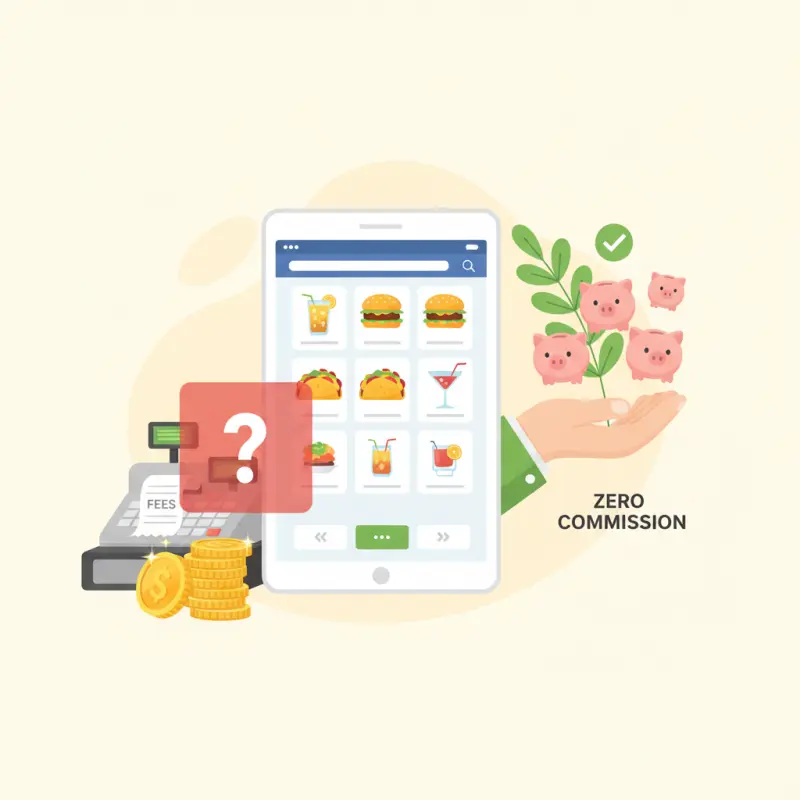
Subscription models like petpooja billing only break even against commission platforms at extremely high volumes. Below 500 monthly orders, restaurants lose money on subscriptions. Zero-commission platforms eliminate this calculation entirely.
Zero-Commission Alternative: OCHI's Different Approach
OCHI operates without monthly fees or per-order commissions. Restaurants get complete management tools — POS, online ordering, inventory tracking — through their branded subdomain (votrenom.ochi.ma). The platform processes over 50,000 monthly orders across Morocco with zero fees.
Instead of choosing between subscriptions and commissions, restaurants keep 100% of revenue. The model works because OCHI monetizes through optional services, not core operations. Compare this to pos toast or similar platforms demanding upfront payments plus ongoing fees.
What Lightspeed Gets Right (And What It Doesn't)
Credit where due: Lightspeed excels at specific tasks. Multi-location restaurant groups benefit from centralized reporting and standardized operations. The API ecosystem supports hundreds of integrations. Analytics dashboards provide insights larger operations need.
Strengths Worth Considering
Inventory management across multiple branches saves restaurant groups significant time. Automated purchase orders based on par levels reduce waste. Employee management features handle complex scheduling across locations. These features justify costs for enterprises — not independent restaurants.
Critical Limitations for Moroccan Restaurants
Arabic language support remains partial at best. Right-to-left text displays incorrectly in receipts. Payment gateway options exclude popular Moroccan processors. Customer support operates on North American hours, leaving dinner service issues unresolved until the next day.
The "enterprise-first" design shows everywhere. Features assume dedicated IT staff, stable high-speed internet, and standardized operations. Moroccan restaurants operate differently — flexible menus, cash-heavy transactions, relationship-based supplier networks.
Making the Right Choice for Your Restaurant in 2026
Skip the feature comparison charts. Focus on three factors: monthly order volume, technical complexity tolerance, and growth trajectory.
Decision Framework: Lightspeed vs. Alternatives
Choose Lightspeed if you process over 2,000 monthly orders across multiple locations with dedicated managers who need centralized control. The investment pays off through operational efficiency at scale.
Choose zero-commission platforms if you're an independent restaurant prioritizing revenue retention over feature depth. Most Moroccan restaurants fall into this category — single location, owner-operated, community-focused.
Test before committing. Create your free OCHI demo at votrenom.ochi.ma in five minutes. Run it alongside your current system. Compare actual costs, not promised savings.
The Path Forward
Restaurant technology should amplify your strengths, not complicate your operations. Whether that means Lightspeed's enterprise features or OCHI's zero-commission simplicity depends on your specific situation.
The future belongs to restaurants that choose tools matching their actual needs — not the ones with the most impressive feature lists. See how OCHI eliminates fees while delivering everything your restaurant needs at ochi.ma/partners.