AI Overview
Commercial kitchen software replaces paper tickets with digital displays that eliminate order errors and kitchen bottlenecks. Moroccan restaurants lose an average of 30,600 MAD monthly to preventable kitchen mistakes caused by manual ticket systems. Commercial kitchen software provides real-time order tracking, modification alerts, and station coordination through kitchen display screens. Systems like OCHI's Kitchen Display System sync directly with POS terminals to ensure orders flow seamlessly from front-of-house to kitchen stations. The software eliminates handwriting interpretation errors, prevents orders from getting lost, and provides timing visibility across all cooking stations. Restaurants in Agadir and Casablanca report 40% fewer kitchen errors and 15% faster ticket times after switching from paper systems. Implementation requires POS integration, staff training on digital workflows, and display screens positioned at each kitchen station for maximum efficiency.
Table of Contents
Friday night in Marrakech. Your kitchen printer jams mid-service, leaving 40 orders floating somewhere between the POS and your line cooks. This isn't a technology problem — it's a commercial kitchen software problem that costs Moroccan restaurants thousands of dirhams every week.
Most restaurant owners searching for kitchen solutions find CAD programs for designing layouts. What they actually need: software that manages the chaos when orders pile up and every second counts.
Why Your Paper Tickets Are Costing You Orders
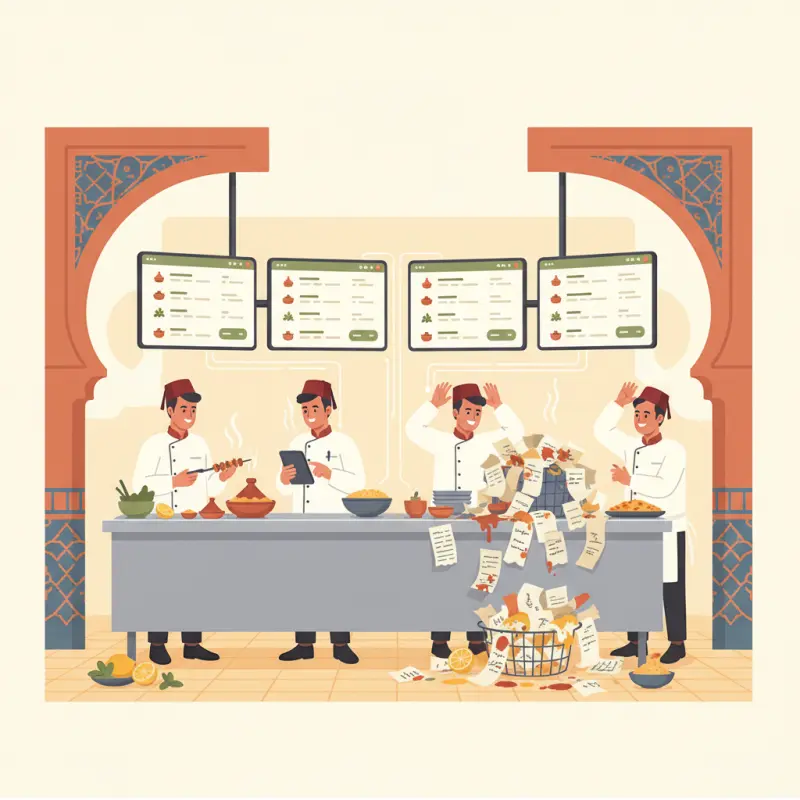
Walk into any restaurant kitchen in Agadir at 8pm and you'll see the same scene: tickets hanging from rails, some falling behind equipment, others smeared with sauce. The average restaurant loses three to five orders per shift to this system. That's 15-25 unhappy customers who waited too long or received the wrong dish.
The real damage happens during peak hours. When 40 orders hit within 20 minutes, your expeditor becomes a bottleneck. They're manually sorting tickets, shouting modifications, and trying to remember which table ordered first. Meanwhile, your grill cook just started preparing a well-done steak that should have hit the fire 10 minutes ago.
The Hidden Cost of Manual Kitchen Operations
Paper tickets create three specific problems that compound during service. First, modifications get lost in translation — that "no onions" request becomes invisible once grease smudges the ink. Second, you have no visibility into station bottlenecks until orders start backing up. Third, timing coordination between stations relies entirely on verbal communication in a noisy environment.
A Casablanca steakhouse tracked their errors for one month: 12% of orders had at least one mistake. That's 360 wrong dishes out of 3,000 orders. Each remake costs an average of 85 MAD in ingredients and labor. Do the math — that's 30,600 MAD lost monthly to preventable errors.
Stack audit
What do you currently use?
Tick what you have. We’ll show what OCHI replaces or connects to.
Kitchen Display System Software: Digital vs. Paper Reality Check
The shift from paper to digital isn't just about looking modern. It's about measurable improvements in order processing speed and accuracy. Here's what the data shows across Moroccan restaurants making the switch:
| System Type | Avg. Order Processing Time | Error Rate | Monthly Cost |
|---|---|---|---|
| Paper Tickets | 2.3 minutes | 12% | 500 MAD (printer supplies) |
| Basic Tablet Display | 1.4 minutes | 7% | 890 MAD |
| Real-time KDS with Routing | 52 seconds | 4.8% | Included with OCHI |
Why WebSocket Technology Matters for Your Kitchen
Traditional kitchen management software refreshes every 30-60 seconds. That's a lifetime when you're coordinating multiple stations. Modern systems use WebSocket connections for instant updates — the moment a server enters a modification, it appears on the relevant kitchen screen.
OCHI's KDS uses Laravel Reverb to push changes in real-time. When a customer adds "extra spicy" to their order through votrenom.ochi.ma, that modification appears on your kitchen display before the server even leaves the table. No refresh delays. No missed changes. No excuses for serving the wrong dish.
The color-coding system prevents confusion at first glance: green for new orders, yellow for items being prepared, red for anything delayed beyond standard prep time. Your expo station sees everything at once while individual stations only see their relevant items.
Station Routing: The Feature Nobody Talks About But Everyone Needs
Most commercial kitchen software treats your kitchen like one big box. Smart routing recognizes that your cold station shouldn't see hot appetizer orders, and your grill cook doesn't need to know about the mezze platter. This isn't just organization — it's operational efficiency that changes how orders flow through your kitchen.
Here's how intelligent routing works: when an order contains mixed items, the system automatically splits them by station. Appetizers route to cold prep, mains to the appropriate cooking station, desserts to pastry. Each station starts their items based on preparation time, ensuring everything finishes together.
The 60% Error Reduction Reality
A seafood restaurant in Casablanca implemented station-specific routing through their kitchen ordering system. Their error rate dropped from 12% to 4.8% in six weeks. The biggest improvement: dietary restrictions and allergies now flash in red on the relevant station's display. No more sending out dishes with ingredients that customers specifically asked to avoid.
Load balancing adds another layer of efficiency. When your grill station has eight steaks firing and a new order comes in, the system can route it to your second grill or alert the expeditor about the delay. This prevents the pile-up effect where one busy station creates a domino of delays.
Central Kitchen Software for Multi-Location Operations
Restaurant groups face a different challenge: maintaining consistency across branches while tracking performance metrics. Your Rabat location might excel at prep times while Fès struggles with order accuracy. Without central kitchen software, these patterns stay hidden in branch-level reports.
Centralized systems provide three critical functions for multi-location operations. Recipe standardization ensures your tagine tastes the same in every city. Real-time inventory sync prevents one branch from running out while another overstocks. Performance dashboards compare metrics across locations, highlighting which practices to replicate and which to fix.
The True Cost of Kitchen Software Integration
Traditional kitchen display system software charges per location, plus integration fees, plus training. A five-location restaurant group typically pays:
- Software licensing: 890-1,800 MAD per location monthly
- Integration with existing POS: 8,900 MAD one-time fee
- Training and setup: 4,450 MAD per location
- Annual support contracts: 17,800 MAD
OCHI includes KDS functionality within its zero-commission platform. When you're already using the ordering and POS system, adding kitchen displays requires no integration fees. The same staff login works across all systems. One support contact for everything.
Your Kitchen Ordering System Setup in Marrakech: A Real Scenario
Let's walk through what actually happens when a Marrakech restaurant switches to digital kitchen management. Take Restaurant Yasmine, a 120-seat traditional Moroccan restaurant handling 200 orders on weekend nights.
From Order Placement to Kitchen Display
A customer visits yasmine.ochi.ma and orders a three-course meal. The order instantly appears on the kitchen's main display screen, color-coded by course. The cold station sees the salad with a 10-minute prep time. The grill station sees the lamb tagine set to start in eight minutes. The dessert station gets an alert to begin plating the pastilla 25 minutes after order confirmation.
Each station has a tablet showing only their items. Touching an item cycles through statuses: received, preparing, ready. The expo screen shows all items with their current status, allowing perfect coordination without shouting across the kitchen.
Making the Switch: What Actually Changes Day One
Training takes 20 minutes per staff member — less time than learning a new recipe. The interface uses universal kitchen language: "fire," "hold," "rush." Muscle memory from years of reading tickets transfers immediately to reading screens.
The backup system addresses every owner's fear: what happens if the internet fails? OCHI's local caching keeps the last 100 orders accessible. A simple tablet hotspot provides emergency connectivity. Paper ticket printing can activate as a last resort, though most restaurants never need it after the first month.
The transformation in kitchen efficiency isn't magical. It's methodical. When every order routes correctly, when every modification displays clearly, when every station coordinates automatically — your kitchen runs the way you always imagined it should. See how OCHI's complete restaurant platform, including integrated kitchen management, works at ochi.ma/partners.
Frequently Asked Questions
What is commercial kitchen software for restaurants?
Commercial kitchen software manages restaurant kitchen operations through digital order displays, real-time inventory tracking, and automated workflow coordination. It replaces paper ticket systems with screens that show orders, modifications, and timing information.
How much does commercial kitchen software cost in Morocco?
Commercial kitchen software in Morocco typically costs 500-2000 MAD monthly depending on features and restaurant size. OCHI offers kitchen display systems with zero commission fees as part of their restaurant management platform.
Does kitchen software work with existing POS systems?
Most commercial kitchen software integrates with popular POS systems through APIs or direct connections. OCHI's platform includes both POS and kitchen display functionality in one unified system.
Can kitchen software reduce food waste and errors?
Kitchen software reduces errors by 60-80% through clear digital displays and automated order routing. It cuts food waste by providing accurate preparation timing and preventing duplicate orders.
What features should Moroccan restaurants look for in kitchen software?
Essential features include Arabic language support, offline functionality, modification alerts, station-specific displays, and integration with local payment methods. Real-time order tracking and inventory management are also crucial for busy kitchens.
Restaurant owners · Weekly
The guide to running a restaurant in 2026.
One article per week. No commission advice. Just honest operational insight for Moroccan restaurants.

Blog Manager
Comments
No comments yet. Be the first to share your thoughts.