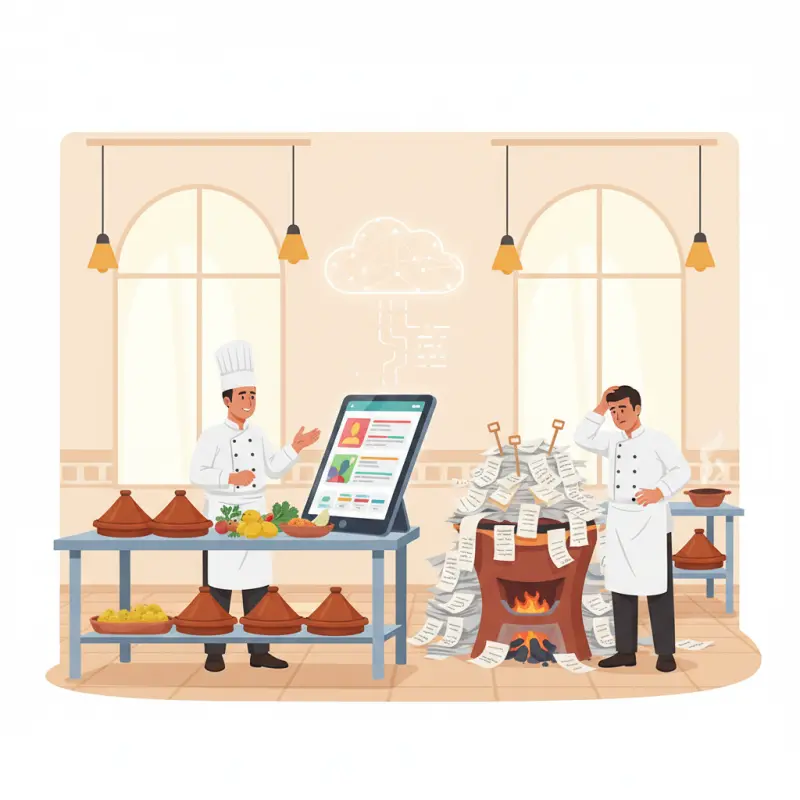
Kitchen Display System Software: Beyond the Pretty Screen
Most articles about kitchen display system software list features like they're selling a smartphone. Color screens. Touch interface. Cloud sync. But the real question is: how does it actually change your kitchen workflow?
The difference lies in real-time communication. Traditional systems refresh every 30 seconds — an eternity during dinner rush. Modern WebSocket technology updates instantly. When a server modifies an order, the kitchen sees it immediately. No refresh lag. No missed changes. No confusion.
Why Real-Time Updates Change Everything
WebSocket connections maintain a constant link between your ordering system and kitchen displays. Think of polling (the old way) like checking your mailbox every few minutes. WebSockets? That's having mail delivered directly to your hand the moment it arrives.
Color-coded status systems only work when they're instant. Green for new orders. Yellow for in-progress. Red for urgent. But if your system takes 30 seconds to update colors, your grill station has already started the wrong order. OCHI's KDS uses Laravel Reverb WebSockets — updates appear in under 100 milliseconds.
Station routing prevents the bottleneck problem that kills kitchen efficiency. Orders automatically route to the right station based on items. Salads to cold prep. Grills to hot line. Desserts to pastry. No more shouting across the kitchen. No more confusion about who makes what.
The Three KDS Mistakes That Kill Efficiency
Screen placement matters more than screen quality. Mount displays at eye level, angled away from heat and steam. Too high? Necks crane. Too low? Backs ache. Poor placement adds 20 seconds to every ticket read.
Information overload defeats the purpose of going digital. Show only what each station needs. The grill doesn't need to see dessert orders. The salad station doesn't need temperature preferences for steaks. Clean, focused displays prevent errors better than any training.
Disconnected systems create new problems. Your kitchen ordering system must integrate with inventory. When an item runs out, it should vanish from the display instantly. Otherwise, you're back to shouting "86 the salmon!" across a noisy kitchen.
Central Kitchen Software: The Multi-Location Reality Check
Opening a second location in Rabat when your first thrives in Fès? Congratulations. Now you need central kitchen software that handles reality, not theory. Most multi-branch features assume every location runs identically. They don't.
Your Fès location has a commercial convection oven. Rabat has a standard range. Same recipe, different cooking times. Your head chef in Fès has 15 years experience. Rabat's chef just graduated culinary school. Copy-paste management fails before the first order.
Why Copy-Paste Kitchen Management Fails
Equipment variations demand flexible systems. A tagine that takes 45 minutes in a traditional oven needs 30 in a convection. Your kitchen management system software must adjust prep times per location, not force standardization that doesn't match reality.
Staff skill differences require adaptive workflows. Experienced chefs handle complex multi-component dishes. New staff need step-by-step guidance. The same software interface won't work for both. OCHI allows role-based displays — detailed for beginners, streamlined for veterans.
Local preferences matter even within Morocco. Agadir customers expect more seafood options. Marrakech diners want traditional preparations. Your central system needs location-specific menu modifications without breaking standardization completely.
Building Systems That Scale (Not Just Duplicate)
Flexible recipe scaling means more than multiplying ingredients. Doubling a sauce recipe doesn't mean doubling the salt. Tripling a tagine changes cooking dynamics. Smart scaling accounts for non-linear relationships.
Location-specific modifications preserve your brand while respecting local needs. Core recipes stay consistent. Garnishes, sides, and presentations adapt. Your system tracks both standard and variant recipes without confusion.
Training modules that adapt to each location's reality work better than one-size-fits-all approaches. Video training for visual learners. Step-by-step cards for methodical staff. Real-time guidance during service for immediate help.
The OCHI Difference: 60% Fewer Kitchen Errors
Restaurant Atlas in Agadir Marina switched from paper tickets to OCHI's integrated kitchen management software in January 2026. The results tell a story no marketing claim could match.
Case Study: Restaurant Atlas, Agadir Marina
Before OCHI: 47 errors weekly plagued their kitchen. The refire rate hit 23 percent — nearly one in four orders needed correction. Kitchen staff averaged 10-hour shifts just to keep up with mistakes. The head chef was ready to quit.
After OCHI: errors dropped to 18 weekly within the first month. Refire rate fell to 9 percent. Average shift length normalized to 8 hours. The head chef now mentors junior staff instead of firefighting constant problems.
What changed? WebSocket KDS integration with their ordering system created true real-time communication. Orders flow from customer to kitchen without translation errors. Status updates happen instantly. Every station sees exactly what they need, when they need it.
The Technical Details That Matter
Real-time order synchronization means no lag between order placement and kitchen notification. When a waiter enters an order on the POS, it appears on the kitchen display in milliseconds. Modifications update instantly. No confusion. No delays.
Per-item status tracking revolutionizes coordination. Each dish shows its own progress: pending, preparing, prepared. The expediter sees exactly when to fire the next course. No more guessing. No more cold food waiting for its tablemates.
Automatic prep time calculations adjust for real-world variables. System learns from historical data. Busy Saturday? Prep times extend automatically. Slow Tuesday? Times compress. The kitchen stays synchronized without manual intervention.
Integration between POS, KDS, and inventory creates a closed loop. When the last portion of lamb sells, it disappears from all systems simultaneously. No more taking orders for items you can't fulfill.
What Nobody Tells You About Kitchen Management System Software
Here's the truth most vendors won't say: kitchen management software fails when it tries to be everything. The best systems master three core functions instead of adding twenty features nobody uses.
The Feature Bloat Problem
Browse any kitchen software comparison chart. You'll see hundreds of features. Recipe scaling. Nutrition calculation. Supplier management. Food photography. AI predictions. Meanwhile, kitchens still struggle with basic order accuracy.
The three functions that actually matter: accurate order display, real-time status tracking, and seamless POS integration. Get these right and your kitchen runs smoothly. Add complexity and you create new problems.
Integration beats built-in features every time. Your kitchen software should connect with best-in-class tools, not recreate them poorly. OCHI integrates with existing inventory systems instead of building another mediocre one.
Pricing Reality: What You Actually Pay
Software costs extend beyond monthly fees. Implementation takes time. Training takes money. Mistakes during transition cost revenue. Most vendors hide these realities behind "simple setup" promises.
| Cost Category |
Traditional Systems |
OCHI |
| Monthly Software |
3,000-8,000 MAD |
0 MAD (usage-based) |
| Implementation |
20,000-50,000 MAD |
Self-service |
| Training Time |
2-4 weeks |
2-3 days |
| Commission on Orders |
15-30% |
0% |
OCHI's zero-commission model changes the math entirely. You pay for what you use, not promises. No setup fees. No monthly minimums. Your branded subdomain (votrenom.ochi.ma) goes live the day you sign up.
Kitchen management software transforms operations when implemented thoughtfully. The difference between chaos and control isn't about having the most features — it's about having the right features working flawlessly when you need them most. Ready to see how digital kitchen management could work in your restaurant? Explore the full platform at ochi.ma/partners.