Driver Assignment Logic: The Algorithm That Makes or Breaks Your Margins
Most food delivery management software assigns the nearest available driver to each order. This seems logical until you run the numbers. A driver 500 meters away heading in the opposite direction often takes longer than one 1km away already moving toward your restaurant.
Why "Nearest Driver" Logic Costs You Money
Here's what happens with simple nearest-driver assignment: Order comes in from Agadir's Talborjt district. Your system assigns Ahmed, who's 400m away but just delivered to Hay Mohammadi. He needs to make a U-turn, navigate back through traffic, and wait at two lights. Meanwhile, Youssef is 900m away but already heading toward your restaurant after a delivery in the same direction.
The five-minute difference compounds. Ahmed arrives late to pick up the order. The food waits. The customer waits. Your rating drops. All because the algorithm optimized for the wrong metric.
Batch Deliveries: When Two Orders Beat One
Smart batch logic transforms delivery economics. Two orders going to the same building or adjacent streets can share one driver trip. But most systems batch poorly — grouping by order time instead of destination proximity.
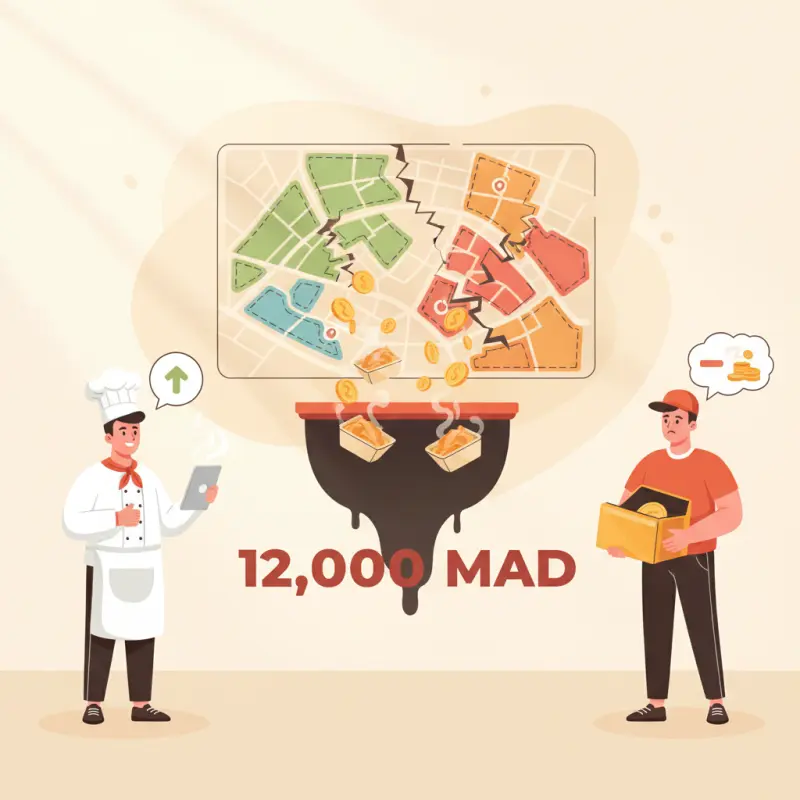
OCHI's delivery management system uses polygon-based batching. Orders within the same micro-zone wait up to five minutes for potential batching. This small delay saves 40% on delivery costs while maintaining service standards.
The True Cost of Failed Assignments
When auto-assignment fails, manual intervention costs multiply. A manager spending 30 seconds reassigning an order doesn't seem expensive until you multiply by 50 orders per dinner rush. That's 25 minutes of management time during your busiest period — time that should focus on quality and service.
Traditional delivery platforms charge 15% to 35% commission. They position this as the cost of customer acquisition and technology. What they don't mention is how this commission structure warps your entire business model.
The Real Math: 100 Orders at 30% Commission
| Metric |
With 30% Commission |
Direct Orders (0% Commission) |
| 100 Orders × 150 MAD |
15,000 MAD revenue |
15,000 MAD revenue |
| Platform Commission |
-4,500 MAD |
0 MAD |
| Food Cost (35%) |
-5,250 MAD |
-5,250 MAD |
| Labor (25%) |
-3,750 MAD |
-3,750 MAD |
| Net Profit |
1,500 MAD (10%) |
6,000 MAD (40%) |
The commission doesn't just reduce profit — it eliminates your ability to invest in quality, staff, or growth. You're working four times harder for the same result.
Why Free Looks Expensive (Customer Psychology)
Platforms claim they bring customers you wouldn't otherwise reach. But they also train those customers to expect discounts, free delivery, and platform-specific deals that you fund through higher menu prices. A customer paying 180 MAD for a meal on a commissioned platform sees the inflated price. The same meal at 150 MAD on your direct ordering system looks expensive because it charges 10 MAD delivery.
This psychological trap keeps restaurants dependent on commissioned platforms even as margins disappear.
Control vs Convenience: The False Choice
Platforms frame the decision as convenience versus control. Use their system for easy orders, or build your own for full control. This is false. Modern restaurant delivery software like OCHI gives you both — the convenience of a full-featured platform with complete control over pricing, customers, and data. Same-day setup, zero commissions, your brand front and center.
GPS Tracking and Customer Communication: Beyond the Dot on the Map
Every food delivery management system mentions GPS tracking. Few explain what good tracking actually accomplishes. It's not about showing a dot moving on a map — it's about managing three different audiences with different needs.
Update Frequency: Every 10 Seconds vs Every Minute
Customers want to see movement. They'll refresh the tracking page every 30 seconds during the last mile. But updating GPS location every 10 seconds drains driver phone batteries and floods your servers with unnecessary data.
The sweet spot is dynamic frequency. Update every 60 seconds when the driver is more than 1km away. Increase to every 20 seconds within 500m. This balances customer reassurance with technical efficiency.
Battery Life vs Accuracy Trade-offs
High-accuracy GPS modes can pinpoint a driver within 3 meters but consume battery at twice the normal rate. A driver starting a shift with 80% battery might run out by dinner rush. Low-power modes preserve battery but might show the driver on the wrong street.
Smart systems switch modes based on context. High accuracy when approaching the delivery address, balanced mode during transit, low-power when waiting at the restaurant.
Managing Customer Expectations During Delays
Real-time tracking creates expectations that real-world delivery can't always meet. A driver stuck in unexpected traffic on Avenue Hassan II appears motionless on the map. Without context, customers assume the worst.
Proactive communication prevents complaints. "Your driver is 5 minutes away but moving slowly due to traffic" beats silent uncertainty. Your online food ordering and delivery platform should automate these updates based on actual conditions.
Building Your System: Start Here, Scale There
The path from manual delivery management to a fully optimized system isn't about implementing everything at once. It's about building foundations that scale.
Week 1: Core Order Flow Only
Start with basic digital ordering. Get orders into a system instead of phone calls and paper. Set one delivery zone — a conservative polygon around your densest customer area. Use manual driver assignment. Focus entirely on replacing chaos with basic structure.
Train your staff on one thing: entering orders correctly. Don't introduce tablets, automation, or complex features. Just get clean data flowing.
Month 3: Add Driver Management
Once order flow is stable, add driver tracking and basic auto-assignment. Start collecting delivery time data. Learn which zones actually work and which lose money. Adjust polygons based on real performance, not assumptions.
This is when you'll discover surprising patterns. Maybe Tuesday lunch delivery to the business district is highly profitable. Maybe weekend delivery to beach areas takes too long. Let data guide zone adjustments.
Month 6: Advanced Analytics and Automation
With solid operations and good data, add intelligence. Predictive ordering to prepare for rushes. Dynamic batching to optimize driver routes. Automated customer communication to reduce support load.
By now, your food delivery management software isn't just processing orders — it's actively improving margins through better decisions.
The restaurants winning at delivery understand that success comes from operational excellence, not feature lists. They draw smart zones, assign drivers intelligently, avoid commission traps, and use tracking to manage expectations. They treat their delivery operation as a core business function, not an afterthought.
See how OCHI helps restaurants in Morocco build profitable delivery operations at ochi.ma/partners.