AI Overview
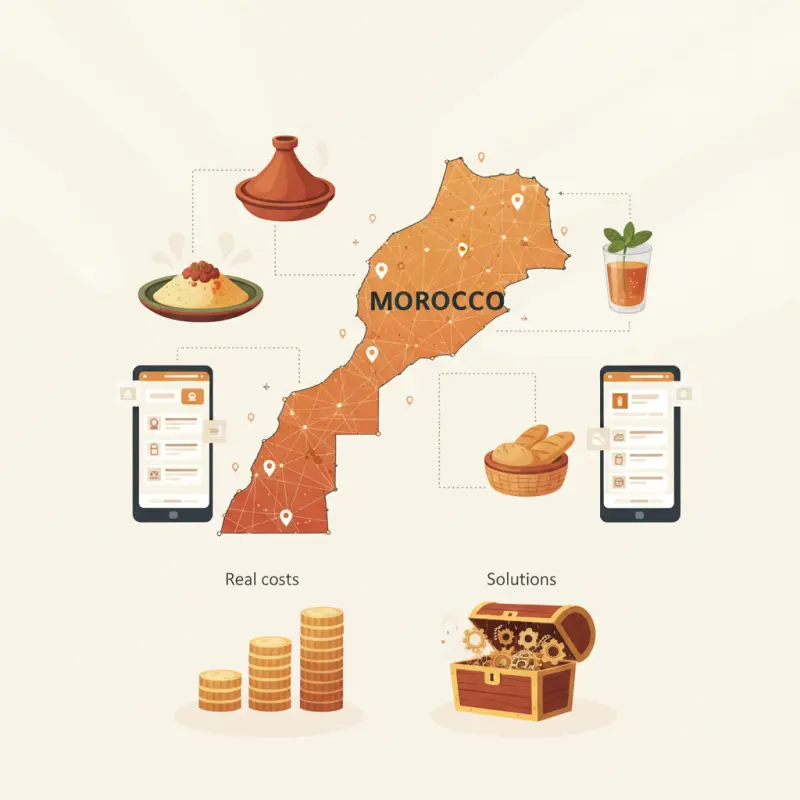
Food delivery platform software in Morocco typically charges 15-30% commission per order, costing restaurants an average of 264,000 MAD annually. Most platforms fail in Moroccan markets because they use Western address systems that don't work in medinas, calculate delivery times based on straight-line distances that ignore local traffic patterns, and prioritize credit card payments when 70% of Moroccan customers prefer cash on delivery. Traditional commission-based platforms force restaurants with 8-12% profit margins to operate at losses after factoring in packaging costs. Zero-commission platforms like OCHI solve these problems by providing Morocco-specific GPS tracking, cash reconciliation features, and local payment integration. Choose software that handles Arabic addresses, supports cash payments, and charges flat monthly fees instead of per-order commissions to maintain profitability.
Table of Contents
The average restaurant in Casablanca loses 22,000 MAD per month to delivery platform commissions. That's 264,000 MAD annually — enough to hire two full-time staff or renovate the entire dining room.
Most food delivery platform software promises to solve your problems while quietly becoming your biggest expense. This guide cuts through the marketing noise to show you exactly what matters: real costs, technical requirements, and the operational details that determine whether your delivery service thrives or bleeds money.
Why Most Food Delivery Platform Software Fails in Morocco
Traditional platforms copy Western models that assume numbered streets, standardized addresses, and uniform city layouts. Visit any restaurant in the old medina of Marrakech and watch delivery drivers spend 15 minutes on the phone trying to find addresses that Google Maps can't parse.
The problems run deeper than navigation. International food delivery management software calculates delivery times based on straight-line distances. In Agadir, that means your system thinks a 2km delivery takes eight minutes — ignoring the fact that your driver must navigate around the souk, through construction zones, and past the evening traffic near Avenue Hassan II.
Commission-based platforms compound these failures. When you're already operating on 8-12% profit margins, a 25% commission doesn't just reduce profits — it eliminates them. A tagine that costs 35 MAD to make and sells for 65 MAD nets you 30 MAD profit. Hand over 16.25 MAD in commission, and you're left with 13.75 MAD. Factor in packaging, and you're working for free.
Generic solutions also ignore local payment preferences. While Silicon Valley platforms push credit cards, 70% of Moroccan online orders still prefer cash on delivery. Your restaurant delivery software needs to handle cash reconciliation, not just digital transactions.
Food cost calculator
What’s your real margin?
Food cost
29.2%
Gross margin
70.8%
Profit / dish
85 MAD
Healthy · under 30%
Digitize your menu with OCHIThe Real Cost of Food Delivery Management Software
Commission Models: The 15-30% Problem
Here's what platforms don't advertise clearly:
| Platform Type | Commission Rate | Monthly Cost (1000 orders) | Annual Cost |
|---|---|---|---|
| Major aggregators | 25-30% | 22,500 MAD | 270,000 MAD |
| Mid-tier platforms | 15-20% | 13,500 MAD | 162,000 MAD |
| OCHI | 0% | 0 MAD | 0 MAD |
These calculations assume an average order value of 90 MAD. The numbers exclude setup fees (typically 5,000-15,000 MAD), monthly minimums, payment processing fees (2-3%), promotional fees, and featured placement costs.
A restaurant processing 50 delivery orders daily through a 25% commission platform loses 337,500 MAD annually. That's not a service fee — that's a second rent.
Zero-Commission Reality Check
OCHI's zero-commission model works because we charge restaurants a transparent platform fee, not a percentage of every sale. You know your costs upfront. No surprises when sales increase.
The math is simple: fixed monthly fee versus percentage-based bleeding. A busy restaurant in Rabat switching from a 25% commission platform to OCHI saves enough in three months to buy new kitchen equipment. Over 12 months, the savings can fund an entire renovation or expansion.
This isn't about being the cheapest option. It's about aligning incentives. When platforms take a cut of every order, they're motivated to maximize order volume — not restaurant profitability. Fixed-fee models mean the platform succeeds when restaurants succeed.
Setting Up Delivery Zones That Actually Work
Zone Configuration Basics
Polygon zones beat radius zones for accuracy in Moroccan cities. A 5km radius from your restaurant in central Casablanca might include wealthy Anfa and working-class Hay Mohammadi — two areas with vastly different delivery dynamics and customer expectations.
OCHI's polygon mapping lets you draw precise boundaries following actual roads and neighborhoods. Exclude areas with chronic traffic. Include that affluent residential pocket just beyond your normal radius. Adjust zones for lunch versus dinner patterns.
Delivery time algorithms must account for real-world factors. Peak prayer times. School pickup hours. The weekend beach traffic in Agadir. Smart food ordering and delivery platforms adjust estimates dynamically based on current conditions, not theoretical speeds.
Driver Assignment Logic
Auto-assignment seems simple until you're juggling 20 orders across eight drivers during Friday lunch rush. The algorithm needs multiple weighted factors:
Distance matters, but so does direction. A driver heading north shouldn't take a south-side order just because it's 500 meters closer. Order value influences priority — that 400 MAD family meal gets delivered before the 65 MAD sandwich. Driver history counts too. Your veteran who knows every shortcut in the medina handles complex addresses better than the rookie.
Batch deliveries multiply complexity. OCHI's system optimizes multi-order routes considering preparation times, delivery windows, and thermal limits. Three orders going to the same office building? One trip. But not if the first order will sit for 20 minutes waiting for the third.
GPS tracking must update every 10-15 seconds for customer confidence. Anything slower and customers assume their order is lost. The online food ordering and delivery platform needs to show smooth movement, not jumpy updates that make drivers appear to teleport between streets.
The Platform Features That Matter vs. Marketing Fluff
Essential Functions Only
Four features determine whether your delivery operation succeeds:
Real-time order management prevents the chaos of missed orders and confused kitchens. Your kitchen display system must show order status clearly — new, preparing, ready. Each item needs individual tracking. When table 5's tagine is ready but their couscous needs five more minutes, your system should know.
GPS tracking builds trust. Customers who see their driver approaching order again. Those left wondering become one-time buyers. The tracking needs to be accurate enough that customers can walk outside as the driver arrives.
Payment processing must handle Morocco's banking ecosystem. International processors often reject Moroccan cards or charge excessive fees. Local integration means seamless transactions and lower costs.
Inventory sync prevents the cardinal sin of accepting orders you can't fulfill. When you run out of chicken at 8 PM on Saturday, your online menu must update instantly. Nothing damages reputation faster than canceling orders after customers waited 30 minutes.
Features That Sound Good But Don't Matter
AI-powered recommendations mean nothing to a new restaurant without order history. Advanced analytics dashboards go unused when owners are too busy managing daily operations. Social media integrations rarely drive actual orders — customers order from platforms they trust, not Instagram posts.
Focus on operational excellence before advanced features. A restaurant with perfect order accuracy and 25-minute delivery times outperforms one with AI recommendations and 45-minute waits.
OCHI's Technical Advantage: Built for Moroccan Restaurants
OCHI started in Agadir, not Silicon Valley. Every feature reflects Moroccan restaurant reality. The branded subdomain system (yourrestaurant.ochi.ma) gives you professional presence without technical complexity. Multi-branch management handles everything from small chains to restaurant groups with 20 locations.
Integration with CMI, PayZone, and other local payment systems means transactions actually work. Arabic interface support includes proper right-to-left layouts, not Google Translate approximations. French and Arabic customer support responds within minutes, not hours.
The platform handles the complexities of Moroccan addresses through driver apps with landmark-based navigation and customer phone integration. Delivery zones adjust for each branch. Downtown Marrakech needs different boundaries than suburban locations.
Real-time tracking shows customers exactly where their order is — from kitchen to doorstep. Push notifications keep them informed without overwhelming. The loyalty program drives repeat orders through points and tier rewards that actually motivate Moroccan consumers.
Zero commission means every dirham of revenue stays with your restaurant. While others take 25% of your success, OCHI provides the infrastructure to build your own delivery empire. See what zero-commission delivery looks like at ochi.ma/partners.
Frequently Asked Questions
What percentage do food delivery platforms typically charge restaurants in Morocco?
Most food delivery platforms in Morocco charge 15-30% commission per order. For a restaurant with average monthly revenue of 75,000 MAD, this equals 22,000 MAD in monthly fees or 264,000 MAD annually.
Why do international food delivery platforms struggle in Moroccan cities?
International platforms fail because they use Western address systems that can't parse medina locations, calculate delivery times based on straight-line distances ignoring local traffic patterns, and prioritize credit card payments when 70% of Moroccan customers prefer cash on delivery.
What features should restaurants look for in delivery platform software for Morocco?
Essential features include Arabic address support, cash on delivery reconciliation, GPS tracking that works with local street layouts, integration with Moroccan payment methods, and flat-rate pricing instead of commission-based models.
How much can restaurants save by switching to commission-free delivery platforms?
Restaurants can save 15-30% per order by using commission-free platforms. A restaurant processing 1,000 orders monthly at 65 MAD average order value saves 9,750-19,500 MAD monthly, or up to 234,000 MAD annually.
Restaurant owners · Weekly
The guide to running a restaurant in 2026.
One article per week. No commission advice. Just honest operational insight for Moroccan restaurants.

Blog Manager
Comments
No comments yet. Be the first to share your thoughts.