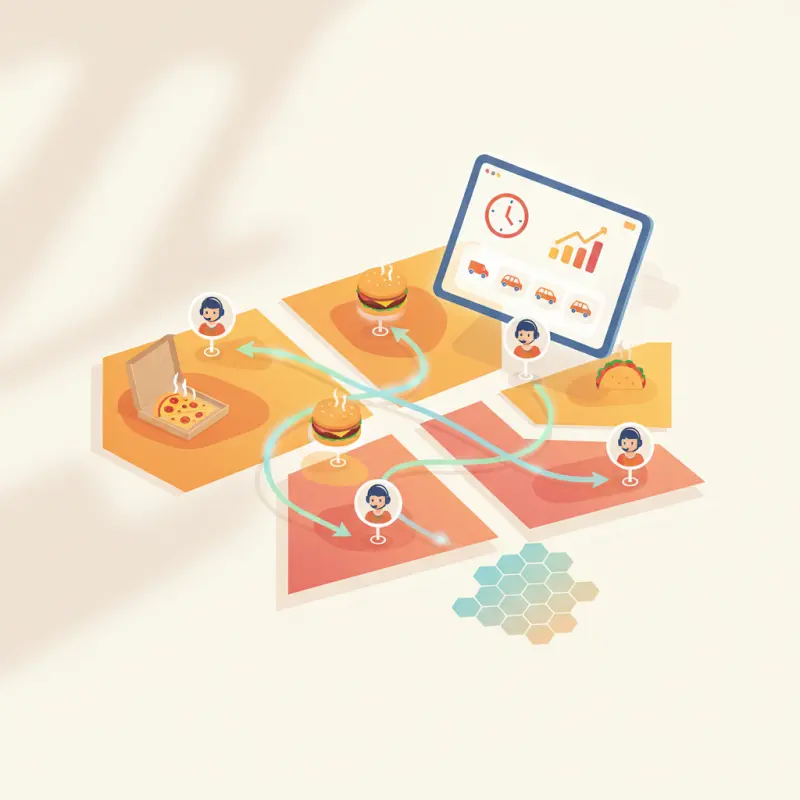
Food Delivery Software Guide: Zone Logic and Driver Assignment
Blog Manager
··4 min read
AI Overview
Food delivery software profitability depends on three core mechanics: zone configuration, driver assignment logic, and batch delivery optimization. Food delivery software using polygon zones outperforms radius-based systems by 18% in dense urban areas like Casablanca's Maarif district because they follow actual street boundaries rather than creating geographic dead zones. Automatic driver assignment algorithms consider driver location, remaining capacity, and order value simultaneously to optimize routes. Batch delivery logic groups multiple orders heading to the same neighborhood, allowing drivers to complete two extra deliveries per shift in properly configured systems. Restaurant owners lose an average of 280,000 MAD annually to inefficient delivery operations that could be prevented with proper software configuration. Configure your delivery zones using polygon mapping rather than radius circles to eliminate routing inefficiencies and reduce delivery times.
Table of Contents
For restaurant owners
Start your restaurant in 60 minutes.
From signup to your first real order — no commission, no setup fee, no sales call.
Restaurant owners in Agadir lose an average of 280,000 MAD annually to delivery commissions — money that could hire two full-time staff members. Understanding how food delivery software actually works reveals why some restaurants thrive while others barely survive the digital shift.
This guide cuts through the marketing noise to show you the operational mechanics that matter: zone logic, driver algorithms, and the true cost structures hiding in your monthly statements.
Zone Configuration: Where Your Drivers Go (And Where They Don't)
Your delivery zone configuration determines profitability more than any other software setting. Poor zone setup wastes driver time, frustrates customers, and quietly drains your margins through inefficient routing.
Polygon zones follow actual street boundaries and neighborhood borders. When you draw a polygon around your delivery area in Casablanca's Maarif district, the system respects that Boulevard Zerktouni creates a natural boundary. Drivers won't get orders for addresses they can't physically reach.
Radius zones create perfect circles that ignore geography. A 5-kilometer radius from your restaurant might include customers across the Hassan II Boulevard — technically within range but requiring a 20-minute detour through traffic. These "dead zones" appear available to customers but kill your delivery times.
The cost impact hits hard: restaurants using polygon-based food delivery management software report 18% faster delivery times in dense urban areas. That translates to each driver completing two extra deliveries per shift.
Driver Assignment Logic That Actually Works
Automatic driver assignment considers three factors simultaneously: current driver location, remaining delivery capacity, and order value optimization. The algorithm assigns your closest available driver while grouping orders along efficient routes.
Batch delivery logic groups multiple orders heading to the same neighborhood. A smart food ordering and delivery platform identifies when three orders for Hay Riad can travel together, reducing your per-delivery cost by 40%.
Manual assignment — where dispatchers choose drivers for each order — adds 35 minutes of coordination time per shift. That's labor cost with zero customer value.
Stack audit
What do you currently use?
Tick what you have. We’ll show what OCHI replaces or connects to.
The Commission Math: What Restaurant Owners Actually Pay
Traditional commission-based platforms present their fees simply: "15% commission." The real cost structure runs much deeper, eating into margins through multiple hidden charges.
Fee Type
Traditional Platform
Zero-Commission Model
Cost on 1,000 MAD Order
Base Commission
15-30%
0%
150-300 MAD
Payment Processing
2.9% + 2 MAD
2.9% + 2 MAD
31 MAD
Marketing Fees
3-5%
0%
30-50 MAD
Priority Placement
2-8%
0%
20-80 MAD
Total Restaurant Receives
569-739 MAD
969 MAD
—
A restaurant processing 50 orders daily through traditional platforms loses 400,000 to 700,000 MAD annually in commissions alone. That's enough to open a second location.
Zero-Commission Model Reality Check
Zero-commission platforms like OCHI charge fixed monthly fees instead of per-order percentages. The break-even point typically hits at 15-20 orders per day — below that, commission models might cost less. Above that threshold, restaurants keep significantly more revenue.
OCHI's model means a busy Marrakech restaurant processing 100 daily orders keeps an extra 50,000 MAD monthly compared to 25% commission platforms. The online food ordering and delivery platform pays for itself within three days of typical operation.
GPS Tracking: Beyond the Dot on the Map
Real-time tracking affects three critical metrics: customer satisfaction scores, delivery completion rates, and driver accountability. Not all tracking systems deliver equal precision.
High-accuracy GPS (5-meter precision) shows drivers navigating specific streets and entering building complexes. Customers see their order approaching in real-time, reducing support calls by 60%. Low-accuracy systems (50-meter precision) show drivers jumping between blocks, creating confusion and complaints.
What Restaurant Owners See vs. What Customers See
Your restaurant delivery software dashboard should display driver speed, route efficiency, and stop duration at each delivery. Customers need simplified views: order accepted, being prepared, on the way, and arriving soon.
Dynamic arrival calculations adjust for traffic patterns and driver performance history. A sophisticated system knows your driver takes 12 minutes to reach Agadir's Talborjt district during lunch rush but only eight minutes at dinner. Static estimates frustrate customers with consistently wrong predictions.
The Delivery Analytics That Matter
Track average delivery time by zone and day to optimize your polygon boundaries. If Sundays in Dakhla district average 45 minutes while weekdays take 25, you might restrict that zone during peak times.
Driver efficiency metrics reveal training opportunities. When one driver averages 22-minute deliveries while others complete similar routes in 18 minutes, you've identified a coaching moment that saves four minutes per order.
Multi-Location Management: One Dashboard, Multiple Restaurants
Restaurant groups need centralized oversight without sacrificing individual location flexibility. Modern food delivery management software handles this through hierarchical permissions and branch-specific settings.
Inventory Synchronization Across Branches
Real-time stock sync prevents the embarrassment of accepting orders you can't fulfill. When your Guéliz branch runs out of chicken tagine, the system automatically marks it unavailable only at that location.
Menu variations between branches reflect local preferences and pricing. Your beachfront location might charge 20% more than your inland branch — the system handles these variations automatically while maintaining central menu control.
Recipe-level inventory tracking means running out of tomatoes affects multiple dishes appropriately. The system knows which items to mark unavailable based on shared ingredients.
Staff Role Management at Scale
Eight permission levels separate responsibilities clearly. Your branch manager accesses reports and inventory. Cashiers handle payments only. Chefs update preparation times. Drivers see their assigned orders. No overlap, no confusion.
Multi-branch reporting aggregates performance while maintaining individual visibility. Compare Tuesday lunch performance across all locations to identify which branches need support.
Driver pools can serve multiple nearby locations. Your Marina and Corniche branches in Casablanca might share delivery staff during off-peak hours, improving driver utilization by 35%.
The right food delivery software transforms your operation from chaos to control. Test these features yourself at votrenom.ochi.ma and discover how zero-commission delivery works for your Agadir restaurant. Browse our complete delivery management guides and explore detailed platform features built specifically for Moroccan restaurants.
Frequently Asked Questions
What's the difference between polygon and radius zones in food delivery software?
Polygon zones follow actual street boundaries and neighborhood borders, while radius zones create perfect circles that ignore geography. Polygon zones prevent drivers from getting orders they can't efficiently reach, resulting in 18% faster delivery times in dense urban areas.
How does automatic driver assignment work in delivery platforms?
Automatic assignment considers three factors: current driver location, remaining delivery capacity, and order value optimization. The system assigns the closest available driver while grouping orders along efficient routes to maximize deliveries per shift.
What is batch delivery logic and why does it matter?
Batch delivery logic groups multiple orders heading to the same neighborhood into single trips. This allows drivers to complete two extra deliveries per shift by eliminating redundant travel between similar locations.
How much do restaurants typically lose to delivery commission fees?
Restaurant owners in Agadir lose an average of 280,000 MAD annually to delivery commissions. This amount could hire two full-time staff members and significantly impact restaurant profitability.
Which zone configuration works best for urban restaurant delivery?
Polygon zones work best for urban delivery because they respect actual street layouts and neighborhood boundaries. They eliminate dead zones that appear available to customers but create inefficient routing for drivers.
Restaurant owners · Weekly
The guide to running a restaurant in 2026.
One article per week. No commission advice.
Just honest operational insight for Moroccan restaurants.
Blog Manager
Comments
No comments yet. Be the first to share your thoughts.