AI Overview
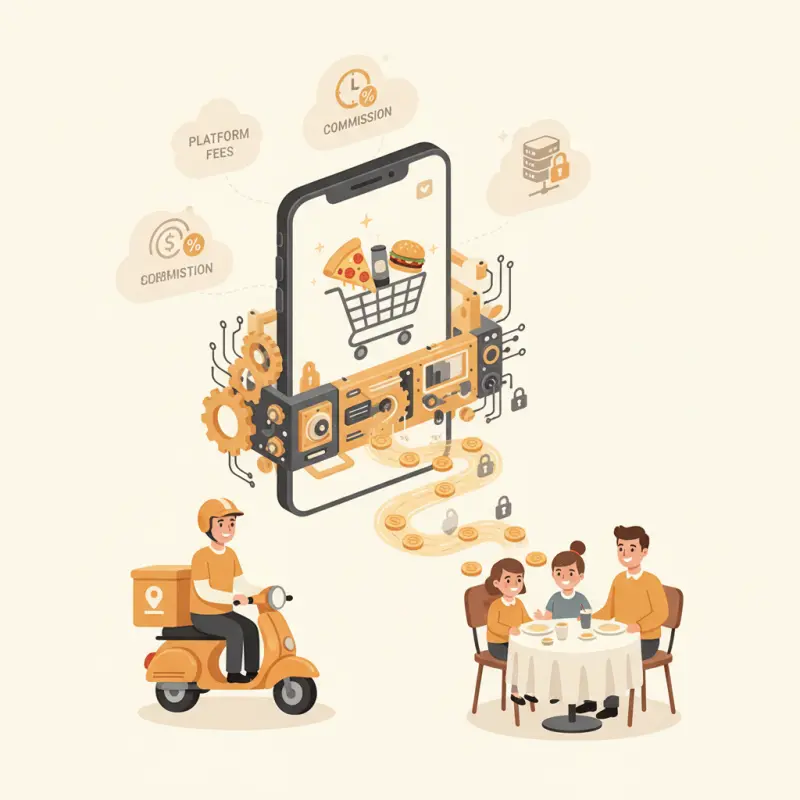
Online food ordering and delivery software platforms in Morocco charge restaurants 25-30% commission plus additional fees that often eliminate profits entirely. Most online food ordering and delivery software advertises as 'free to join' but typical monthly costs reach 30-38% of gross sales when including commissions, payment processing (2.9% plus fixed fees), and marketing charges. A Casablanca restaurant earning 100,000 MAD monthly pays 31,200-38,200 MAD in platform fees, while average restaurant margins in Morocco only reach 10-15%. Agadir kebab shops report profit margins dropping from 12% to negative 3% after joining these platforms. Small orders under 50 MAD become loss-makers due to fixed transaction fees. Calculate your total platform costs including all fees before committing to any service.
Table of Contents
Every restaurant owner in Morocco knows the promise: sign up for online food ordering and delivery software, watch your revenue grow. What they don't tell you is that the average restaurant using these platforms actually makes less profit than before they started.
The math is brutal. A restaurant doing 100,000 MAD monthly through an online food ordering and delivery platform loses 25,000 MAD to commissions alone. Add payment processing fees, marketing charges, and suddenly you're working twice as hard for less money.
The Real Cost of "Free" Food Delivery Management Software
Most platforms advertise themselves as free to join. The signup costs nothing. The tablet arrives at your door. The training takes an afternoon. Then the orders start flowing and the real costs begin.
Here's what a typical Casablanca restaurant pays monthly on a "free" platform:
| Fee Type | Rate | On 100,000 MAD Sales |
|---|---|---|
| Commission | 25-30% | 25,000-30,000 MAD |
| Payment Processing | 2.9% + 3 MAD | 3,200 MAD |
| Marketing Fees | 3-5% | 3,000-5,000 MAD |
| Delivery Fees (customer pays) | 15-25 MAD | Platform keeps it |
| Total Monthly Cost | 30-38% | 31,200-38,200 MAD |
The commission trap works because restaurants feel they have no choice. The platform brings customers. You need customers. So you pay.
The Commission Trap: Why 15-30% Fees Kill Your Margins
Restaurant margins in Morocco average 10-15% on a good day. When your food delivery management software takes 25%, you're losing money on every order. The platforms know this. They're counting on volume to keep you hooked.
A kebab shop in Agadir shared their numbers: 300 orders monthly through the platform, average ticket 80 MAD. Gross revenue: 24,000 MAD. Platform fees: 7,200 MAD. Their profit margin went from 12% to negative 3%.
Payment Processing: The Hidden 3-5% Nobody Mentions
Beyond commissions, payment processing adds another layer of cost. Most platforms bundle this into their service, charging 2.9% plus a fixed fee per transaction. On small orders — which make up 60% of delivery volume — this percentage can reach 5% of the order value.
Cash orders? The platform still takes their cut. They process nothing but charge you anyway.
True Cost Calculator: What You Actually Pay Monthly
Calculate your real platform costs: Take your monthly revenue, multiply by 0.35 (average all-in platform cost), then subtract from your current profit. Most restaurants discover they're paying 40,000-50,000 MAD monthly for the privilege of being on a food ordering and delivery platform.
Stack audit
What do you currently use?
Tick what you have. We’ll show what OCHI replaces or connects to.
Delivery Zone Setup: Polygons vs. Radius (And Why Most Restaurants Get This Wrong)
Your delivery zone determines everything: which customers can order, how long deliveries take, and whether drivers accept your orders. Most restaurant delivery software offers two options, but rarely explains which works better.
Polygon Zones: Precision Delivery Mapping for Agadir's Complex Streets
Polygon zones let you draw exact delivery boundaries on a map. You trace around neighborhoods, excluding areas with difficult access or low demand. In Agadir, this means including Hay Mohammadi and Talborjt while excluding the industrial zones where delivery times triple.
A seafood restaurant using polygon zones increased their delivery completion rate from 78% to 94%. They excluded three problem areas where drivers regularly got lost, focusing on neighborhoods they could serve in under 30 minutes.
Radius Zones: Simple Setup, Limited Control
Radius zones create a circle around your restaurant. Simple to set up — pick a distance, done. But Moroccan cities don't work in perfect circles. A 5km radius from downtown Casablanca includes both Boulevard Mohammed V (10 minutes) and industrial Sidi Moumen (45 minutes in traffic).
Driver Assignment Logic: Manual vs. Automatic Systems
How your online food ordering and delivery platform assigns drivers matters more than how many drivers you have. Manual assignment means your staff picks each driver — slow but gives control. Automatic assignment uses algorithms considering distance, driver rating, and current orders.
The best systems combine both: auto-assign with manual override. When your regular driver knows the construction on Avenue Hassan II is causing delays, you can assign someone else.
The Driver Economics Nobody Talks About: Batch Deliveries and Real-Time Tracking
Here's what food delivery management software companies won't tell you: more drivers often means worse service. The economics of delivery only work when drivers stay busy.
Why Five Drivers Beat Ten: The Batch Delivery Math
A driver needs 15-20 deliveries per shift to earn decent money. With ten drivers and 100 daily orders, each driver gets 10 deliveries. They earn less. They quit. You're constantly training new drivers who don't know your customers or areas.
Five experienced drivers handling 20 deliveries each stay motivated. They learn efficient routes. They recognize regular customers. They batch nearby orders naturally, delivering two or three orders per trip.
GPS Tracking That Actually Works: Real-Time vs. 5-Minute Delays
Most platforms update driver location every 5-10 minutes to save server costs. Customers see their driver "stuck" at one location, then suddenly jumping across the map. Real-time tracking updates every few seconds, showing smooth movement and accurate ETAs.
OCHI's real-time GPS tracking shows customers exactly where their driver is, reducing "where's my order?" calls by 89%. Our blog covers more operational improvements that actually matter.
Auto-Assignment Algorithms: Distance vs. Driver Experience
Basic algorithms assign the nearest driver. Smart algorithms factor in driver ratings, completion rates, and zone familiarity. A driver who's delivered to Quartier Industriel 50 times beats a closer driver visiting for the first time.
Platform Control: Branded Domains vs. Marketplace Dependency
The biggest decision isn't which features your restaurant delivery software offers. It's who controls your business. Marketplace dependency means the platform owns your customers. One algorithm change and your orders disappear.
yourname.ochi.ma: Why Your Brand URL Matters for Casablanca Customers
When customers order from brasserieatlas.ochi.ma, they're ordering from Brasserie Atlas, not from a platform. Your brand. Your URL. Your customer relationship. Marketing becomes simple: put your ordering link everywhere. Business cards, social media, receipts.
Compare this to marketplace URLs: platform.com/restaurant/brasserie-atlas-casablanca-hay-hassani-2. Impossible to remember. Impossible to brand. Impossible to own.
Customer Data Ownership: Platform Lock-in vs. Export Freedom
Most platforms guard customer data religiously. You can see summaries but can't export emails or phone numbers. Leave the platform? Start from zero. Your customer list — built over years — stays with them.
True ownership means downloading your complete customer database anytime. Email addresses, order history, preferences. Your data to use for email campaigns, SMS offers, or switching platforms.
Marketing Automation: Email Lists You Control vs. Platform-Owned Data
A Marrakech restaurant using their own customer data sends targeted campaigns: tagine lovers get lamb specials, vegetarians see new quinoa bowls. Open rates: 45%. Order rates: 12%. Cost: 200 MAD monthly for email software.
Same restaurant on a marketplace sending "promoted placement" ads through the platform: 2% conversion rate, 5,000 MAD monthly cost.
OCHI's Zero-Commission Model: Real Numbers from 1,000+ Moroccan Restaurants
OCHI works differently. Zero commission means restaurants keep 100% of their revenue. No percentages. No hidden fees. No surprises. Here's how it works in practice.
Commission Comparison: 0% vs. Industry Standard 25%
The math speaks for itself:
| Monthly Revenue | Traditional Platform (25% commission) | OCHI (0% commission) | Monthly Savings |
|---|---|---|---|
| 50,000 MAD | 12,500 MAD fees | 0 MAD fees | 12,500 MAD |
| 100,000 MAD | 25,000 MAD fees | 0 MAD fees | 25,000 MAD |
| 200,000 MAD | 50,000 MAD fees | 0 MAD fees | 50,000 MAD |
That saved money goes straight to your bottom line. Or into better ingredients. Or staff bonuses. Your choice, not the platform's.
Monthly Revenue Impact: Actual Case Study from Marrakech Restaurant
Riad Kitchen in Marrakech switched to OCHI in January. Previous platform: 180,000 MAD monthly revenue, 45,000 MAD in fees. With OCHI: same 180,000 MAD revenue, zero fees. They hired two more cooks with the savings.
Their driver setup uses polygon zones covering the medina and Gueliz. Five regular drivers handle 120 daily deliveries using batch delivery. Real-time tracking reduced customer complaints by 80%.
Implementation Timeline: 48 Hours vs. 2-Week Industry Average
Most online food ordering and delivery software takes weeks to implement. Technical setup. Menu upload. Staff training. Payment verification. By week three, you're still not taking orders.
OCHI launches restaurants in 48 hours. Day one: account setup and menu import. Day two: staff training and test orders. Day three: you're live. The platform includes everything — POS, kitchen display, driver tracking, customer apps — all connected from day one.
The restaurant industry is changing. Delivery and online ordering are no longer optional. But paying 30% of your revenue for basic technology? That model is dying. Smart restaurants are taking back control — their brand, their customers, their profits. See what OCHI can do for your restaurant at ochi.ma/partners.
Frequently Asked Questions
What percentage do online food ordering and delivery software platforms charge in Morocco?
Most platforms charge 25-30% commission on each order, plus payment processing fees of 2.9% and additional marketing charges of 3-5%. Total costs typically reach 30-38% of gross sales.
Why do restaurants lose money with online food ordering and delivery software?
Restaurant margins in Morocco average 10-15%, but platform fees consume 25-38% of revenue. This creates negative margins where restaurants lose money on every order despite increased volume.
Are there hidden fees in online food ordering and delivery software?
Yes. Beyond advertised commissions, restaurants pay payment processing fees, marketing charges, and delivery fees. These additional costs add 5-8% to the base commission rate.
How much does a 100,000 MAD monthly restaurant pay in platform fees?
A restaurant with 100,000 MAD monthly sales pays 31,200-38,200 MAD in total platform fees, including 25,000-30,000 MAD in commissions alone.
Restaurant owners · Weekly
The guide to running a restaurant in 2026.
One article per week. No commission advice. Just honest operational insight for Moroccan restaurants.

Blog Manager
Comments
No comments yet. Be the first to share your thoughts.