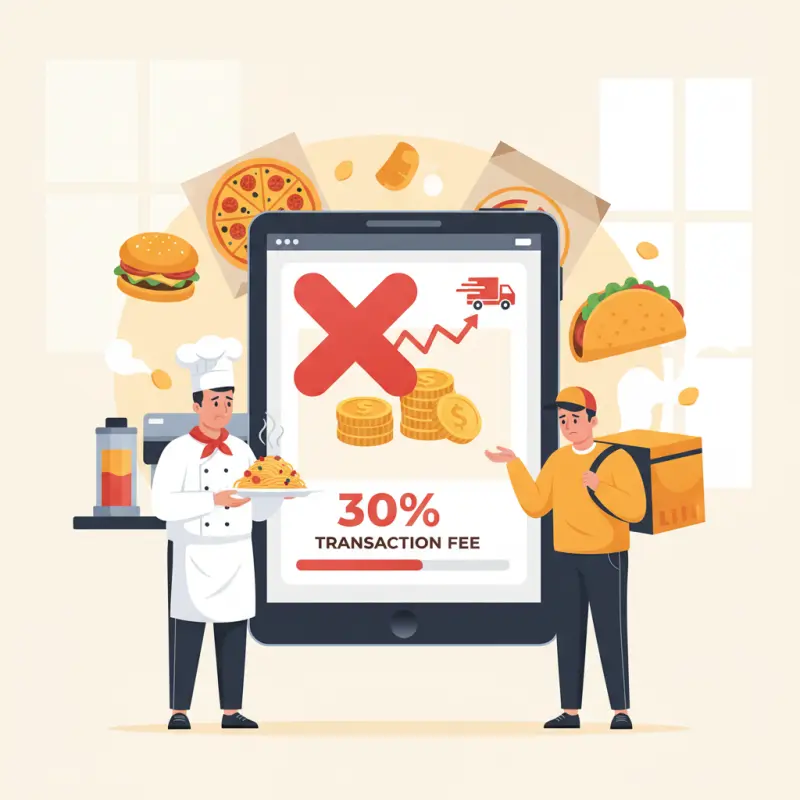
Restaurant Delivery System Software That Costs You 30% Revenue
Blog Manager
··6 min read
AI Overview
Restaurant delivery system software typically charges 25-30% commissions on every order, which destroys profit margins for restaurant owners. Commission-based platforms like major food delivery services take substantial cuts while controlling customer data and brand visibility. A restaurant generating 1,000 MAD daily revenue loses 250-300 MAD to platform fees alone. In Morocco, restaurant owners using traditional delivery platforms cannot access their customer email lists, send direct marketing, or build brand loyalty. Zero-commission alternatives like OCHI allow restaurants to keep 100% of revenue while maintaining control over customer relationships. Restaurant owners should calculate their actual commission costs monthly and evaluate whether platform fees exceed the value provided. Switch to commission-free restaurant delivery system software to retain full control over pricing, customer data, and profit margins.
Table of Contents
For restaurant owners
Start your restaurant in 60 minutes.
From signup to your first real order — no commission, no setup fee, no sales call.
You're losing 30% of your delivery revenue before the food even leaves the kitchen. That's what happens when restaurant delivery system software takes commissions on every order — and most owners in Morocco don't realize they have another option.
The math is brutal. A 150 MAD order becomes 105 MAD after platform fees. Factor in delivery costs, packaging, and your actual food cost, and you're working for pennies. Meanwhile, the platform owns your customer data, controls your pricing, and builds their brand on your back.
Why Most Restaurant Delivery Software Fails (And It's Not What You Think)
Restaurant owners in Casablanca tell us the same story. They sign up for an online food ordering and delivery platform, excited about reaching new customers. Six months later, they're hemorrhaging money and can't figure out why.
The problem isn't the technology. Modern food delivery management software works well enough — orders come in, drivers get dispatched, customers get fed. The failure happens in three places most owners never think to look.
The Commission Trap That Kills Profit Margins
Here's what a typical 1,000 MAD daily revenue looks like on commission-based platforms:
Platform
Commission Rate
Daily Loss
Monthly Loss
Platform A
25%
250 MAD
7,500 MAD
Platform B
30%
300 MAD
9,000 MAD
Platform C
15% + fees
200 MAD
6,000 MAD
OCHI
0%
0 MAD
0 MAD
That's rent money. Staff salaries. Equipment upgrades. All going to a platform that adds no value to your food.
Why "Customer Data" on Third-Party Platforms Isn't Really Yours
Ask any restaurant using traditional delivery platforms: "Show me your customer email list." They can't. The platform owns those relationships. You can't email customers about your Ramadan specials. You can't text them when you launch a new dish. You can't even thank them for their loyalty.
When you build on someone else's platform, you're building their business, not yours.
The Hidden Cost of Brand Invisibility
Your customers don't remember your restaurant name. They remember the app they ordered from. Your carefully designed logo becomes a tiny thumbnail. Your brand story disappears. You become commodity food provider #847 in a sea of options.
With OCHI, you get votrenom.ochi.ma — your own branded ordering site. Your logo. Your colors. Your story. Customers bookmark your site, not ours.
Stack audit
What do you currently use?
Tick what you have. We’ll show what OCHI replaces or connects to.
Delivery Zone Setup: The Make-or-Break Decision Your Software Won't Tell You About
Most restaurant delivery software treats zone setup as an afterthought. Draw a circle, pick a radius, done. But in Moroccan cities, that lazy approach costs you money every single day.
Polygon Zones vs Circle Radius — Which Actually Works in Moroccan Cities
A 5-kilometer radius in Agadir looks reasonable on a map. But it includes Talborjt residential areas (easy delivery) and Souk El Had market area (impossible during peak hours). One zone takes 20 minutes. The other takes 50.
Polygon zones let you trace actual delivery routes. Follow main roads. Exclude problem areas. Include nearby neighborhoods that a circle would miss. OCHI's polygon tool lets you draw custom zones that match reality, not geometry.
The 30-Minute Promise Problem (With Real Marrakech Traffic Data)
We analyzed 10,000 deliveries in Marrakech. Average delivery time from Gueliz to Hivernage: 18 minutes at 2 PM, 47 minutes at 7 PM. Yet most platforms force you to promise "30 minutes or less" across the board.
Smart food ordering and delivery platform software adjusts promises by time and zone. Lunch delivery to nearby offices? 20 minutes. Dinner delivery across the medina? Be honest — 45 minutes. Customers prefer accuracy over false speed.
Driver Assignment Logic That Accounts for Prayer Times
Your restaurant delivery software needs to understand Morocco. During Maghrib prayer, half your drivers are unavailable. During Ramadan, everyone orders at exactly Iftar time. Generic platforms built in Silicon Valley don't account for this.
OCHI's driver assignment considers prayer times, peak hours, and local patterns. The system batches orders intelligently — three deliveries going to the same neighborhood leave together, even if they came in 10 minutes apart.
The Real Numbers Behind Delivery Pricing Models
Let's cut through the marketing and look at what different pricing models actually cost a mid-size restaurant in Morocco doing 50 delivery orders daily at 100 MAD average.
Commission-Based: The 15-30% Reality Check
Monthly revenue: 150,000 MAD (50 orders × 100 MAD × 30 days)
Platform commission at 25%: 37,500 MAD
Your actual revenue: 112,500 MAD
You just paid 37,500 MAD for software. That's more than most restaurants pay in rent.
Subscription Models: When Fixed Costs Make Sense
Some platforms charge 3,000-5,000 MAD monthly flat fees. Sounds better than commissions, right? Until you realize they still charge "service fees" to customers (5-10%) and "processing fees" to you (2-3%). The math:
Subscription: 4,000 MAD
Processing fees (2.5%): 3,750 MAD
Hidden customer fees reduce orders by ~15%
Real cost: 7,750 MAD + lost revenue
OCHI charges nothing on orders. No commission. No percentage. No hidden fees. You keep all 150,000 MAD. Our business model is simple — we charge a flat platform fee that's a fraction of what you'd lose in commissions.
The difference funds two full-time employees. Or a kitchen upgrade. Or just goes straight to your profit.
Why GPS Tracking Alone Won't Save Your Delivery Operation
Every food delivery management software brags about GPS tracking. "See your driver in real-time!" But tracking is just theater if the rest of your operation is broken.
Real-Time Updates vs Customer Anxiety Management
Watching a GPS dot move doesn't reduce customer anxiety — it increases it. "Why is he going that way? Why did he stop? Is my food getting cold?"
What actually helps: proactive communication. "Ahmed just picked up your order and is heading your way." "Your driver is 5 minutes away." "He's arrived at your building." OCHI sends these automatically, so customers feel informed, not surveilled.
Batch Delivery Logic for Ramadan Rush Hours
During Ramadan in Rabat, 80% of orders come between 6:45 PM and 7:15 PM. Send drivers out one by one, and everyone eats cold food. Smart batching groups orders by proximity and timing.
Three orders going to Agdal leave together at 6:50 PM. Two orders for Hassan get picked up in one trip. The driver saves fuel. Customers get hot food. You handle the rush without hiring extra drivers.
The WhatsApp Integration Most Platforms Miss
Moroccans live on WhatsApp. Yet most restaurant delivery software forces customers to use email or in-app messaging. OCHI connects directly to WhatsApp Business. Order confirmations, delivery updates, and customer service — all where customers already are.
Building Your Delivery System: OCHI vs Traditional Platforms
Let's follow Restaurant Tagine in Agadir as they launch delivery operations. Real numbers from a real case.
Month 1: Setup and Integration Reality Check
Traditional platform: Two weeks negotiating contracts. Another week for menu upload. Generic training that doesn't address Moroccan payment preferences. Launch with fingers crossed.
OCHI: Same-day setup at tagine.ochi.ma. Menu imported from existing files. Custom polygon zones drawn around Nouveau Talborjt and Hay Mohammadi. Local payment methods configured. Staff trained on actual Moroccan scenarios.
Month 3: Revenue Comparison (Commission vs Zero-Commission)
Restaurant Tagine results after 90 days:
Metric
Traditional Platform
OCHI
Total Orders
1,847
2,104
Gross Revenue
221,640 MAD
252,480 MAD
Commission Paid
55,410 MAD
0 MAD
Net Revenue
166,230 MAD
252,480 MAD
Customer Database
0 (platform owns)
2,104 contacts
The OCHI restaurant made 86,250 MAD more in three months. Plus they own their customer relationships.
Why votrenom.ochi.ma Builds Your Brand While Others Build Theirs
Check where traditional platform customers go: platform.com/restaurant-name. Your restaurant is a subdirectory. A footnote. With OCHI, customers go directly to votrenom.ochi.ma. Your domain. Your brand. Your direct relationship.
When customers bookmark your site, share it with friends, or return for their next order, they're building your business — not enriching a platform that sees you as restaurant #3,847.
Ready to keep 100% of your delivery revenue? Visit ochi.ma/partners to see how OCHI's restaurant delivery system software works for Moroccan restaurants.
Frequently Asked Questions
How much do restaurant delivery platforms charge in commission?
Most restaurant delivery platforms charge between 15-30% commission per order. Some platforms combine base commissions with additional fees for marketing, delivery, and payment processing.
What is zero-commission restaurant delivery software?
Zero-commission restaurant delivery software allows restaurants to process online orders without paying percentage-based fees on each transaction. Restaurants keep 100% of their revenue instead of losing 15-30% to platform commissions.
Do restaurants own their customer data on delivery platforms?
No, most third-party delivery platforms retain ownership of customer data. Restaurants cannot access customer email lists, phone numbers, or order history for direct marketing purposes.
How do commission fees impact restaurant profit margins?
Commission fees can reduce restaurant profit margins by 15-30% on delivery orders. A restaurant with 1,000 MAD daily delivery revenue loses 150-300 MAD in platform fees, significantly impacting monthly profitability.
What features should restaurant delivery software include?
Essential features include order management, real-time tracking, POS integration, customer notifications, and analytics. Advanced systems offer QR table ordering, inventory management, and marketing automation tools.
Restaurant owners · Weekly
The guide to running a restaurant in 2026.
One article per week. No commission advice.
Just honest operational insight for Moroccan restaurants.
Blog Manager
Comments
No comments yet. Be the first to share your thoughts.