AI Overview
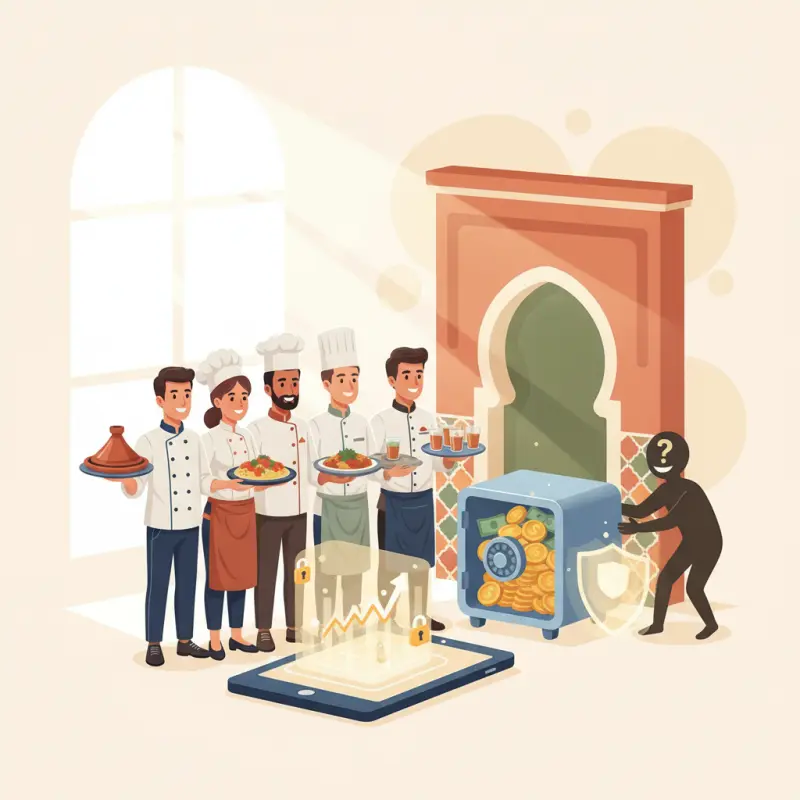
A restaurant labor management system prevents employee theft that causes 30% of restaurant closures in Morocco. Restaurant labor management system platforms like OCHI provide eight distinct staff roles instead of basic admin-staff permissions that enable theft. Casablanca restaurants lose 7% of revenue to internal theft — 21,000 MAD monthly for restaurants grossing 300,000 MAD. The problem isn't bad employees but bad permission systems where everyone has identical access without audit trails. Traditional HR software tracks scheduling metrics while missing suspicious refunds and unauthorized voids. OCHI's system assigns specific permissions: Admin controls everything, Branch Manager handles operations but can't delete data, Cashier processes payments but can't void orders without approval. Eight role-based permissions create accountability through audit trails. Configure role-based permissions that match your actual restaurant hierarchy to eliminate theft opportunities.
Table of Contents
The Hidden Cost of Poor Restaurant Labor Management: Why Your Staff Might Be Stealing More Than Time
Employee theft causes 30% of restaurant closures in Morocco. Not the economy. Not competition. Your own staff.
Most restaurant owners think a restaurant labor management system is about scheduling shifts and tracking hours. They're wrong. The real drain on your profits happens when your cashier processes fake refunds at 11 PM, your waiter voids legitimate orders to pocket cash, or your manager gives unauthorized discounts to friends. In Casablanca alone, restaurants lose an average of 7% of revenue to internal theft — that's 21,000 MAD monthly for a restaurant grossing 300,000 MAD.
The problem isn't bad people. It's bad systems. When everyone has the same access, when there's no audit trail, when permissions are either "everything" or "nothing" — you've created an environment where theft is easy and detection is impossible.
Traditional restaurant HR software focuses on the wrong metrics. They'll tell you about labor cost percentages and optimal staffing levels. Meanwhile, your evening shift cashier just processed their fifth suspicious refund this week, and you'll never know because your system doesn't track who did what.
Platform comparison
Where does your money really go?
| Commission | 27% | 25% | 30% | 0% |
| Customer data | They own it | They own it | They own it | You own it |
| Your branding | Theirs | Theirs | Theirs | Yours |
| Payout cadence | Biweekly | Weekly | Biweekly | Weekly |
| Setup cost | Free | Free | Free | Paid |
Eight Staff Roles That Actually Make Sense for Moroccan Restaurants
Here's what most restaurant workforce management software gets wrong: they give you either two roles (admin and staff) or 20 roles that nobody understands. Your restaurant doesn't need 20 roles. You need eight that match how Moroccan restaurants actually operate.
OCHI built their permission system around real restaurant operations:
| Role | What They Can Do | What They Can't Do | Why It Matters |
|---|---|---|---|
| Admin | Everything | Nothing restricted | Owner-only access |
| Branch Manager | Branch operations, reports, staff management | Delete historical data, modify prices | Trust but verify |
| Cashier | Process payments, handle cash | Void orders, issue refunds without manager | Prevents cash theft |
| Waiter | Take orders, request modifications | Process payments, delete items | Order integrity |
| Kitchen Staff | View orders, mark prepared | Modify orders, access payment info | Kitchen focus only |
| Delivery | View delivery details, update status | Access customer payment methods | Privacy protection |
| Accountant | View reports, export data | Process transactions, modify records | Read-only compliance |
| Staff | Basic access, clock in/out | Everything else | Minimum access needed |
This isn't theoretical. A restaurant in Marrakech's Guéliz district discovered their senior waiter was voiding legitimate orders after customers paid cash — pocketing over 2,000 MAD weekly. They only caught it when they implemented role-based permissions and saw the pattern in their audit logs.
The best restaurant scheduling software in the world won't help if your staff can delete the evidence of their theft. Granular permissions aren't about control — they're about clarity. When each person can only do what their job requires, unusual patterns become obvious.
The Audit Trail That Catches Fake Refunds (Real Scenario from Casablanca)
Restaurant Palmier in Casablanca's Maârif district noticed their profit margins dropping despite steady sales. The owner blamed rising food costs until they installed a proper restaurant labor management system with audit trails. What they found: their night shift supervisor processed 47 refunds in one month — all between 10 PM and midnight, all for cash orders, all when the owner wasn't present.
Here's how employee action tracking revealed the pattern:
Week 1: Three refunds, different amounts, plausible reasons ("customer complained about cold food")
Week 2: Five refunds, similar amounts (30-50 MAD), same time window
Week 3: Twelve refunds, escalating amounts, vague reasons
Week 4: Twenty-seven refunds totaling 1,400 MAD — caught red-handed
The supervisor's method was simple: wait for cash-paying customers during busy dinner rush, process the order normally, then issue a refund after they left. The cash went into his pocket. Without per-employee history tracking in their system, this would have looked like normal business variance.
OCHI's approach tracks every action by every employee with timestamps and details. Not to micromanage — to protect both the business and honest employees. When you can see who voided what order at what time, patterns emerge fast. More importantly, employees knowing this tracking exists prevents most theft before it starts.
What Restaurant Labor Management Actually Costs (With Real Numbers)
Let's talk real numbers. Not marketing fluff.
| Cost Category | Basic Systems | Advanced Systems | Hidden Costs |
|---|---|---|---|
| Monthly Software | 200-500 MAD | 800-1,500 MAD | Training time, integration fees |
| Setup & Training | 2,000-5,000 MAD | 8,000-15,000 MAD | Lost productivity during transition |
| Employee Theft Loss | 3-7% of revenue | 3-7% of revenue | 9,000-21,000 MAD/month (300K revenue) |
| Time Theft | 2-4 hours/employee/week | 2-4 hours/employee/week | 3,200 MAD/month (10 employees) |
Now here's the contrarian truth: the best payroll software for restaurants isn't the one with the most features. It's the one that pays for itself by preventing losses. A restaurant in Agadir's city center implemented proper controls and recovered 18,000 MAD monthly — not through scheduling optimization but through catching unauthorized discounts and fake refunds.
Traditional platforms charge you 1,000+ MAD monthly for scheduling software, then another 1,000 MAD for POS permissions, then another fee for reporting. OCHI includes labor management in their zero-commission platform — you're already paying nothing in fees, and the theft prevention alone covers any system cost.
Beyond Scheduling: Shift Management That Prevents Chaos
Forget optimization algorithms. Your Moroccan restaurant needs shift management that handles reality: the morning cashier calling in sick, the evening rush requiring all hands, the cash that needs counting between shifts.
Real shift management means:
Cash reconciliation between shifts becomes mandatory. When Ahmed hands over to Fatima, the system forces a count. Discrepancies get flagged immediately, not discovered days later. One restaurant in Fès reduced cash variances by 89% just by implementing shift-based cash counts.
Manager approval workflows prevent expensive mistakes. Your waiter can request to void an item, but only the shift manager can approve it. The request, the reason, and the approval all get logged. No more "I forgot to mention I voided that expensive tagine because the customer complained."
Integration with your POS means real-time labor tracking. You see not just who's working, but what they're generating. When your Tuesday lunch waiter averages 2,000 MAD in sales but your Thursday dinner waiter averages 5,000 MAD, you have data for better decisions. This isn't about squeezing staff — it's about putting your best people in the best positions.
The end goal isn't complex workforce analytics. It's operational control. When your shift handover includes automatic cash counts, required manager approvals, and real-time performance data, chaos becomes order. Your managers stop firefighting and start managing.
Smart restaurant owners know that labor management is really about risk management. Every permission you grant, every action you don't track, every shift that ends without reconciliation — these are open doors for loss. The question isn't whether you need a restaurant labor management system. The question is whether you'll implement one before or after you discover what it's costing you not to have one.
See how OCHI's zero-commission platform handles permissions, audit trails, and shift management at ochi.ma/partners.
Frequently Asked Questions
What is a restaurant labor management system?
A restaurant labor management system manages staff permissions, tracks employee actions, and prevents unauthorized transactions through role-based access controls. It combines scheduling, permissions, and audit trails in one platform.
How does employee theft affect restaurants in Morocco?
Employee theft causes 30% of restaurant closures in Morocco. Restaurants in Casablanca lose an average of 7% of revenue to internal theft, costing 21,000 MAD monthly for establishments grossing 300,000 MAD.
What staff roles should restaurants have for security?
Restaurants need eight core roles: Admin with full access, Branch Manager for operations, Cashier for payments only, Waiter for table service, Kitchen Staff for orders, Delivery Driver for logistics, Inventory Manager for stock, and Accountant for financial reports.
How do audit trails prevent restaurant theft?
Audit trails record who performed each action with timestamps, making suspicious activity visible. When cashiers process multiple refunds or waiters void orders frequently, managers can identify patterns and investigate immediately.
Why do traditional restaurant systems enable theft?
Traditional systems give either full admin access or basic staff permissions with no middle ground. This creates situations where cashiers can process refunds, managers can modify prices, and there's no record of who did what.
Restaurant owners · Weekly
The guide to running a restaurant in 2026.
One article per week. No commission advice. Just honest operational insight for Moroccan restaurants.

Blog Manager
Comments
No comments yet. Be the first to share your thoughts.