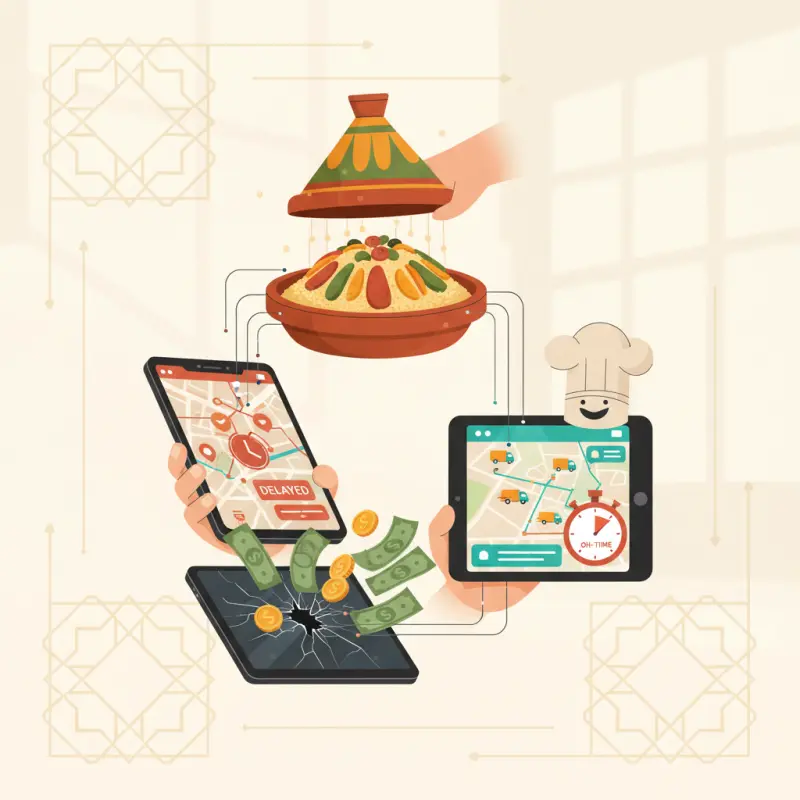
Most food delivery tracking software fails in Moroccan cities because it treats all delivery distances equally, ignoring traffic patterns and street layouts. Standard radius-based zones cause restaurants to lose money on deliveries beyond 3km while creating unrealistic delivery estimates. A 5km delivery in Agadir's coastal roads takes 12 minutes, while the same distance through Marrakech's medina requires 25 minutes. Commission-based platforms like Jumia Food and Glovo compound this problem by taking 15-30% of every order while providing inadequate zone configuration tools. Polygon zones that follow actual street layouts reduce average delivery times by 30% compared to simple radius zones. Replace radius-based delivery zones with polygon zones that exclude traffic-heavy areas and focus on profitable neighborhoods with consistent delivery times.
Table of Contents
For restaurant owners
Start your restaurant in 60 minutes.
From signup to your first real order — no commission, no setup fee, no sales call.
Most restaurants lose money on every delivery beyond 3km — and their food delivery tracking software won't tell them why. In Morocco's competitive restaurant market, where commission-based platforms take 15-30% of every order, the difference between profit and loss often comes down to understanding your delivery zones and driver efficiency.
This guide breaks down the operational reality of food delivery tracking software that vendors won't discuss: zone economics, driver behavior patterns, and the hidden costs that kill profitability.
Why Most Food Delivery Tracking Software Creates More Problems Than It Solves
Your delivery tracking shows the driver arriving in 20 minutes. The customer sees the same estimate. Forty minutes later, they're calling to complain while your driver is stuck in Casablanca's Boulevard Zerktouni traffic. The software didn't lie — it just doesn't understand Moroccan cities.
The core problem isn't the tracking technology. It's that most restaurant delivery software treats all kilometers equally. A 5km delivery in Agadir's flat coastal roads takes 12 minutes. The same distance through Marrakech's medina? Try 25 minutes on a good day.
The Zone Setup Nobody Talks About
Radius-based delivery zones look clean on a map. Draw a 5km circle around your restaurant and you're done. Except that circle includes everything from highway-adjacent neighborhoods with 8-minute delivery times to dense residential areas where drivers spend 15 minutes finding parking.
Polygon zones follow actual street layouts and traffic patterns. That 5km radius becomes a custom shape that excludes problem areas and focuses on profitable neighborhoods. The setup takes longer, but your average delivery time drops by 30%.
Here's what happens when you get zone configuration wrong: your food ordering and delivery platform quotes unrealistic times, drivers rush and make mistakes, and customers learn not to trust your estimates. The tracking becomes a countdown to disappointment.
When Real-Time Tracking Becomes Real-Time Lying
GPS accuracy drops to 50 meters in narrow medina streets. Your tracking shows the driver at the customer's door when they're actually two blocks away, searching for the right derb. The customer watches their food "arrive" while still waiting.
Drivers know they're being tracked. When they're running late, some park outside the delivery zone for five minutes to avoid triggering late-delivery alerts. Others mark orders as "delivered" from their bikes to improve their stats. The software records on-time delivery. The customer experiences something different.
Smart online food ordering and delivery platforms build buffer time into their estimates. If the algorithm says 20 minutes, show the customer 25. Under-promise by 20% and you'll over-deliver consistently.
Stack audit
What do you currently use?
Tick what you have. We’ll show what OCHI replaces or connects to.
A typical Agadir restaurant spends 15-20 MAD per delivery on driver costs (fuel, time, vehicle wear). Add commission fees from traditional platforms and you're looking at 35-45 MAD total cost per order. When your average order value is 150 MAD, that's 30% of revenue gone before counting food costs.
Distance vs Profitability Analysis
Delivery Distance
Driver Cost (MAD)
Time (Minutes)
Orders per Hour
Break-even Order Value
0-2 km
12
15
4
80 MAD
2-3 km
18
22
2.7
120 MAD
3-5 km
25
35
1.7
180 MAD
5+ km
35
45+
1.3
250 MAD
The numbers tell a clear story: deliveries beyond 3km need either higher order values or delivery fees to break even. Most restaurant delivery software doesn't surface this data, leaving operators to discover it through painful trial and error.
OCHI's Approach: Zero Commission, Full Control
Traditional platforms take their 15-30% cut regardless of your delivery economics. A 5km delivery that barely breaks even becomes a guaranteed loss after commission.
OCHI's zero-commission model changes the math. That same delivery keeps its full revenue, turning marginal orders profitable. The platform includes polygon-based zone management and real-time GPS tracking without the platform tax. You set zones based on actual profitability, not platform requirements.
The OCHI restaurant management platform also provides zone-based pricing tools. Charge 10 MAD delivery within 2km, 20 MAD for 2-4km, and 35 MAD beyond that. Customers understand distance-based pricing. They just need transparency.
Auto-Driver Assignment: The Algorithm Restaurant Owners Don't Understand
Your food delivery management software receives an order. Within 60 seconds, it needs to identify available drivers, calculate distances, estimate preparation times, and assign the optimal driver. Most platforms treat this process as a black box.
What Happens in Those First 60 Seconds
The assignment algorithm weighs four factors: driver proximity (40%), current driver load (30%), historical performance (20%), and vehicle type (10%). A driver 2km away with no current orders beats a driver 500m away carrying three orders.
But algorithms miss context. That nearby driver might be on a motorcycle, perfect for navigating Essaouira's narrow streets but wrong for a 10-pizza corporate order. The distant driver has a car with insulated bags.
Peak dinner hours break standard assignment logic. Every driver carries multiple orders. The algorithm queues new orders, creating 10-minute delays before assignment. Customers see "confirming order" while nothing happens.
Manual Override: When You Need Human Judgment
Friday prayers in Casablanca create a 90-minute delivery dead zone. The algorithm doesn't understand why half your drivers are unavailable. Manual assignment lets you route orders to your non-Muslim drivers during this window.
VIP customers need your best drivers — the ones who knock instead of calling, who handle large orders without mixing up items. No algorithm identifies these soft skills. Manual override puts experience where it matters.
Weather changes everything. Rain in Rabat doubles delivery times. Your food ordering and delivery platform might still auto-assign based on normal conditions. Manual control lets you add buffer time and assign only experienced drivers during storms.
Batch Deliveries and Multi-Stop Optimization: The Math Behind Driver Efficiency
Three lunch orders come in for Agadir's Secteur Touristique within five minutes. Send three drivers and you'll spend 90 minutes of total driver time. Batch them intelligently and one driver completes all three in 35 minutes.
The Secteur Touristique Scenario
Order 1 arrives at 12:15 for Hotel Sofitel on Boulevard Mohammed V. Order 2 comes at 12:18 for Agadir Marina. Order 3 at 12:20 heading to a surf camp in Taghazout. Individual delivery would send drivers back and forth across the same routes.
Batched routing creates this sequence: Restaurant → Sofitel (5 min) → Marina (7 min) → Taghazout (20 min) → Return (18 min). Total time: 50 minutes including stops. You've saved 40 minutes of driver time and cut fuel costs by 60%.
But timing matters. If order 1 finishes preparation 10 minutes before order 3, the Sofitel customer waits an extra 10 minutes for hot food. Their tagine arrives lukewarm because you optimized for driver efficiency over customer experience.
When Batching Backfires
Ice cream and hot pizza don't batch well. One order degrades while maintaining the other. Your tracking shows efficient routing. Your customers taste the compromise.
Multi-stop routes work best with similar preparation times and temperature requirements. Four sandwich orders? Perfect batch. Mix of hot grills, cold salads, and frozen desserts? Send separate drivers.
Some food delivery management software forces aggressive batching to maximize platform metrics. OCHI gives you control — set maximum wait times, temperature-based routing rules, and customer priority levels. The algorithm suggests; you decide.
Choosing Platform vs Building: The Real Cost Analysis
Restaurant owners face three options: join commission-based platforms, build custom software, or find a middle ground. The decision shapes your economics for years.
Three-Year Cost Breakdown
Option
Year 1 Cost
Year 2 Cost
Year 3 Cost
Total (3 Years)
Commission Platform (25% of 50K€ annual delivery)
12,500€
12,500€
12,500€
37,500€
Custom Development
18,000€
3,000€
3,000€
24,000€
OCHI (Setup + Monthly)
3,600€
2,400€
2,400€
8,400€
Commission platforms seem free upfront but drain revenue forever. Custom development promises control but requires technical expertise and ongoing maintenance. Most restaurants underestimate debugging costs and feature updates.
The Break-Even Point Restaurant Owners Miss
At 50,000€ annual delivery revenue, commission-free platforms pay for themselves in four months. Double that revenue and the payback period drops to two months. Yet most operators focus on upfront costs instead of long-term economics.
Hidden costs compound the problem. "Free" trial periods end with data lock-in. Setup fees appear after you've trained staff. Payment processing adds another 2.5%. Your 25% commission becomes 30% total platform cost.
OCHI's transparent pricing means no surprises. Pay for the restaurant delivery software, keep your revenue. The platform includes every feature discussed — polygon zones, GPS tracking, driver management, batch optimization — without the commission tax.
The smartest operators think beyond software costs. They calculate customer lifetime value, delivery profit margins, and zone expansion opportunities. When you keep 100% of revenue, growth compounds faster.
See how OCHI's zero-commission platform can transform your delivery operations at ochi.ma/partners — where your success doesn't cost you 30% of revenue.
Frequently Asked Questions
Why does food delivery tracking software show inaccurate delivery times?
Most food delivery tracking software uses radius-based zones that don't account for traffic patterns, road conditions, or urban layouts. A 5km delivery might take 12 minutes on coastal roads but 25 minutes through dense city centers.
What's the difference between radius zones and polygon zones for delivery?
Radius zones create simple circles around restaurants but ignore real-world obstacles. Polygon zones follow actual street layouts and exclude problem areas, reducing average delivery times by 30%.
How do commission-based platforms affect delivery profitability?
Platforms like Jumia Food and Glovo take 15-30% commission on every order while providing basic tracking tools. Combined with poor zone configuration, restaurants often lose money on deliveries beyond 3km.
What causes drivers to get stuck during deliveries in Morocco?
Dense residential areas with limited parking, medina streets that don't appear on GPS maps, and traffic bottlenecks like Casablanca's Boulevard Zerktouni create delays that standard tracking software doesn't predict.
How can restaurants improve their delivery zone profitability?
Use polygon zones instead of radius zones, exclude high-traffic areas that cause delays, and focus on neighborhoods with consistent delivery times and good road access.
Restaurant owners · Weekly
The guide to running a restaurant in 2026.
One article per week. No commission advice.
Just honest operational insight for Moroccan restaurants.
Blog Manager
Comments
No comments yet. Be the first to share your thoughts.