AI Overview
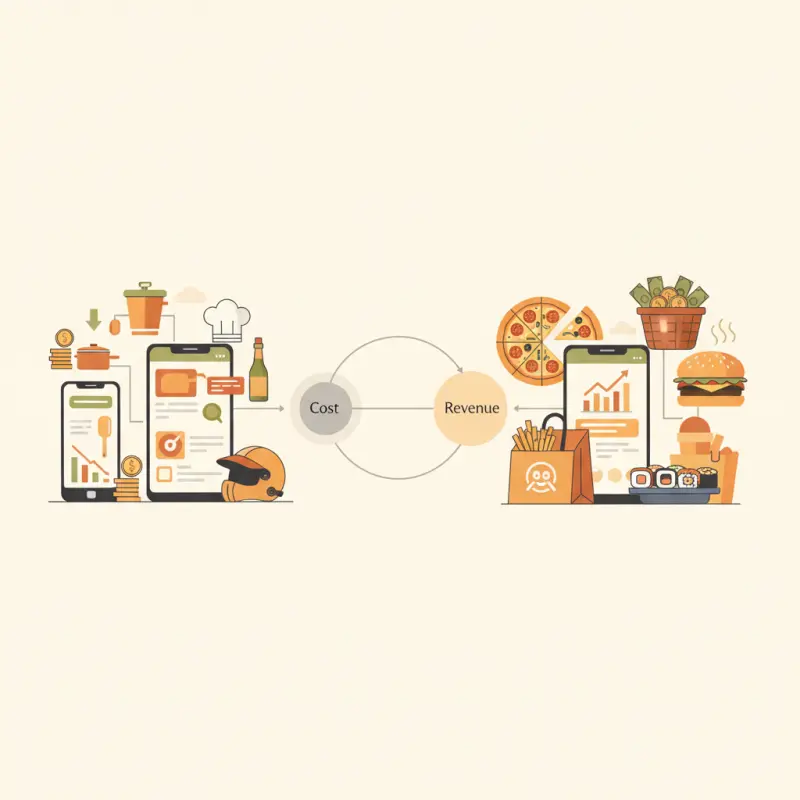
Commission-based web and mobile food ordering and delivery systems typically charge restaurants 20-30% of revenue through platform fees, payment processing, and marketing costs. A web and mobile food ordering and delivery system with zero commissions allows restaurants to retain 100% of their revenue instead of losing 6,000-9,000 MAD daily on a 30,000 MAD volume. Traditional platforms like Uber Eats and Deliveroo also charge promotional fees for visibility and premium support subscriptions. Delivery zone configuration significantly impacts profitability — restaurants in Agadir serving customers beyond 5 kilometers face 25-minute round trips that make orders under 150 MAD unprofitable at standard delivery fees. Smart polygon zones can include dense residential areas like Charaf and Hay Salam while excluding distant locations. Choose a commission-free platform to eliminate the 200-300 MAD loss on every 1,000 MAD order.
Table of Contents
Your restaurant in Agadir processes 1,000 MAD in lunch orders today. After commission fees, you keep 700-800 MAD. This isn't a pricing problem — it's a platform problem. The right web and mobile food ordering and delivery system determines whether you keep 70% or 100% of your revenue.
Most restaurant owners focus on features when choosing an online food ordering and delivery platform. They should focus on economics. The difference between profit and loss often comes down to three factors: commission structure, delivery zone efficiency, and order channel management.
The Real Cost of Your Current Delivery Setup
Traditional food delivery management software takes more than commissions. They take your growth potential.
Commission Math That Kills Profit Margins
A typical Casablanca restaurant processing 30,000 MAD daily through commission-based platforms loses 6,000-9,000 MAD to fees. That's one employee's monthly salary disappearing into platform costs.
| Order Value | Platform Commission (20%) | Payment Fee (2.9%) | Marketing Fee (5%) | You Keep |
|---|---|---|---|---|
| 100 MAD | 20 MAD | 2.90 MAD | 5 MAD | 72.10 MAD |
| 500 MAD | 100 MAD | 14.50 MAD | 25 MAD | 360.50 MAD |
| 1,000 MAD | 200 MAD | 29 MAD | 50 MAD | 721 MAD |
These platforms also charge for visibility. Want your restaurant to appear in the top 10 results? That's another 3-5% in "promotional fees." Need priority support during rush hours? Premium subscription required.
Why Your Delivery Zones Determine Your Success
Delivery economics change dramatically beyond 5 kilometers. In Agadir's sprawling coastal layout, a restaurant in Talborjt serving customers in Hay Mohammadi faces 25-minute round trips. At 15 MAD delivery fee, you lose money on every order under 150 MAD.
Smart zone configuration solves this. Polygon zones let you include profitable neighborhoods while excluding distant areas. A restaurant near Souk El Had can create a custom polygon covering the dense residential areas of Charaf and Hay Salam while avoiding the sparse industrial zones.
Radius zones work better for restaurants in central Marrakech, where customer density remains consistent. A 3-kilometer radius from Guéliz covers enough affluent customers without stretching delivery times.
Quick check · 3 questions
Is OCHI right for your restaurant?
Step 1 of 3
How do you currently take online orders?
Web vs Mobile Ordering: Why You Need Both (But Not How You Think)
Mobile apps don't always win. Your food ordering and delivery platform needs to excel at both channels — but for different reasons than most assume.
The Desktop Lunch Order Reality
Watch any Casablanca office at 11:45am. Employees browse restaurant menus on desktop screens, not phones. They place group orders averaging 450 MAD — triple the typical mobile order value. These desktop users have time to browse, compare, and add extra items.
QR code ordering bridges both worlds perfectly. A diner at your restaurant scans the table code with their phone but gets a web experience optimized for quick ordering. No app download. No friction. Just scan, order, eat. OCHI's QR ordering system processes these seamlessly through yourname.ochi.ma without requiring customer accounts.
Order Channel Management Nightmares
Running separate systems for web and mobile orders creates chaos. Your kitchen receives a mobile order for the last tagine. Thirty seconds later, a web order comes for the same item. Now you have an angry customer and a negative review.
Unified inventory prevents this. When restaurant delivery software syncs all channels, that last tagine gets marked unavailable everywhere the moment it's ordered. Your Kitchen Display System shows all orders in one queue, regardless of source.
Driver Assignment and GPS Tracking: Beyond the Basics
Delivery success depends on smart driver management. The best algorithms balance speed, efficiency, and driver satisfaction.
Auto-Assignment Algorithms That Actually Work
Distance-based assignment seems logical until you factor in Moroccan traffic patterns. A driver 2 kilometers away in downtown Rabat might take 20 minutes during lunch rush. The driver 4 kilometers away on Mohammed V Avenue arrives in 12 minutes.
Time-based assignment accounts for these realities. It considers current traffic, driver performance history, and even weather conditions. But algorithms need override options. When your regular driver knows a customer's building has a tricky entrance, manual assignment prevents delays.
Batch delivery transforms economics. Instead of one driver making three separate trips to Anfa, they deliver all three in one route. Customers still get hot food, drivers earn more per hour, and you cut delivery costs by 40%. OCHI's batch delivery system groups orders intelligently within 10-minute windows.
GPS Tracking Accuracy in Moroccan Cities
Generic GPS gives 50-meter accuracy. In dense neighborhoods like Hay Hassani, that means drivers circling blocks looking for addresses. Modern systems achieve 10-meter accuracy — the difference between the correct building and three buildings away.
Customer notifications need precision timing. Send "driver arriving" alerts too early, customers aren't ready. Too late, they wonder where their food is. The sweet spot: 5-minute arrival windows with real-time updates showing the driver's exact location on a map.
The Zero-Commission Alternative: Real Numbers
Zero-commission platforms flip the economics. You pay for technology, not for every transaction.
Commission Fees vs Platform Fees: The Math
A Marrakech restaurant processing 100,000 MAD monthly through traditional platforms pays 20,000-30,000 MAD in commissions. With OCHI's zero-commission model, they pay a flat monthly platform fee and keep every dirham of revenue.
The break-even point surprises most owners. At just 50 orders monthly, zero-commission platforms become more profitable. At 200 orders, you save enough to hire another chef. At 500 orders, you're keeping an extra 15,000 MAD monthly — enough to open a second location.
What votrenom.ochi.ma Actually Includes
Your branded subdomain isn't just a URL — it's your complete digital presence. Customers bookmark votrenom.ochi.ma, not a generic platform. You control the branding, menu presentation, and customer data.
The Kitchen Display System replaces paper tickets with digital efficiency. Orders appear instantly, sorted by preparation time. Chefs mark items as preparing, then prepared. The Order Status Screen shows customers their order progress by token number.
Multi-branch restaurants get unified management. Set different menus for lunch and dinner across locations. Track which branch sells more grilled chicken. Assign staff roles per location — your Agadir branch manager can't modify Casablanca's menu.
Making the Switch: Implementation Timeline
Migration doesn't mean disruption. Smart implementation keeps orders flowing while you transition.
Week 1-2: Platform Setup and Menu Migration
Professional food photography pays for itself in two weeks. Customers order what looks appetizing. Upload your existing photos or use OCHI's photography guidelines for smartphone shots that sell.
Role assignment prevents confusion. Assign managers, cashiers, waiters, and kitchen staff their specific permissions. Your head chef sees kitchen orders. Your delivery coordinator manages drivers. Your cashier handles payments. Nobody sees data they shouldn't.
Payment testing catches issues before launch. Process test orders with every payment method. Verify refund procedures. Configure receipt printing. These details prevent day-one problems.
Week 3-4: Customer Migration Strategy
Table QR codes create immediate value. Diners discover your new ordering system naturally. They scan, browse your full menu with photos, and order from their phones. No waiter delays. No miscommunication. Orders flow directly to your kitchen.
Social media announcements need strategic timing. Post when your customers are hungriest — 11am for lunch crowds, 6pm for dinner. Show the actual ordering experience. Mention "same menu prices, no extra fees" to address the primary concern.
Database migration preserves customer relationships. Import existing customer emails and phone numbers. Send personalized messages about your new platform. Include their favorite items and order history to show continuity.
The future of restaurant technology isn't about choosing between web and mobile food ordering and delivery systems. It's about unified platforms that put control back in restaurant owners' hands. When you stop paying commissions on every order, technology becomes an investment, not an expense.
See how OCHI's zero-commission platform can transform your restaurant's economics at ochi.ma/partners.
Frequently Asked Questions
How much commission do web and mobile food ordering and delivery systems charge?
Most platforms charge 20-30% total fees including base commission (15-20%), payment processing (2.9%), and marketing fees (3-5%). On a 1,000 MAD order, restaurants typically keep only 700-720 MAD after all fees.
What's the difference between commission-based and commission-free delivery platforms?
Commission-based platforms take 20-30% of each order plus additional fees for visibility and support. Commission-free platforms charge fixed monthly fees but let restaurants keep 100% of order revenue.
How do delivery zones affect restaurant profitability?
Delivery costs increase dramatically beyond 5 kilometers due to longer round trips. In Agadir's layout, serving distant areas makes orders under 150 MAD unprofitable at standard 15 MAD delivery fees.
Can restaurants customize delivery zones on ordering platforms?
Advanced systems offer polygon zone configuration, allowing restaurants to include profitable dense areas while excluding distant neighborhoods. This optimizes delivery efficiency and order profitability.
What hidden fees do food delivery platforms charge restaurants?
Beyond base commissions, platforms charge payment processing fees (2.9%), promotional fees for visibility (3-5%), premium support subscriptions, and sometimes onboarding or setup costs.
Restaurant owners · Weekly
The guide to running a restaurant in 2026.
One article per week. No commission advice. Just honest operational insight for Moroccan restaurants.

Blog Manager
Comments
No comments yet. Be the first to share your thoughts.