AI Overview
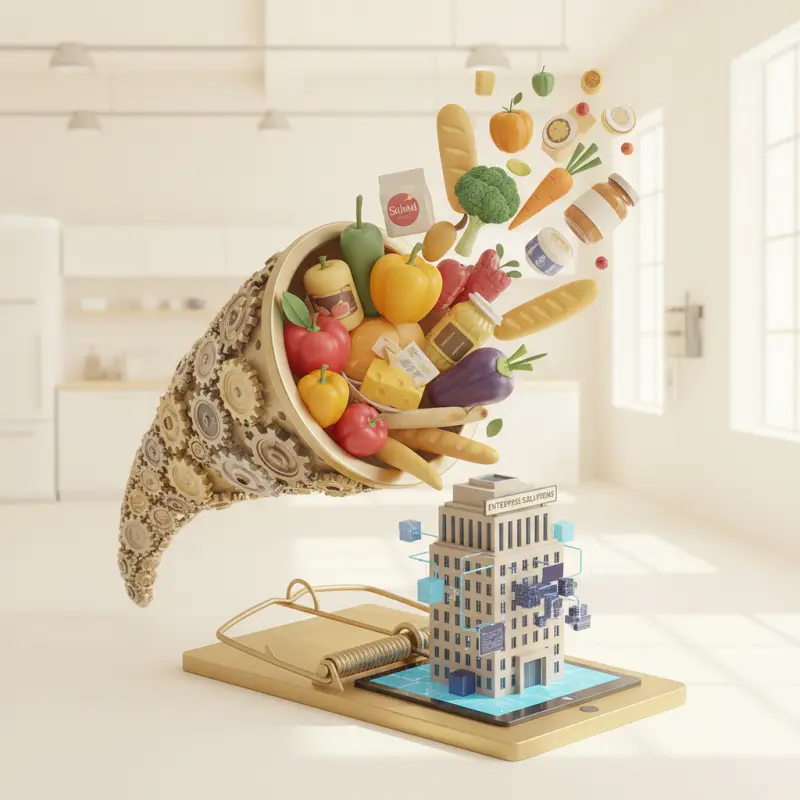
Most food production inventory management software targets food manufacturers, not restaurants, creating expensive mismatches. These enterprise systems charge 200 to 500 dollars monthly for features like multi-warehouse management and RFID integration that don't apply to restaurant kitchens. Moroccan restaurants lose 40,000 MAD yearly to inventory waste while paying for batch tracking systems designed for factories, not kitchens that cook to order. Enterprise platforms like SAP and Oracle require two-week training courses, while restaurant staff need systems they can master in minutes. Restaurants measure portions in grams — 12 grams of ras el hanout for tagine, 2.3 kilograms of semolina for 46 harcha portions — not the pallet quantities that manufacturing ERPs track. Choose restaurant-specific inventory systems that track portion-level measurements and integrate with your existing POS rather than factory-focused software.
Table of Contents
The Hidden Cost of Generic Food Production Inventory Management Software
Your restaurant loses 40,000 MAD yearly to inventory waste, yet software vendors push 500-dollar monthly systems built for food factories. This disconnect between what Moroccan restaurants need and what the market offers explains why 73% of independent restaurants still track stock on paper.
Most food production inventory management software targets enterprises with warehouses and production lines. They sell features like batch tracking, HACCP compliance modules, and multi-warehouse transfers — capabilities meaningless to a 50-table restaurant in Casablanca trying to track tomorrow's couscous portions.
The Enterprise Trap: When Big Software Meets Small Kitchens
Food manufacturing ERPs operate on different assumptions than restaurants. A factory counts pallets; you count portions. They track monthly production cycles; you manage daily perishables. Their "minimum viable inventory" might be 10,000 units. Yours is three kilos of fresh mint.
The subscription math reveals the trap. Enterprise restaurant stock management software charges 200 to 500 dollars monthly for features like:
| Enterprise Feature | Monthly Cost | Restaurant Relevance |
|---|---|---|
| Multi-warehouse management | $75 | You have one kitchen |
| Batch production tracking | $100 | You cook to order |
| RFID integration | $125 | Your chef uses scales |
| Advanced forecasting AI | $200 | You know Fridays are busy |
Training creates another barrier. Your Marrakech kitchen team needs two minutes to learn a simple system. Enterprise platforms demand two-week certification courses. By the time staff masters the software, half have moved to new jobs.
What Restaurant Stock Management Software Actually Needs to Track
Restaurants measure differently. You don't stock "bags of semolina" — you track 2.3 kilograms remaining, enough for 46 portions of harcha. Your tagine recipe uses 12 grams of ras el hanout, not "one spice packet." These gram-level differences determine whether you profit or lose on each dish.
Recipe variations multiply complexity. Your vegetable tagine might use preserved lemons in winter but fresh ones in summer. Your Friday couscous doubles the meat portion. Each variation needs its own cost calculation, something generic restaurant software inventory systems miss.
Moroccan ingredient costs fluctuate seasonally. Tomatoes cost 3 MAD per kilo in August but 12 MAD in January. Saffron prices spike during harvest season. Restaurant inventory programs must track these shifts to maintain accurate food costs.
Stack audit
What do you currently use?
Tick what you have. We’ll show what OCHI replaces or connects to.
The Gram-Level Difference: Why Precision Matters More Than Features
Competitors showcase dashboards with 47 graphs and real-time analytics. Meanwhile, your kitchen bleeds profit through unmeasured olive oil, estimated spice portions, and "handful" measurements that vary by cook.
The 2% Rule Most Restaurant Inventory Programs Ignore
Daily waste seems minor. Two percent spillage, 2% over-portioning, 2% spoilage — each feels negligible. Compound these daily leaks over a year, and you've lost 25% of your food budget. For a mid-size Rabat restaurant purchasing 160,000 MAD of ingredients yearly, that's 40,000 MAD vanishing through imprecision.
The difference between tracking "bags of flour" versus "2.3kg flour remaining" determines profitability. When your restaurant inventory management software shows exact quantities, your chef stops the guesswork. They know precisely when to reorder, how much each msemen costs, and whether tonight's special pricing covers ingredients.
OCHI's gram-level tracking across 1,000+ Moroccan restaurants reveals patterns invisible to estimation-based systems. Restaurants using precise measurements reduce waste by 15% within the first month — not through complex algorithms, but simple accuracy.
Recipe Costing That Actually Works
Most restaurant software inventory systems calculate recipe costs once during setup, then assume stability. Reality differs. Your harissa might use fresh tomatoes in summer (4 MAD/kg) but switch to paste in winter (18 MAD/kg). Without dynamic recipe costing, your summer profits become winter losses.
Ingredient substitutions create another costing challenge. When preserved lemons run out, you substitute fresh ones with salt. The flavor stays similar; the cost triples. Generic inventory software misses these operational realities that define restaurant economics.
OCHI connects recipe management to real-time ingredient costs. When tomato prices spike, your menu costs update automatically. When you modify a recipe, the system recalculates margins across every dish using that ingredient. This integration between inventory and operations prevents the hidden losses that kill restaurant profits.
The Real ROI: Numbers Competitors Won't Share
Software companies promise "reduce waste" and "increase efficiency" without quantifying results. Real restaurants need real numbers: How much will I save? When does the investment pay back? What happens in month six?
The Agadir Restaurant Case Study
Riad Al Bahar operates 47 seats near Agadir's marina, specializing in daily catch preparations. Before implementing proper inventory tracking, they faced common challenges: 28% food waste from over-purchasing, manual ordering that missed price fluctuations, and stockouts twice weekly that disappointed regular customers.
Six months after implementing OCHI's food production inventory management software, their metrics transformed. Waste dropped to 13% through accurate daily ordering. Automated purchase orders prevented both stockouts and excess. Most importantly, they discovered their signature grilled fish platter — thought to be their most profitable dish — actually lost money due to underestimated sauce costs.
The financial impact: 18,000 MAD saved in six months. Not through complex optimization algorithms, but simple accuracy in tracking what comes in, what goes out, and what each dish actually costs to prepare.
The Break-Even Math
Setup time determines adoption success. OCHI's inventory system deploys in two hours: upload your supplier list, input current stock levels, define your recipes. Enterprise systems demand two weeks minimum: database configuration, workflow customization, staff training schedules, integration testing.
Monthly costs reveal the real difference:
| Cost Factor | Traditional Software | OCHI Platform |
|---|---|---|
| Software subscription | 2,000-5,000 MAD | 0 MAD (zero commission) |
| Training/onboarding | 10,000 MAD | Self-service |
| Monthly maintenance | 500 MAD | Included |
| Break-even timeline | 8-12 months | Month one |
For restaurants already using OCHI's POS and online ordering, inventory tracking adds zero additional cost. The savings from waste reduction typically exceed 3,000 MAD monthly — making payback immediate.
Beyond Inventory: The Integration Reality
Inventory exists within restaurant operations, not above them. When your POS doesn't communicate with your stock system, problems multiply. Other platforms treat these as separate products, creating operational friction that staff won't tolerate.
Why Standalone Restaurant Inventory Management Software Creates More Problems
Data silos kill accuracy. Your POS records 50 tagines sold. Your inventory system shows ingredients for 48. Somewhere, two portions vanished — maybe staff meals, maybe data entry errors, maybe both. Without integration, you'll never know.
Double entry amplifies mistakes. Your cashier rings up sales in the POS. Your chef updates inventory separately. One mistaken zero turns 10 kilos into 100, throwing off every calculation downstream. These compound errors explain why standalone systems fail in busy kitchens.
Staff resist learning multiple systems. They already juggle orders, customers, and kitchen chaos. Adding another login, another interface, another set of procedures guarantees abandonment within weeks.
The Single Dashboard Advantage
OCHI connects inventory throughout your operation. When a customer scans your QR code and orders through yourname.ochi.ma, the system immediately deducts ingredients from stock. No manual updates, no synchronization delays, no guesswork.
Low-stock alerts integrate with your menu. Running low on shrimp? The system can automatically mark seafood paella as unavailable across all channels — your website, QR ordering, and delivery platforms. No more apologizing to customers for out-of-stock items.
Real-time cost updates flow everywhere. When olive oil prices change, your recipe costs recalculate. Your menu prices can adjust (if you choose). Your profit reports reflect reality, not last month's assumptions. This connected intelligence transforms inventory from a chore into competitive advantage.
The best food production inventory management software disappears into your daily operation. It doesn't demand attention — it prevents problems before they cost money. See how restaurants across Morocco track every gram at ochi.ma/partners.
Frequently Asked Questions
Why doesn't food production inventory management software work for restaurants?
Food production inventory software targets factories that count pallets and track monthly cycles. Restaurants need to track portions in grams and manage daily perishables, creating a fundamental mismatch.
How much do restaurant inventory management systems typically cost?
Enterprise food production systems cost 200 to 500 dollars monthly. Restaurant-focused solutions typically cost 50 to 150 dollars monthly with features that actually match kitchen operations.
What features do restaurants need in inventory management software?
Restaurants need portion-level tracking, recipe costing, waste logging, and POS integration. Features like multi-warehouse management and batch tracking are designed for manufacturing, not restaurant kitchens.
How long does it take to train staff on restaurant inventory software?
Restaurant-specific systems take minutes to learn. Enterprise food production platforms require two-week certification courses, which creates training barriers for high-turnover kitchen staff.
Do Moroccan restaurants really lose 40,000 MAD yearly to inventory waste?
Yes, this reflects poor inventory tracking systems. Most independent restaurants still use paper because enterprise software doesn't match their operational needs or budget constraints.
Restaurant owners · Weekly
The guide to running a restaurant in 2026.
One article per week. No commission advice. Just honest operational insight for Moroccan restaurants.

Blog Manager
Comments
No comments yet. Be the first to share your thoughts.