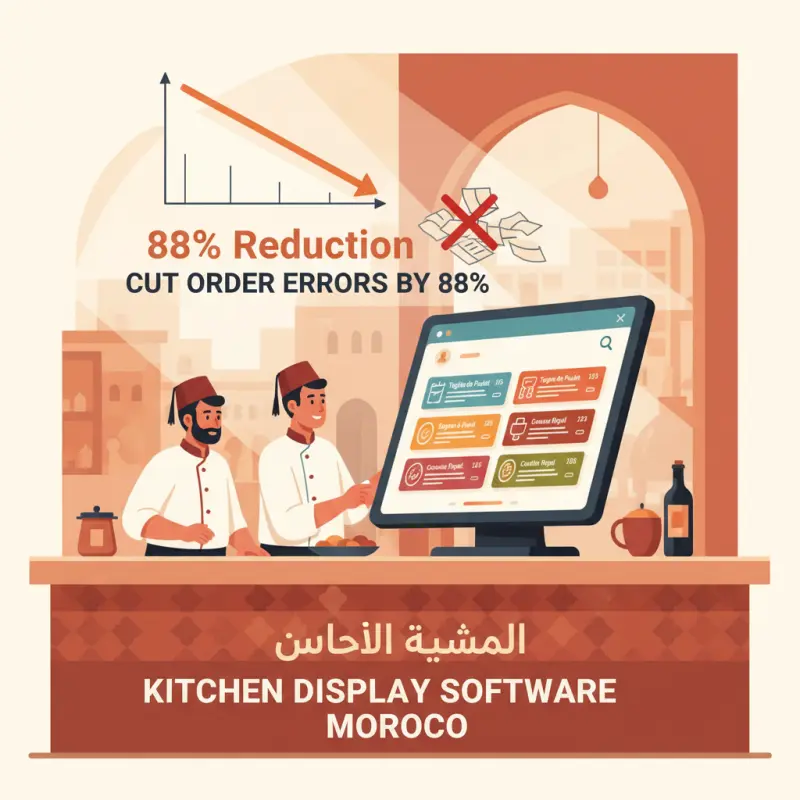
What Kitchen Display Software Actually Does (Beyond the Marketing)
Strip away vendor promises about "revolutionizing your kitchen." At its core, kitchen management software does three things: shows orders clearly, routes them intelligently, and tracks their progress. Everything else is decoration.
Digital Tickets: More Than Just Screens
A proper kitchen ordering system displays each order with impossible-to-miss details. Customer names appear in large text. Modifications stand out in red. Allergies flash until acknowledged. No more guessing whether that smudge means "medium" or "medium-rare."
Modern systems color-code by urgency. Green orders just arrived. Yellow means you're approaching target time. Red screams that you're late. One glance tells your team exactly where to focus.
Station Routing That Matches Your Kitchen Layout
Paper tickets force linear workflows. Every order follows the same path regardless of logic. Central kitchen software routes intelligently — salads to cold prep, grills to hot line, desserts to pastry. Each station sees only what they need, when they need it.
This routing adapts to your actual kitchen. If your pizza oven sits near the fryer, the system groups those orders. If certain dishes require sequential preparation, it enforces the correct order. Your workflow drives the software, not vice versa.
Real-Time Order Status Without the Chaos
Traditional expediting means shouting across the kitchen. "Where's table 12?" "Is the tagine ready?" "Who has the couscous?" Digital systems show every item's status instantly — ordered, preparing, ready, served. No questions needed.
This visibility extends beyond the kitchen. Servers check order progress on their phones. Managers spot bottlenecks from the dining room. Everyone operates with the same real-time information.
The Moroccan Restaurant Reality Check: Power, Internet, and Arabic Support
International kitchen display software vendors pretend every restaurant operates in Silicon Valley. In Morocco, we face different realities — realities that determine whether your investment becomes an asset or expensive wall decoration.
When the Power Goes Out at 8 PM Rush
Power cuts hit Moroccan restaurants regularly, especially during summer peak hours. Most kitchen display system software dies instantly, leaving you blind during the worst possible moment. Smart operators demand systems with battery backup and automatic recovery.
The best platforms cache orders locally. When power returns, your tickets reappear exactly where they left off. No lost orders, no confusion, no manually recreating the queue from memory. This feature alone separates professional systems from pretty demos.
Arabic Order Names and French Kitchen Terms
Your customers order in Arabic. Your kitchen speaks French. Your POS might default to English. Language chaos creates errors that no amount of training fixes. Proper kitchen management software handles multiple languages simultaneously — Arabic customer names display clearly while kitchen instructions appear in French.
Right-to-left Arabic text breaks many systems designed for Western markets. Numbers appear backwards. Names get mangled. Make any vendor demonstrate Arabic support with your actual menu items before signing anything.
3G Internet in Agadir: What Actually Works
"Cloud-based" sounds modern until your internet crawls during dinner rush. In coastal cities like Agadir, connection speeds vary wildly. Systems requiring constant connectivity fail when you need them most.
Look for platforms using WebSocket connections — they maintain live updates even on slow connections. If the internet drops completely, local mode keeps orders flowing. When connectivity returns, everything syncs automatically. No manual intervention required.
The Numbers: ROI Calculator for Kitchen Display Software
Vendors quote monthly fees but hide the full picture. Here's what implementation actually costs across three common scenarios:
| Restaurant Type |
Hardware Cost |
Monthly Software |
Training Time |
Payback Period |
| 50-seat restaurant (Marrakech) |
12,000 MAD (3 tablets + mounts) |
500 MAD |
2 days |
4 months |
| 20-seat café (Fès) |
4,000 MAD (1 tablet + mount) |
300 MAD |
1 day |
6 months |
| Multi-location chain (3 branches) |
36,000 MAD (9 tablets + mounts) |
1,200 MAD |
5 days |
3 months |
Month-by-Month Payback Timeline
Month one brings immediate wins: 50% fewer order errors, 15% faster ticket times. Month two sees workflows optimize as staff masters the system. By month three, you're saving more than the monthly fee through reduced waste alone. Month four — full payback achieved through combined savings in labor, ingredients, and customer satisfaction.
These projections assume normal operations. During Ramadan or tourist season, when volumes spike, payback accelerates. One avoided disaster during a 300-cover evening pays for three months of software fees.
Hidden Costs Vendors Don't Mention
Budget for surprises. Tablet stands cost 400 dirhams each. Protective cases (essential in kitchens) add 200 more. Network upgrades might run 2,000 dirhams. Staff overtime during training week: 1,500 dirhams. Integration with your existing POS: potentially thousands more if compatibility issues arise.
Some vendors charge per user, others per device. Transaction fees might apply. API calls could incur costs. Support beyond basic levels often requires premium subscriptions. Read every contract line — especially the footnotes.
When Paper Actually Makes More Sense (Yes, Really)
Not every restaurant needs digital displays. If you serve fewer than 50 covers daily, have a simple menu, and experience minimal rush periods, paper might work fine. The investment threshold typically sits around 100 daily orders — below that, ROI stretches too long.
Seasonal restaurants face different math. If you operate four months yearly, the payback period quadruples. Unless you're drowning in orders during those months, traditional systems might suffice.
OCHI's WebSocket Kitchen Display: Built for Moroccan Operations
OCHI approached kitchen display software differently. Instead of porting Western solutions, we built for Moroccan reality — unreliable power, mixed languages, and the actual workflows of local kitchens.
Zero-Lag Order Updates (Even on Slow Internet)
Our WebSocket architecture maintains persistent connections between your POS and kitchen displays. Orders appear instantly — no polling, no refresh delays, no watching spinning wheels during rush hour. When a server sends an order, it hits your kitchen screen in under 200 milliseconds.
This speed matters during peak times. Traditional systems using HTTP polling check for updates every few seconds, creating dangerous lag. With OCHI, your kitchen operates in true real-time. Modifications, cancellations, and rush requests appear the moment they're entered.
Bilingual Display: Arabic Customer Names, French Kitchen Terms
OCHI's interface handles Arabic names elegantly while keeping kitchen instructions in your preferred language. Customer "محمد الحسني" displays clearly while cooking notes remain in French: "Bien cuit, sans oignon." No confusion, no translation needed.
Color coding transcends language barriers entirely. Green means new, yellow means preparing, red means late — universal signals your team understands instantly. Customizable alert sounds ensure urgent orders never hide in the queue.
Offline Mode That Actually Works
When internet fails, OCHI's local caching keeps your kitchen running. Orders already received display normally. New orders queue locally and sync when connection returns. Your team never stops cooking, never loses an order, never needs to improvise.
One Agadir beachfront restaurant switched from paper to OCHI's system last summer. Despite frequent connection issues during tourist season, they reported 60% fewer order errors and 22-minute average ticket times — down from 31 minutes with paper. The owner calculated saving 1,100 dirhams weekly through reduced waste and faster table turns.
Modern kitchens need modern tools. But those tools must respect local realities — the languages we speak, the infrastructure we have, the way we actually cook. Choose kitchen display software that strengthens your operation, not software that forces you to change everything for minimal benefit. See how OCHI's restaurant platform works at ochi.ma/partners — including our KDS built specifically for Moroccan restaurants.