AI Overview
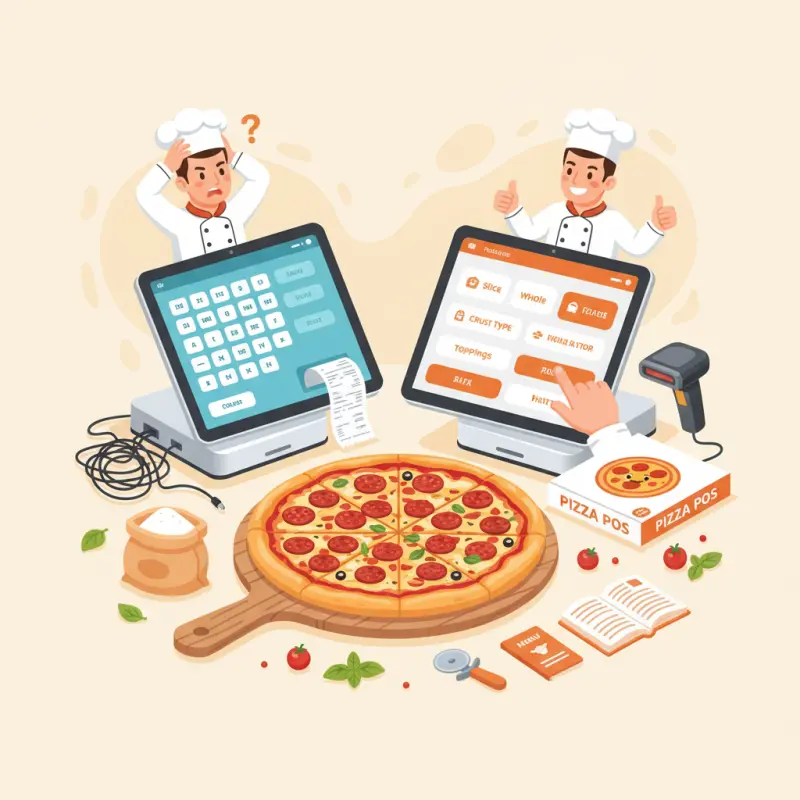
Generic restaurant POS systems fail pizza shops because they can't handle the mathematical complexity of split toppings, quarter sections, and multiple modifications on single orders. A pizza point of sale system requires specialized architecture to display half-pepperoni, half-vegetarian orders clearly to kitchen staff instead of confusing text strings. Pizza shops in Morocco using standard systems lose 15-20% more money per order error than other restaurants because wrong pizzas can't be fixed — they must be remade completely. Volume surges during Friday nights in cities like Marrakech expose another weakness: generic systems designed for steady restaurant flow collapse under pizza-specific ordering patterns. Kitchen display screens freeze when 200 orders hit between 7 PM and 10 PM, creating bottlenecks that inflate prep times by 40%. Look for POS systems specifically designed for pizza operations with visual order displays and surge capacity management.
Table of Contents
A pizza shop in Casablanca loses 1,500 MAD every month to a single POS mistake: their system can't handle half-and-half pizzas properly. This isn't just about software — it's about understanding that pizza operations demand precision that generic restaurant systems can't deliver.
Most restaurant owners discover this truth after burning through three different systems, each promising to solve their problems. The reality? A pizza point of sale system needs fundamentally different architecture than what works for a tagine restaurant or burger joint.
Why Generic Restaurant POS Systems Fail Pizza Shops
Pizza isn't just another menu category. It's a mathematical puzzle of combinations, modifications, and split decisions that break standard restaurant logic. When your POS treats a half-pepperoni, half-vegetarian pizza like two separate items, you've already lost control of your kitchen.
The Half-Pizza Problem
Watch any pizza kitchen during rush hour. Half the orders involve split toppings, quarter sections, or "extra cheese on one side only." Standard POS systems handle this with clunky modifiers that confuse kitchen staff and inflate prep times by 40%.
The math gets worse. Order errors on pizzas cost 15-20% more to fix than other restaurant mistakes. Why? You can't just scrape off wrong toppings and start over. That 120 MAD large pizza becomes a complete loss, plus the remake cost, plus the delivery delay, plus the angry customer who might never order again.
Kitchen confusion multiplies these losses. When your POS displays "1/2 Special 1/2 Margherita +olives -mushrooms on left" as a text string, your cook spends precious seconds decoding instead of cooking. Those seconds add up to hours of lost productivity each week.
Volume Surge Management
Friday night in Marrakech: 200 orders between 7 PM and 10 PM. Tuesday lunch: maybe 30. Generic systems designed for steady restaurant flow collapse under these pizza-specific surges. Screens freeze. Orders queue incorrectly. Staff panic.
The interface complexity matters here. During peak hours, every extra tap or confusing screen costs you completed orders. Pizza shops need streamlined workflows that assume chaos, not calm. When your POS requires five steps to input a simple pepperoni pizza, you're already behind.
Stack audit
What do you currently use?
Tick what you have. We’ll show what OCHI replaces or connects to.
The Real Cost of Pizza POS Mistakes (With Numbers)
Let's move past vague warnings and examine what poor POS choices actually cost Moroccan pizza shops. These aren't theoretical — they're pulled from real operations across Agadir and Rabat.
Commission Trap Analysis
Traditional delivery platforms charge 15-30% commission per order. For a pizza shop doing 1,000 MAD in weekly delivery sales, that's a monthly loss of 600-1,200 MAD. Scale that annually and you're looking at 7,200-14,400 MAD vanishing into platform fees.
| Weekly Delivery Revenue | Platform Commission (20%) | Monthly Loss | Annual Loss |
|---|---|---|---|
| 1,000 MAD | 200 MAD | 800 MAD | 9,600 MAD |
| 2,500 MAD | 500 MAD | 2,000 MAD | 24,000 MAD |
| 5,000 MAD | 1,000 MAD | 4,000 MAD | 48,000 MAD |
That's pure profit leaving your business for the privilege of receiving orders you generated through your own marketing efforts.
Integration Failure Costs
Running separate systems for online orders and in-store sales creates expensive redundancies. Manual order entry adds 2-3 minutes per delivery order. During a 50-order evening, that's 150 minutes of wasted labor — nearly three hours of paying someone to type what a computer should handle automatically.
The inventory nightmare compounds this waste. When online and POS systems don't sync, you're constantly overselling items or turning away orders for products you actually have. One Fès pizzeria tracked a 15% revenue loss from poor inventory management alone.
Essential Pizza POS Features That Actually Matter
Forget the marketing buzzwords. Here's what your pizza point of sale system actually needs to handle the realities of dough, sauce, and cheese.
Order Accuracy Tools
Visual pizza builders change everything. Instead of text-based modifications, your staff sees an actual pizza diagram showing exactly where each topping goes. Left half pepperoni, right half mushroom, extra cheese on the whole thing — displayed visually, understood instantly.
Kitchen display systems need this same visual clarity. When orders appear as pizza diagrams rather than text lists, preparation accuracy jumps by 30%. Your cooks work faster when they see rather than read.
Modification tracking becomes critical for custom orders. "No sauce, double cheese, well-done" needs to flow through every system touchpoint without manual translation. Miss one modifier and you've lost a customer.
Multi-Channel Order Management
Your Saturday night reality: phone ringing, customers at the counter, online orders streaming in. A proper pizza POS unifies these channels into one dashboard where orders queue by preparation time, not arrival sequence.
Real-time inventory sync prevents the embarrassment of selling out online while your counter staff takes orders for the same items. Every pepperoni slice counts across all channels simultaneously.
Automated routing sends orders directly to the appropriate prep station. Thin crust to oven one, thick crust to oven two, salads to the cold prep area. No confusion, no delays.
Why Food Truck and Cafe POS Systems Miss the Mark
Some pizza shops try adapting cafe pos systems or pos systems for food trucks, thinking "close enough" will work. It won't.
Space and Speed Constraints
Cafe accounting software optimizes for leisurely table service and complex beverage modifications. Pizza demands rapid-fire order processing with ingredient-level precision. When your system asks for table numbers during delivery orders, you're using the wrong tool.
Point of sale systems for food trucks face different limitations. They excel at simple menus and quick transactions but crumble under pizza's complexity. Try entering a family deal with four different pizzas, each with unique toppings, on a food truck POS. The line behind your counter will stretch to Tangier.
Accounting Integration Gaps
Standard accounting modules miss pizza-specific calculations entirely. Food cost percentages need to account for cheese price fluctuations, seasonal tomato variations, and the reality that pepperoni costs triple what vegetables do.
Without recipe-based costing, you can't track profitability by pizza type. That "Super Deluxe" might look popular, but if it's costing you money on every sale, popularity becomes a problem.
OCHI's Modular Approach to Pizza Operations
OCHI adapts to pizza operations through modular components you activate based on need, not forced bundles of features you'll never use.
Unified Control Dashboard
Imagine running your entire pizza business from one screen. Orders from your branded subdomain (pizzaplace.ochi.ma), phone orders, walk-ins — all flowing through the same system. No juggling tablets, no commission fees, just pure operational control.
The GPS delivery tracking alone saves 20 minutes per driver shift. Customers see exactly where their pizza is. Drivers follow optimized routes. You monitor everything from one dashboard.
Zero commission means that 5,000 MAD in weekly delivery sales stays in your pocket. Over a year, that's 260,000 MAD funding equipment upgrades instead of platform profits.
Pizza-Specific Workflow Design
OCHI's visual pizza builder integrates directly with the kitchen display system. Your counter staff builds the order visually, it appears identically in the kitchen, and preparation begins without translation errors.
Delivery zones map automatically based on your actual coverage area. Set different minimums for distant neighborhoods. Assign drivers efficiently based on proximity and current orders.
Role management keeps your operation tight. Kitchen staff see only what they need. Delivery coordinators track only drivers. Cashiers access only payment functions. Clean permissions prevent costly mistakes.
Implementation Timeline: 30 Days to Full Pizza POS Control
Moving to a proper pizza point of sale system doesn't require months of disruption. Here's a realistic timeline based on actual Moroccan pizza shop implementations.
Week 1-2: System Setup and Staff Training
Start with menu configuration. Every topping, every size, every possible combination needs accurate pricing. This foundation determines everything else. Upload your items, set modifiers, test edge cases like "extra extra cheese" pricing.
Kitchen display installation happens parallel to menu setup. Mount screens, test visibility angles, ensure network stability. Run mock orders to verify flow from front counter to prep stations.
Basic staff training focuses on order entry and payment processing. Three two-hour sessions cover 90% of daily operations. Keep initial training simple — advanced features come after comfort with basics.
Week 3-4: Advanced Features and Optimization
Online ordering goes live once staff masters in-store operations. Your pizzashop.ochi.ma subdomain starts accepting orders. Test with friends first, then soft launch to regular customers.
Delivery zone mapping requires actual driver input. They know which addresses confuse GPS, which neighborhoods order most, which routes avoid traffic. Build zones based on reality, not theory.
Analytics setup reveals profitability patterns immediately. Which pizzas earn most? What times drive revenue? Where do orders cluster? Data replaces guesswork within days.
Ready to see how OCHI handles your pizza shop's specific needs? Set up your branded ordering system at votrenom.ochi.ma and keep 100% of your revenue.
The difference between a generic restaurant system and a true pizza point of sale system isn't features — it's understanding that every saved second and prevented error compounds into sustainable profit. Browse our blog for more insights on running efficient restaurant operations, or explore OCHI's complete platform to see how we handle the complexities of modern food service without the commission trap.
Frequently Asked Questions
What makes a pizza point of sale system different from regular restaurant POS?
Pizza POS systems handle complex topping combinations, half-and-half orders, and visual kitchen displays that standard restaurant systems can't manage effectively. They're built for the mathematical complexity of pizza customization.
Why do pizza order errors cost more than other restaurant mistakes?
Pizza errors cost 15-20% more because you can't fix wrong toppings — the entire pizza must be remade. This creates double costs plus delivery delays and customer dissatisfaction.
How does volume surge affect pizza POS systems?
Pizza shops experience extreme volume spikes during peak hours that can overwhelm generic POS systems. Screens freeze and order queues fail when hundreds of orders hit within three hours.
What should pizza shops look for in a POS system?
Look for visual order displays, surge capacity management, specialized pizza modification handling, and kitchen display systems designed for complex topping combinations rather than simple menu items.
Restaurant owners · Weekly
The guide to running a restaurant in 2026.
One article per week. No commission advice. Just honest operational insight for Moroccan restaurants.

Blog Manager
Comments
No comments yet. Be the first to share your thoughts.