AI Overview
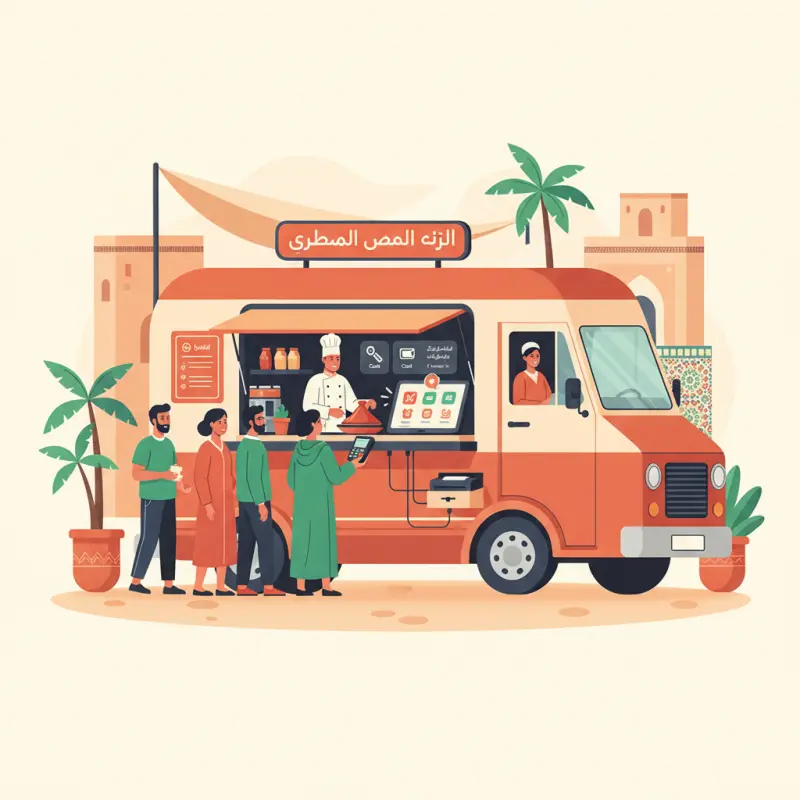
Point of sale systems for food trucks fail because traditional restaurant POS systems assume stable power, reliable internet, and counter space that mobile operations don't have. Food trucks need systems built for movement, not adapted from stationary setups. Six out of ten food truck owners in Morocco switch their POS within 18 months due to workflow mismatches and connectivity issues. During peak hours like Ramadan iftar rush in Marrakech, every 30-second delay per order means the last customer waits 10 minutes longer, causing half to leave. A POS requiring six taps instead of two serves 40% fewer customers, costing MAD 2,000-3,000 in lost revenue per busy evening. Choose a POS with offline functionality, simplified workflows designed for quick service, and battery optimization for mobile operations.
Table of Contents
A food truck owner in Casablanca loses MAD 1,200 every month to transaction fees alone. That's before counting the 15-30% commission from delivery platforms, hardware replacements, and data plans that POS vendors conveniently forget to mention.
Point of sale systems for food trucks require different thinking than brick-and-mortar restaurants. The reality of mobile operations — from WiFi dead zones to battery constraints — demands solutions built for movement, not adapted from stationary setups.
Why Most Food Truck POS Systems Fail in Real Operations
Traditional restaurant POS systems assume you have stable power, reliable internet, and counter space. Food trucks have none of these guarantees. The result? Six out of ten food truck owners switch their POS system within 18 months.
The failure starts with workflow mismatches. A POS designed for seated dining assumes customers browse menus leisurely. Food truck customers want their tajine or shawarma in under five minutes. Every extra tap, every buried menu item, every payment delay costs you customers who simply walk to the next truck.
The Queue Problem Nobody Talks About
Watch any food truck during Ramadan iftar rush in Marrakech. The line stretches 20 people deep. Each 30-second delay per order means the last customer waits an extra 10 minutes. Half will leave before ordering.
The math is brutal: if your POS requires six taps to complete a standard order instead of two, you serve 40% fewer customers during peak hours. That's MAD 2,000-3,000 in lost revenue per busy evening. Multiply that across a month, and your "affordable" POS system costs you more than a premium one with proper workflow design.
WiFi Dead Zones and Battery Drain
Your truck moves between the medina, business districts, and beach locations. Each spot has different connectivity. Most cloud-based POS systems fail completely without internet, leaving you to write orders on paper like it's 1995.
Even with offline mode, battery life becomes your enemy. A standard tablet running typical POS software dies after six hours of continuous use. Your lunch shift runs eight hours minimum. Add the dinner rush, and you're juggling power banks while taking orders — not exactly the professional image that builds customer trust.
Stack audit
What do you currently use?
Tick what you have. We’ll show what OCHI replaces or connects to.
The True Cost Breakdown:
Beyond the Monthly Fee
Vendors advertise "starting at MAD 299/month" but hide the real expenses. Here's what running pos systems for food trucks actually costs in Morocco:
| Cost Category | Traditional POS | Zero-Commission Platform |
|---|---|---|
| Monthly Software Fee | MAD 299-599 | MAD 0 |
| Transaction Fees (2.9%) | MAD 1,200/month* | MAD 0 |
| Delivery Commission (20% avg) | MAD 4,000/month** | MAD 0 |
| Hardware (amortized) | MAD 250/month | MAD 250/month |
| Data Plan | MAD 300/month | MAD 300/month |
| Total Monthly Cost | MAD 6,049-6,349 | MAD 550 |
*Based on 50 orders/day at MAD 80 average
**Based on 25% of orders through delivery platforms
Transaction Fee Math That Hurts
Every credit card payment through traditional processors costs you 2.9% plus MAD 2. On a MAD 80 order, that's MAD 4.32. Seems small until you calculate monthly volume. A busy food truck processing MAD 120,000 monthly loses MAD 3,480 to transaction fees alone.
Add delivery platform commissions — Glovo and similar services take 15-30% — and you're working for the platforms, not yourself. A cafe pos system that charges both transaction fees and delivery commissions turns your MAD 100 meal into MAD 67 in your pocket.
Hardware Costs They Don't Mention Upfront
The "complete bundle" rarely includes everything. You need a tablet (MAD 2,500), card reader (MAD 1,500), receipt printer (MAD 2,000), and cash drawer (MAD 800). That's MAD 6,800 before you take your first order.
Food truck environments destroy hardware faster. Steam from grills, dust from outdoor locations, and constant movement mean replacing equipment every 18-24 months instead of the 3-5 years in traditional restaurants. Your cafe accounting software might track these expenses, but it won't reduce them.
Essential Features That Actually Matter on a Food Truck
Forget the 47-feature comparison charts. Food trucks need five things done perfectly rather than 50 done poorly.
Speed-Critical Functions
Your menu has 12 items. Eight of them account for 80% of orders. Your POS should put those eight items on the main screen — one touch to add, one touch to customize, one touch to payment. Pizza restaurant pos systems designed for complex orders slow you down when customers just want a margherita with extra cheese.
Split payments matter more than you think. Groups of office workers buying lunch together don't want to sort out payment later. Quick split-by-item or split-equally options save two minutes per group order. Those minutes add up to hours of saved time weekly.
Moroccan Market Specifics
Your customers speak Arabic, French, and English — sometimes switching mid-order. Your POS interface needs to handle right-to-left Arabic text properly, not as an afterthought. Menu translations should be native, not Google Translate approximations that confuse customers.
Local payment integration goes beyond accepting dirhams. CashPlus, PayPal, and emerging mobile payment methods each have their user base. Missing any of them means turning away customers who don't carry cash.
How OCHI Adapts Its Restaurant Platform for Mobile Operations
OCHI started as a full-stack restaurant platform but recognized food trucks face unique challenges. Instead of building a separate system, they made their core platform modular — use what you need, ignore what you don't.
Branded Online Ordering for Location-Based Service
Your truck gets its own subdomain: yourfoodtruck.ochi.ma. Post it on Instagram, and customers order directly. No app downloads, no account creation required. GPS integration shows your current location, solving the eternal "where's the truck today?" question.
Pre-orders transform your business model. Office managers schedule lunch delivery for 20 people, paid in advance. You prepare during slow morning hours and deliver precisely at noon. Same truck, same menu, double the revenue without the queue chaos.
Zero-Commission Model Impact
OCHI charges nothing. No monthly fees, no transaction fees, no commissions. You keep 100% of every order. That MAD 6,000 monthly saving funds truck maintenance, menu expansion, or a second truck within a year.
The platform scales with you. Start with basic ordering and add inventory tracking, multi-location management, or advanced analytics when ready. No feature locks or pricing tiers that punish growth.
Setting Up Your Food Truck POS:
Week-by-Week Implementation
Switching POS systems doesn't require closing for a week. Here's a proven timeline that maintains operations while transitioning:
Week 1: Menu and Payment Setup
Upload your menu Monday morning. Test every item, modifier, and price. Configure payment methods by Wednesday. Run parallel with your old system Thursday and Friday to catch issues without risking service.
Week 2: Staff Training and Backup Systems
Train one staff member thoroughly — they become your champion. Practice during slow afternoon hours. Create laminated quick-reference cards for common operations. Set up offline backup procedures for connectivity issues.
Week 3: Customer Migration and Testing
Announce the change on social media with an incentive: "Order through our new system and get 10% off this week." Monitor every transaction closely. Gather customer feedback actively. Fix small issues before they become big problems.
Week 4: Full Launch and Optimization
Remove the old system completely — no safety net means full commitment. Review transaction times, identify bottlenecks, adjust screen layouts based on real usage patterns. Your POS should be faster now than when you started.
Food truck success in Agadir, Rabat, or anywhere else in Morocco depends on serving great food quickly and keeping costs low. Traditional point of sale systems for food trucks force you to choose between features and affordability. Platforms like OCHI prove you can have both — professional operations without the professional price tag.
Configure your food truck POS system at yourname.ochi.ma and keep every dirham you earn.
Frequently Asked Questions
Why do most point of sale systems fail for food trucks?
Most POS systems are designed for stationary restaurants with stable power and internet. Food trucks face WiFi dead zones, battery constraints, and need simplified workflows for customers who want their order in under five minutes.
How much revenue can a slow POS system cost a food truck?
A POS requiring six taps instead of two serves 40% fewer customers during peak hours. This translates to MAD 2,000-3,000 in lost revenue per busy evening for Moroccan food trucks.
What features should food truck owners prioritize in a POS system?
Offline functionality for connectivity dead zones, simplified order workflows with minimal taps, long battery life, and cloud sync when connection returns. Avoid systems that require stable internet to function.
How do transaction fees impact food truck profitability?
Food truck owners can lose MAD 1,200 monthly to transaction fees alone, before counting 15-30% delivery platform commissions and hidden POS vendor costs like data plans and hardware replacements.
Restaurant owners · Weekly
The guide to running a restaurant in 2026.
One article per week. No commission advice. Just honest operational insight for Moroccan restaurants.

Blog Manager
Comments
No comments yet. Be the first to share your thoughts.