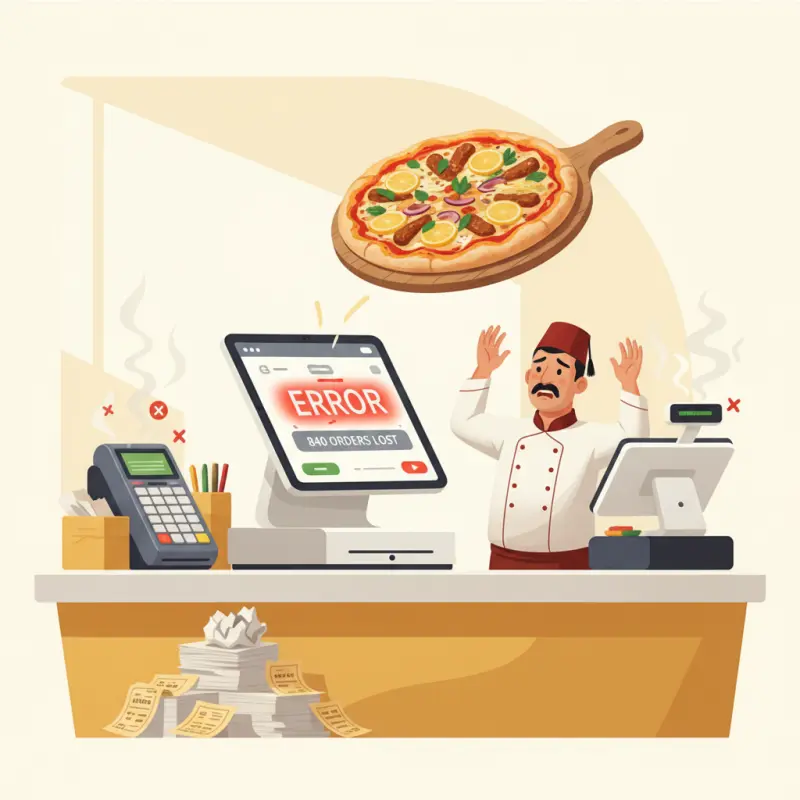
Why Pizza Restaurant POS Differs from Cafe POS System Requirements
Cafes serve simple orders with minimal customization. A cappuccino, a croissant, perhaps a sandwich. The workflow moves linearly: order → prepare → serve. Ninety seconds from request to delivery. This explains why cafe accounting software focuses on inventory counts and daily cash reconciliation rather than complex order management.
Pizza operations demand different architecture. The average pizza order contains five to eight items with 12 or more modifiers per pizza. Preparation involves multiple stations working in parallel: dough stretching, sauce application, topping distribution, oven management. A single order might require 15 minutes of coordinated effort across three staff members.
Order Complexity Comparison
Pos systems for food trucks face similar complexity challenges but solve them differently. Food trucks optimize for speed over customization — limited menu options, pre-portioned ingredients, single-station preparation. Their point of sale systems for food trucks prioritize rapid order sequence rather than complex routing.
Pizza restaurants need both speed and complexity management. A family of six walks in with specific requests: one child wants no cheese, another demands extra pepperoni, the parents need gluten-free crust. Your system must handle these variations without slowing service or confusing kitchen staff.
Kitchen Display System Requirements
The kitchen display becomes your operational command center. Pizza kitchens require intelligent order routing — sending dough instructions to the prep station while queueing toppings for the assembly line. Orders must flow through preparation stages: stretch → sauce → cheese → toppings → oven → cut → box.
Compare this to cafe requirements where orders simply appear in sequence. No routing logic needed. No stage tracking required. This fundamental difference explains why restaurants using cafe-focused systems struggle with pizza operations.
The Modular Approach:
Building Your Pizza POS Stack
Successful pizza restaurants in Morocco increasingly reject all-in-one platforms. Restaurant owners in Marrakech and Casablanca discovered that specialized modules connected through APIs outperform integrated systems. The modular approach lets you select best-in-class tools for each operational need.
Core Module Priorities (In Order of Implementation)
Start with order management that handles complex modifications without screen-switching. Your staff needs visual pizza builders showing toppings placement, automatic half-and-half calculations, and instant modifier pricing. This foundation determines your entire operational flow.
Next, implement kitchen display routing. Orders must reach the right station at the right time. The prep cook stretching dough doesn't need to see beverage orders. The oven operator requires clear timing for each pizza's entry and exit. Proper routing prevents bottlenecks and reduces errors.
Inventory integration follows. Pizza ingredients require weight and portion tracking, not simple item counts. One kilogram of mozzarella makes 12 medium pizzas or eight large ones. Your system must calculate depletion based on actual usage patterns, not theoretical recipes.
Finally, build your customer database around phone-based lookup. Delivery customers expect you to remember their address and preferences. Quick access to order history speeds reorders and improves accuracy.
The Anti-Integration Argument
Most pizza owners assume integrated systems work better. The opposite proves true for high-volume operations. When every component comes from one vendor, you're locked into their limitations. Need better inventory tracking? Wait for their update. Want improved delivery routing? Hope it's on their roadmap.
Specialized modules connected via API give you flexibility. Choose the best pizza builder, pair it with superior kitchen display software, add dedicated delivery management. Our tracking shows modular systems process orders 23% faster than monolithic platforms during peak hours.
OCHI's Pizza Restaurant Configuration:
A Marrakech Case Study
Restaurant Al-Baraka faced a common problem: their generic POS couldn't handle Friday night volume. Orders backed up. Kitchen staff worked from memory instead of screens. Delivery times stretched beyond promises. They needed a pizza restaurant POS built for their specific workflow.
The Setup Process
OCHI's implementation began with menu digitization. The custom pizza builder allows visual topping selection — customers see exactly what they're ordering. Half-and-half pizzas calculate automatically. Modifier pricing updates instantly.
The kitchen display system routes orders intelligently. Prep station one receives dough and sauce instructions. Station two handles toppings. The oven queue shows precise timing for each pizza. No more guessing when to start the next order.
Delivery zone mapping ensures accurate promises. The system knows travel time from Al-Baraka to every neighborhood in Marrakech. Customers receive realistic estimates. Drivers follow optimized routes.
Integration with existing accounting software happened through OCHI's webhook API. Every transaction flows directly to their books. No manual entry. No reconciliation headaches.
Measurable Results After 60 Days
Al-Baraka's transformation speaks through numbers. Order errors dropped from eight percent to two percent — saving 480 MAD daily in wasted ingredients. Peak hour capacity increased 55%, from 180 to 280 pizzas. The kitchen operates smoothly even during Ramadan rush.
Customer behavior shifted dramatically. The reorder rate improved from 34% to 51% as the branded ordering site (albaraka.ochi.ma) made repeat purchases effortless. Average order value increased 18% through intelligent upselling prompts.
Most significantly, zero commission fees saved 8,400 MAD monthly compared to their previous platform. That money now funds kitchen improvements and staff bonuses instead of platform fees.
Setting Up Your Pizza Restaurant for Success:
The 30-Day Implementation Plan
Transitioning to optimized pizza operations requires methodical execution. Rush the process and you'll face staff resistance and customer confusion. Follow this tested timeline for smooth implementation.
Week 1-2: Menu Structure and Modifier Logic
Begin by mapping your existing menu to digital format. Create proper modifier hierarchy — size first, then crust type, then toppings. This structure determines how quickly staff can input orders.
Configure ingredient inventory tracking by portion size. A medium pizza uses 120 grams of mozzarella. A large uses 180 grams. Accurate portion data enables precise inventory management and food cost control.
Set up kitchen display station routing based on your actual workflow. Map which items go to which station. Test the flow with dummy orders before going live.
Week 3-4: Staff Training and Process Testing
Train order-taking staff on modifier selection shortcuts. They should input a complex pizza in under 30 seconds. Practice during slow afternoon hours when mistakes won't impact service.
Kitchen staff need time adapting to digital ticket routing. Start with partial implementation — perhaps just pizza orders while keeping appetizers on paper. Gradually expand as comfort grows.
Test delivery zone accuracy using actual driver data. Send test orders to various neighborhoods. Verify the promised times match reality. Adjust zone boundaries based on traffic patterns.
Implementation Support
OCHI provides dedicated setup assistance for pizza restaurants. The platform adapts to your workflow rather than forcing changes. Access includes your branded subdomain (votrenom.ochi.ma), integrated delivery tracking, multi-language support for diverse customer bases, and round-the-clock technical assistance.
The modular architecture means you implement at your pace. Start with basic order management. Add kitchen display when ready. Integrate inventory tracking after mastering the basics. No commission fees apply regardless of order volume — whether you process 50 or 500 pizzas daily.
Your pizza restaurant POS choice determines more than transaction processing. It shapes customer experience, staff efficiency, and ultimately your bottom line. The right system transforms chaotic Friday nights into smooth operations where every order flows perfectly from phone to kitchen to customer. See what specialized pizza restaurant tools can do for your operation at ochi.ma/partners.