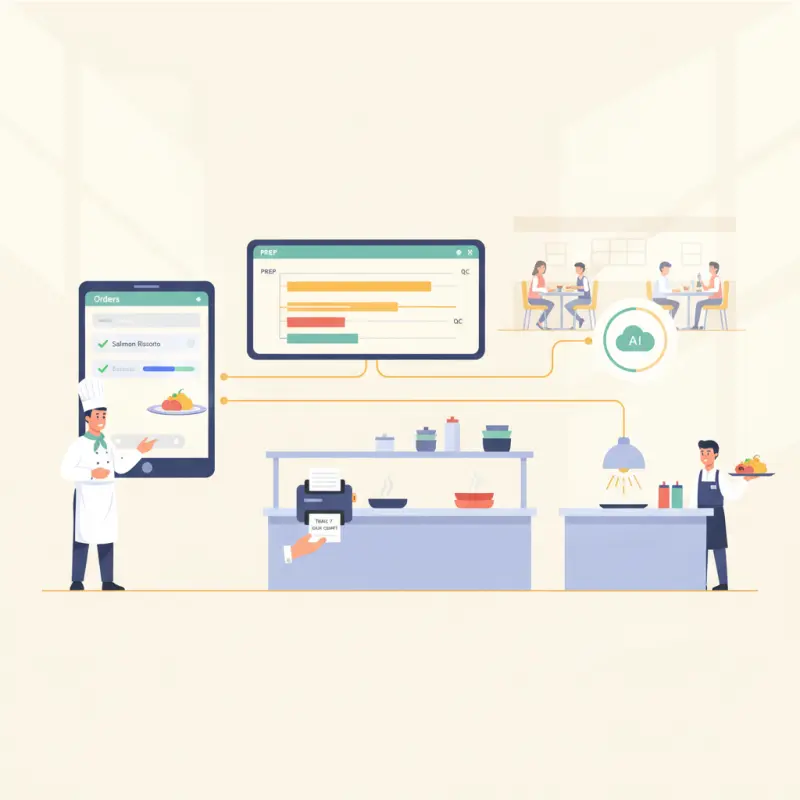
Station Routing: The Make-or-Break Feature Nobody Explains
Here's what restaurant owners miss about kitchen management software: digital displays are just the visible part. The real transformation happens in how orders flow through your kitchen.
Traditional paper systems treat every order as one unit. A ticket with grilled chicken, fattoush, and hummus lands at one station, then moves physically through the kitchen. The grill cook waits for the cold mezze station. The salad prep holds back the entire order. One bottleneck stops everything.
How Station Assignment Actually Works
Modern kitchen ordering systems split orders intelligently. That same ticket becomes three digital tasks: chicken routes to the grill, fattoush to salads, hummus to cold prep. Each station works simultaneously. No waiting. No physical ticket passing. The system knows chicken takes 12 minutes, fattoush takes 4, so it staggers the start times.
This isn't theoretical efficiency. At a 150-seat restaurant in Casablanca using proper station routing, average ticket time dropped from 24 minutes to 18 minutes. That's six tables turned faster per night.
The 15-Minute Rule: When Routing Fails
Bad routing creates worse chaos than paper. If your system sends dessert orders to the grill station or routes all salads through hot prep, you've just digitized dysfunction. The 15-minute rule applies: any item routed to the wrong station adds 15 minutes to overall service time during rush periods.
Multi-Station Orders: The Coordination Challenge
Complex orders reveal whether your kitchen display system software actually understands restaurant operations. A table orders appetizers, mains, and drinks. Without intelligent coordination, the tagine arrives cold while waiting for the French fries, or the appetizers come out with the mains. Smart systems track prep times per item and coordinate firing across stations.
Kitchen Display System Software: WebSocket vs Polling (And Why It Matters)
Two restaurants in Marrakech use digital kitchen displays. One updates every 5 seconds. The other uses WebSocket connections for instant updates. Guess which one still has communication problems during dinner rush?
Real-Time Updates: 500ms vs 5 Second Refresh
Polling-based systems check for new orders every few seconds. During those 5-second gaps, your kitchen operates blind. A rush of 10 orders might all appear at once, overwhelming your prep cooks. Cancellations arrive too late. Modifications miss the cut.
WebSocket architecture maintains constant connection. Orders appear within 500 milliseconds. Changes reflect instantly. When table 6 adds "extra spicy" to their order, your kitchen knows before the server leaves the table.
| Update Method |
Response Time |
Peak Hour Performance |
Error Rate |
| 5-Second Polling |
5,000ms average |
Degrades under load |
8-12% |
| WebSocket (OCHI) |
500ms average |
Consistent |
2-3% |
| Manual Refresh |
30,000ms+ |
Fails completely |
15-20% |
Color-Coded Status: Visual Management for Line Cooks
Numbers tell one story. Colors tell another. Effective kitchen management software uses visual cues that work in a hot, busy, loud environment. Green means new. Yellow means preparing. Red means urgent. Purple means modified. Your cook glances up and instantly knows what needs attention.
OCHI KDS: WebSocket Architecture in Action
OCHI's kitchen display system uses Laravel Reverb WebSocket connections to maintain real-time synchronization across all stations. Orders flow from customer device to kitchen screen in under one second. Color coding adapts to your workflow — customizable per station. The system tracks every status change: pending to preparing to prepared, building the analytics that reveal your true kitchen performance.
Prep Analytics: The Hidden Revenue Killer
Your Tuesday special takes 22 minutes to prepare. Your weekend bestseller takes 8 minutes. Without prep analytics, you're scheduling these items blindly, wondering why Tuesdays feel harder than Saturdays.
Central kitchen software that actually helps restaurants tracks four critical metrics most owners never see. Average prep time per menu item shows which dishes slow your entire operation. Peak hour bottleneck identification reveals whether your grill or your fryer limits capacity. Staff efficiency by station highlights training needs before they become service problems. Menu optimization based on kitchen capacity turns this data into decisions.
A seafood restaurant in Agadir discovered their profitable mixed grill platter took 31 minutes during peak hours — not because of cooking time, but because it required coordination across four stations. They redesigned the dish workflow, pre-prepping certain components. Prep time dropped to 19 minutes. Same dish, same price, 40% faster service.
This isn't about working faster. It's about understanding which menu items match your kitchen's actual capacity. That beautiful tajine might have great margins on paper, but if it creates a 20-minute bottleneck every Friday night, it's costing you table turns.
Central Kitchen Software for Multi-Location: Casablanca to Agadir
Managing one kitchen is complex. Managing three across different cities requires systems that scale intelligently. Central kitchen software addresses the consistency challenge that kills restaurant expansion.
Recipe Standardization Across Locations
Your Casablanca location makes the harira differently than your Agadir branch. Not because they want to — because verbal recipe sharing doesn't work. Digital recipe management ensures every location accesses the same prep instructions, portion sizes, and plating guides. Updates sync instantly across all branches.
Inventory Request Management
Branch kitchens request ingredients from central storage. Without proper systems, these requests become email chains and phone calls. Digital request management tracks what each location needs, when they need it, and whether central kitchen can fulfill it. No more emergency runs because someone forgot to mention they're low on olive oil.
Which location handles rush hours best? Where do most order errors occur? Centralized analytics compare performance metrics across all branches, revealing operational gaps. Maybe your Rabat team excels at coordination but struggles with prep timing. Now you know where to focus training.
The Real Cost: ROI Numbers for Moroccan Restaurants
Restaurant owners fear the investment in kitchen management software. The real question isn't cost — it's how quickly the system pays for itself through efficiency gains.
Paper ticket errors affect 8-12% of orders in a typical Moroccan restaurant. Wrong items, missed modifications, lost tickets. Digital KDS reduces this to 2-3%. For a restaurant doing 100 covers per night, that's 10 fewer remakes daily. At an average ticket of 150 MAD with 30% food cost, you save 450 MAD per day in waste alone.
Service speed improvements deliver larger returns. Kitchen display system software typically reduces average ticket time by 15-25%. Faster service means more table turns. A 50-seat restaurant that turns tables 20% faster serves 10 additional covers per night. That's 45,000 MAD in extra monthly revenue without adding seats or staff.
The scenario that convinced an Agadir restaurant group: they tracked errors for one month on paper, then one month after implementing OCHI's KDS. Error rate dropped 60%, from 11% to 4.4%. Service times improved 22%. The system paid for itself in under four months through waste reduction and increased covers.
Traditional platforms charge 25-30% commission on top of software fees. OCHI's zero-commission model means restaurants keep every dirham of increased revenue. The kitchen ordering system at yourname.ochi.ma includes KDS, station routing, and analytics without bleeding your margins.
Kitchen chaos isn't inevitable. Read more operational insights from restaurants transforming their service, or see the complete kitchen management toolkit at ochi.ma/partners.