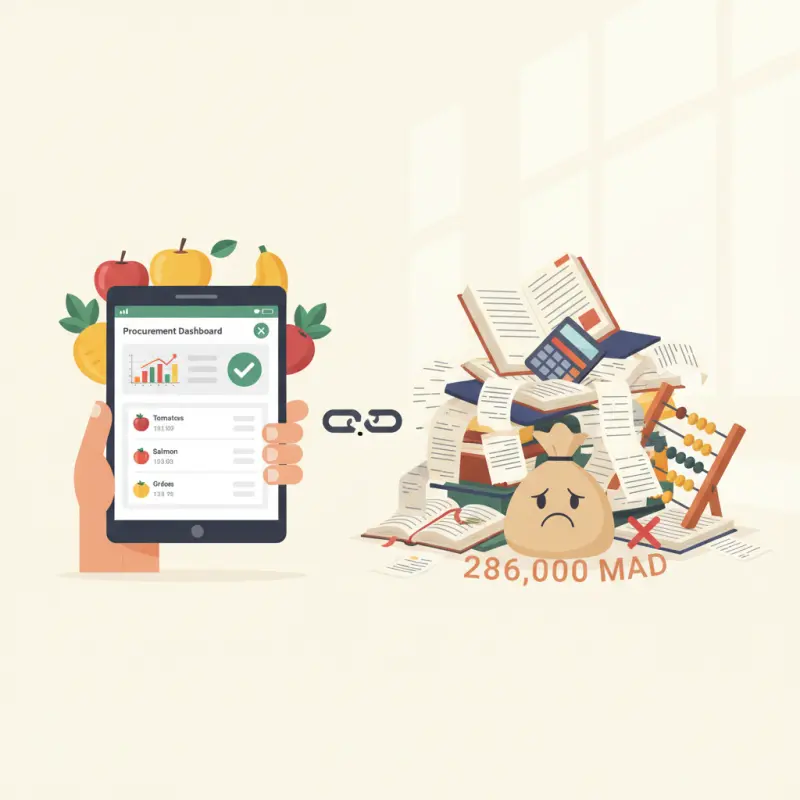
Restaurant Procurement Software: Why Manual Systems Cost 286K MAD Yearly
Blog Manager
··5 min read
AI Overview
Restaurant procurement software reduces food waste from 30% to under 5% while eliminating manual ordering errors that cost restaurants 8-12% of their annual revenue. Manual procurement systems force Moroccan restaurants to lose an average of 286,000 MAD yearly through spoilage, stockouts, and labor inefficiencies. A mid-sized restaurant in Casablanca ordering 10,000 MAD of ingredients weekly typically wastes 2,000-3,000 MAD on spoiled produce alone. Restaurant procurement software provides real-time inventory tracking, automated reorder points based on usage patterns, and mobile access for walk-in cooler decisions. Leading systems integrate with POS data to predict demand accurately, preventing both overstocking and emergency purchases at premium prices. Moroccan restaurants using automated procurement report 40-60% reduction in food waste within three months. Start by tracking your current waste percentages for two weeks before selecting software — most owners underestimate losses by 50%.
Table of Contents
For restaurant owners
Start your restaurant in 60 minutes.
From signup to your first real order — no commission, no setup fee, no sales call.
The Real Cost of Manual Procurement: Why "Good Enough" Kills Profit
Every Monday morning, restaurant owners across Morocco open their fridges to find 30% of last week's produce spoiled. That's not carelessness — it's the hidden tax of manual procurement systems.
The math is brutal. A mid-sized restaurant in Casablanca ordering 10,000 MAD of fresh ingredients weekly loses 2,000-3,000 MAD to waste alone. Add stockouts forcing premium last-minute purchases (another 1,500 MAD), staff hours spent on manual counts (20 hours at 50 MAD/hour), and suddenly you're bleeding 5,500 MAD weekly. That's 286,000 MAD annually — enough to hire two full-time cooks.
Manual systems create blind spots everywhere. Your chef orders tomatoes based on memory, not data. Your supplier delivers 20% more than ordered "just in case." Your prep cook portions by eye, not gram. Each leak seems small. Together, they drain 8-12% of your revenue.
The tragedy? Most owners know they're losing money but think restaurant procurement software costs more than the problem. They're comparing the wrong numbers — software subscription versus total procurement waste. One Marrakech restaurant discovered their "free" manual system was costing them 15,000 MAD monthly in hidden losses.
Stack audit
What do you currently use?
Tick what you have. We’ll show what OCHI replaces or connects to.
Restaurant Stock Management Software: Features That Actually Matter vs. Marketing Fluff
The Non-Negotiables
Real-time stock tracking changes everything. Not end-of-day estimates where you discover problems 16 hours too late. Live updates as items move from storage to prep to plate. When your dinner rush depletes chicken breast inventory, you know immediately — not when tomorrow's prep starts.
Automated reorder points based on actual usage patterns prevent both waste and stockouts. Your restaurant software inventory learns that Tuesdays need 30% more seafood, Fridays burn through twice the normal bread. It suggests orders based on data, not guesswork.
Mobile access matters because decisions happen in the walk-in, not the office. Your chef checking stock levels while receiving deliveries. Your manager approving orders from home. Your prep cook logging waste immediately, not on paper that gets lost.
The Nice-to-Haves That Don't Pay Bills
AI forecasting sounds impressive in demos. For a 50-seat restaurant, it's overkill. Your sales patterns are predictable enough that basic trend analysis works fine. Save the machine learning for chains with 100+ locations.
Complex supplier bidding systems promise savings through competition. Reality: you have three reliable suppliers you've worked with for years. You need simple price comparison, not a procurement marketplace.
Advanced analytics dashboards generate beautiful reports nobody reads. Most restaurant inventory management software vendors pack in 50+ reports. You need five: daily waste, weekly food cost, item movement, supplier performance, and profit margins.
Feature
Annual ROI
Implementation Time
Staff Adoption Rate
Real-time stock tracking
15-20%
1 week
85%
Automated reordering
10-15%
2 weeks
90%
AI demand forecasting
2-5%
3 months
40%
Supplier bidding platform
1-3%
2 months
30%
The 25% Waste Reduction Scenario: How OCHI's Gram-Level Tracking Works
Le Jardin, a 120-seat restaurant in Marrakech, was throwing away 800kg of food monthly. Their head chef insisted waste was minimal — "maybe 5%." OCHI's gram-level tracking revealed the truth: 22% waste rate, costing them 14,000 MAD monthly.
The system caught problems invisible to manual tracking. Prep cooks cutting 180g chicken portions instead of the recipe's 150g — a 20% overuse adding up to 4,000 MAD monthly. Servers entering wrong orders caused 3kg of perfectly good tagines to be discarded weekly. The vegetable station was prepping 30% more than needed "for safety."
Three months after implementing restaurant stock management software, Le Jardin cut waste to 600kg monthly. The key: every gram gets tracked from delivery to disposal. When a case of tomatoes arrives, it's weighed and logged. When prep begins, portions are weighed again. When plates return uneaten, that's tracked too.
The math becomes undeniable. That 25% waste reduction saved 3,500 MAD monthly on ingredients alone. Add reduced labor from more accurate prep lists and fewer emergency supply runs, and Le Jardin netted 5,000 MAD in monthly savings — paying for their entire restaurant inventory program in under 30 days.
Why Most Restaurant Inventory Programs Fail (And How to Pick One That Won't)
The Dirty Secret: It's Not About the Software
Staff adoption beats features every time. A basic system your team uses daily outperforms a sophisticated platform gathering dust. The best restaurant procurement software becomes part of the routine, not another task.
Simple systems survive. If your line cook needs a manual to log received ingredients, you've already failed. If your chef can't check stock levels in 10 seconds on their phone, they won't. Complexity kills compliance.
Local support matters more than global brands. When your restaurant software inventory crashes during Friday dinner service, you need someone answering the phone in Casablanca, not California. You need support that understands Moroccan suppliers, local regulations, and dirham-based accounting.
Red Flags in Restaurant Procurement Software Demos
Vendors who won't show their mobile interface first are hiding something. Your staff lives on their phones — if the mobile experience is an afterthought, the system will fail.
Systems requiring extensive training for basic tasks won't stick. Receiving inventory should take 30 seconds, not 30 steps. Creating a purchase order should be faster than calling your supplier.
Platforms that don't integrate with your existing POS create data silos. Your sales data and inventory data must talk. Otherwise, you're managing two systems and doubling your work.
Getting Started: Your First 30 Days with Restaurant Procurement Software
Week 1: Baseline Your Current Waste
Weigh everything for seven days. Every delivery, every spoiled item, every returned plate. Don't change anything yet — just measure. Most restaurants discover they're wasting 20-30% more than estimated. This baseline becomes your success metric.
Week 2: Set Up Core Inventory Items and Suppliers
Start with your top 20% of ingredients that drive 80% of costs. Input accurate unit costs, create basic recipes, set initial reorder points. Add suppliers with current pricing. Don't aim for perfection — aim for functional. OCHI's system lets you build this foundation in hours, not days.
Week 3: Train Kitchen Staff and Test Workflows
Run parallel systems for one week. Your team uses both manual and digital processes to build comfort. Focus on three core workflows: receiving deliveries, daily inventory counts, and waste logging. Address resistance immediately — usually it's about unclear benefits, not the technology.
Week 4: Measure Results and Adjust Processes
Compare your waste baseline to current performance. Even partial adoption typically shows 10-15% improvement. Identify bottlenecks — maybe receiving takes too long, or waste categories need refinement. Adjust and lock in processes that work.
Success isn't perfection. It's consistent use that compounds into profit. Restaurants using OCHI's branded subdomain (votrenom.ochi.ma) report full adoption within 30 days because the system lives where their business lives — online, accessible, always on.
The difference between restaurants that thrive and those that merely survive often comes down to operational discipline. In today's market, that discipline needs digital support. Manual procurement systems aren't just inefficient — they're actively costing you money every single day.
Ready to cut waste and boost profits? Set up your restaurant's procurement system at votrenom.ochi.ma — zero commission, full control.
Frequently Asked Questions
How much does restaurant procurement software typically cost in Morocco?
Restaurant procurement software in Morocco ranges from 500-2,000 MAD monthly depending on features and restaurant size. Most systems pay for themselves within 60 days through waste reduction alone.
What's the average food waste reduction with restaurant procurement software?
Restaurants typically reduce food waste from 30% to under 5% within three months of implementing procurement software. The average waste reduction is 40-60% in the first quarter.
Can restaurant procurement software integrate with existing POS systems?
Most modern restaurant procurement software integrates with popular POS systems through APIs or direct connections. This allows real-time sales data to inform purchasing decisions automatically.
How long does it take to implement restaurant procurement software?
Implementation typically takes 1-2 weeks including staff training and initial inventory setup. Most restaurants see measurable waste reduction within the first month of use.
What features matter most in restaurant procurement software?
Real-time inventory tracking, automated reorder points based on usage patterns, and mobile access are essential. Supplier integration and waste tracking analytics provide the highest ROI for most restaurants.
Restaurant owners · Weekly
The guide to running a restaurant in 2026.
One article per week. No commission advice.
Just honest operational insight for Moroccan restaurants.
Blog Manager
Comments
No comments yet. Be the first to share your thoughts.